


 Welcome & FAQs
  Table of Senate polls
 Senate graphs
 Tipping-point-state
 Congress: retirements
 Governor's races
 Icons for bloggers
 Data galore


• Sunday Mailbag
Happy Mother's Day to all the mothers, stepmothers and grandmothers out there!
Sunday Q&A
Because of the events of the week, we decided on a shortened Q&A and a shortened mailbag, instead of a full-sized version of one or the other. And we'll hold the latest reader question of the week answers to next week (and, truth be told, probably to the week thereafter, as well—we got 2 weeks' worth of answers).
If you are still working on the headline theme, which was apparently tougher than we thought, we'll add the hint that the band Bow Wow Wow undoubtedly approves. So do the Strangeloves.
Current Events
D.G. in Fairfax, VA, asks: Does John Roberts really believe that the decisions coming out of his Court respect precedent except where absolutely necessary? Should he be confident that future liberal appointed justices will respect those decisions, as evidenced by his latest oped?
(Z) answers: I think it's similar to his thinking on the political leaning of the Court's decisions. He says something to himself like, "At least 85% of our decisions are non-political/honor stare decisis. And in baseball, an .850 batting average is pretty darn good, indeed."
As to liberal justices engaging in a tit-for-tat, he undoubtedly tells himself that the Court will have a conservative majority until he is dead, and probably long after that.
R.P. in Alexandria, NY, asks: I was fascinated by the letters you posted about the type of modernism Iran is pursuing, beginning with the one from D.G. in Sandwich, and especially the one from D.S. in London.
They reminded me of two things. The first was when I was a student intern for a human rights NGO at the United Nations in 1976, and listened in on meetings of the Economic and Social Council where I was hearing some of the first signs of what was to become the Iranian Revolution and much later the Arab Spring. Secondly, I was reminded that it was the Arab world and Muslim scholars who retained the knowledge of pre-Christian science which was brought back through the Crusades to help inspire the Renaissance. If I remember correctly, Arabs also invented algebra.
Sorry for the long prelude, but the question is straightforward. Could we make the case that Iran has been making more consistent progress toward addressing climate change than the United States has during both Trump terms?(Z) answers: Maybe, but that's a very low bar to clear. Iran, as a desert country, is being hit harder by climate change than most. On the other hand, they are in the oil business, and they generally refuse to be part of agreements like the Paris Accord because of the sanctions that have been in place for many years. The Iranians are certainly not on the cutting edge, but they are probably ahead of the U.S. government (though not ahead of some of the state governments).
R.M.S. in Lebanon, CT, asks: I noticed you have written a lot more about the Iran War than you did on the War in Afghanistan while it was ongoing. That war was the longest in American history, had a lot more casualties, and ultimately failed to defeat the Taliban. Why did you cover it less?
(Z) answers: First of all, the longest war in American history is the war against the Apache Nation, which lasted at least 37 years, from 1849-1886. If anyone would like to read the brief essay I wrote for my classes on this subject, you can see a pdf here. I am going to update a few details this summer, but the basic facts are still the same.
In any event, this site has been daily (or nearly so) since 2015. By that time, the Afghanistan War was rarely a political football, and had settled into the background. Whenever it did become a political football, we wrote about it. The Iran War has happened entirely during our "daily" era and has been a political football the whole time.
T.J.C. in Boston, MA, asks: In your item "Republicans Want to Appropriate $1 Billion for the Ballroom," you raised five questions. I'll add a sixth: Why was the request from the Senate Judiciary Committee? What possible concern would they have regarding Trump's balls?
(Z) answers: That is because, in an apparently not-too-successful effort to sneak the money in under the radar, it was tucked into a Secret Service funding bill.
S.G. in Morgantown, WV, asks: Reading Ted Turner's obituary, it became apparent that he shared more than a few similarities with our current president. That brought two questions to mind: (1) Did Turner ever give serious consideration to entering the political arena? and (2) I know it's hard to answer this generally, but what would a Ted Turner presidency look like?
(Z) answers: Turner thought about running for president in 2000, but decided against it.
If he had been elected, he would likely have tried to run the country as USA, Inc., which does not work (as Donald Trump has demonstrated). Further complicating things is that Turner was quite lefty, and would surely have been very frustrated at his inability to get his ideas made into law.
J.J.D. in Massapequa, NY, asks: I am certainly no expert on the very complicated trans issues and admittedly have mixed feelings on some aspects of it, so I appreciated your item "Is the Trump Administration Scraping the Bottom of the Anti-Trans Barrel?" It was very informative. But one thing stood out and leaves me puzzled.
I caught the replays of some of Trump's recent rants about this subject, particularly the one to the children during the Presidential Physical Fitness Award event. What surprised me the most is something you didn't mention—nor did any the commentators (even the left-leaning ones)—that I caught. When Trump tried to say "genital mutilation," he REPEATEDLY called it "mutilization" (which is not a word). He's even used it in Truth Social posts. Has the entire media become so tuned out to his stupidity that an obvious boner like this doesn't even register—even when, in this case, it was in the middle of a delivery that was a public speaking nightmare? If Joe Biden had made this exact same delivery, especially to an audience of education-age children, it would have been instantly seized upon and turned into a mockery at the level of Obama's tan suit.
What gives?(Z) answers: The answer is something along the lines of the old line, "But other than that, Mrs. Lincoln, how was the play?"
When Trump lets his bigot flag fly, or when he starts talking about nuking Iran, or when he threatens 100% tariffs against everyone, that is so fully the important part of the story that the elementary-school grammar absolutely pales in comparison. Everyone knows his command of the language is shaky, and seems to be getting shakier daily, but veering off into a sidebar about that—in most cases—interrupts the flow of an item, and can also come off as petty.
J.W. in Los Angeles, CA, asks: Didn't Trump have a branded airline of his own? And that went in the tank, right? So does he have some responsibility for killing two airlines?
(Z) answers: He did, and it did. But I think it's a bit much to blame him for the failure of Spirit. They ruined themselves. At most, Trump was guilty of being unable to save them.
Politics
F.I. in Philadelphia, PA, asks: Looking into your crystal ball (not Larry Sabato's!), do you see the Iran war ultimately being Trump's legacy? I believe his legacy won't be his first-term economy, the vulgar tweets, the blatant corruption, ICE brutality, COVID mismanagement, the January 6th insurrection, multiple felony convictions, multiple impeachments, or even the Epstein coverup, but rather the Iran War and fuel prices. Will the economic fallout from the conflict be the main thing average Americans remember him for decades from now?
(Z) answers: The people largely responsible for creating "legacy"—historians and journalists—tend to balance, as best they can: (1) fealty to the historical record and (2) understandability. You can't cover every nuance and subtlety, but you also can't oversimplify too aggressively. Most really impactful presidents end up being boiled down to a couple of main things. For Franklin D. Roosevelt, it's the New Deal and World War II. For Lyndon B. Johnson, it's Civil Rights and Vietnam. For Ronald Reagan it's the Cold War and the Great Communicator.
I would guess that Trump's legacy will be boiled down to two (or maybe three) core themes, something along the lines of incompetence and corruption (and maybe bigotry). And then, there will be key exemplars in each category. Iran will be in the "incompetence" group.
L.M. in Boston, MA, asks: Let's say that Donald Trump and his sycophants "find" the evidence that Georgia was rigged and declare that its 16 electoral votes should have gone Republican. What is the point? It doesn't change the outcome of the election; Joe Biden still would have won overall. Do you think he's just trying to use it to justify future actions? I feel like that is too much 4-D chess for Trump. Is he trying to declare anything Biden did illegitimate? That seems more likely to me, even if it doesn't go anywhere just like with his grievances against the autopen- seems like that whole thing only made it as far as his presidential walk of fame plaques.
(Z) answers: It is often very hard to figure out why Trump chooses the particular obsessions that he settles upon. And he clearly has some sort of cognitive or emotional dysfunction, and yet has never been examined or diagnosed, so don't dismiss the possibility that this is caused by something like OCD.
That said, if I had to guess why he cares so very much about Georgia, I would say it's not because he has some larger plan or purpose, but because the state has been red for a long time, and is run by Republicans, and so should have been "his" (in his mind).
S.J. in Sacramento, CA, asks: Why is "spread" calculated as the difference between percentages? If two candidates are polling at 55% and 45%, that's a 10-point spread, but half that number, "5 points", would be more intuitive, as at least 5% of voters would need to switch to change the outcome.
(Z) answers: Your method assumes that everyone who switches from the 55% candidate would vote for the 45% candidate. This is not the case; many of them will vote third-party or not at all if they lose faith in the 55% candidate.
Civics
P.M. in Port Angeles, WA, asks: Do you think it a glaring oversight that the Constitution does not provide means for the removal of elected office holders by the people who elected them? I know the concept of voting, and who the voters should be, has evolved from the original enactment of the Constitution, but since so many states have mechanisms for removal of state officials, if seen as not serving the electorate, it seems reasonable that voters should hold the power to remove elected federal officials, if they are found to have been elected under disingenuous circumstances and are not serving their constituents well.
(Z) answers: It is certainly not an oversight. The fellows who wrote the Constitution created a legislative chamber that has to be constantly listening to constituents (the House, with 2-year terms), a chamber that is much more insulated from popular sentiment (the Senate, with 6-year terms), and a chief executive that splits the difference between the two. This was actually pretty radical; they came from a world where kings served for life, and members of Parliament often lingered for decades.
Is it a mistake? I don't think so. Judging by the experience of California, recall elections tend to be used more often for political purposes rather than their intended purpose.
F.L. in Federal Way, WA, asks: The Supreme Court's power (much like money) depends on the faith and confidence of the public; they have no enforcement, as Andrew Jackson once noted. Of late, that has been greatly eroded. Federal courts below that have (ostensibly) the DoJ to enforce their rulings. Unfortunately, the MAGA GOP has almost completely co-opted them.
Meanwhile, Article II, Section 4 says that Congress may impeach and convict, "The President, Vice President and all civil Officers of the United States."
Would that include officers in the Department of Justice? Would defying a court order be considered a "high crime or misdemeanor"? I understand that the Senate (barring a blue deluge of Biblical proportions) would be unlikely to convict, but is it legally possible?(Z) answers: Members of Congress cannot be impeached, but anyone serving in either of the two other branches can. No member of the DoJ has ever been impeached, but secretaries of two other Cabinet departments have been.
And, as Gerald Ford once observed, a "high crime or misdemeanor" is whatever the House thinks it is. That said, I think some of the things done by acting AG Todd Blanche & Co. very easily clear the bar.
M.H. in Salt Lake City, UT, asks: I was reading a piece by Heather Cox Richardson; she mentioned a concern that the President's limo, known as The Beast, as well as his entourage, might damage the work that is being done at Trump's direction to the Reflecting Pool in Washington. This piece brought to mind the following questions: How heavy is The Beast? What kind of gas mileage does it get? How much does the government pay per gallon of gas? And which D.C. gas station gets its business?
(Z) answers: The government does not make specs for the Beast available, for security reasons. However, various estimates place the weight at between 15,000 and 20,000 pounds, and the gas mileage between 1.5 mpg and 10 mpg.
The vehicle is refueled by Secret Service personnel when it is not in use by the president. And they choose whatever gas station is convenient. The closest gas station to the White House is an Exxon at 22nd and M NW. So, that station probably gets its fair share of Beast business.
History
C.M. in Raymond, NH, asks: Reading about the Iowa economic woes, I thought to myself that it is ironic that they are so dependent on foreign trade yet so landlocked. But then I remembered that they are on the Mississippi and Missouri Rivers. By conventional definitions, all the Midwestern states are landlocked, as they don't border an ocean. But in terms of actual navigable waterways (the Great Lakes, major rivers), which state is most landlocked? I suspect Utah, Colorado, or Wyoming. What is the historian's take?
(Z) answers: The upper Midwest is a pretty good answer. The Great Lakes are great and all, but those states' economies were badly stunted until the Erie Canal opened, and it was possible to get goods to the Atlantic Coast.
Today, the most landlocked state is Nevada. It only has one major river, and that is the Colorado, which forms a relatively small portion of the state's far southern border. This may explain why Nevada's main industry does not involve exports (unless you count STIs as an export).
M.F. in Des Moines, IA, asks: Among elements of the left, there is a belief that most of our modern political problems (MAGA, persistent racism, attacks on expertise and education, etc.) can all be traced back to the former Confederate states and officials receiving a relatively light punishment after the war in favor of reintegration.
I'm quite certain that's a gross oversimplification of a variety of historical factors leading to where we are now. That said, I am left with two questions: (1) Have historians identified potentially negative effects of focusing on reintegration instead of punishment? and (2) Is it a moot point anyway, because the kinds of things we would be talking about (hanging Confederate generals and elected officials, redistributing property en masse) would have lacked political support in the Union, or otherwise met such opposition that we'd have had a post-war bloodbath?(Z) answers: The South was very racist, anti-government, anti-education and violent before the Civil War. The South was very racist, anti-government, anti-education and violent after the Civil War. It is a fantasy to argue that, had Reconstruction gone differently, all of those impulses would somehow have been erased from the cultural and political fabric of that region. And no historian I am aware of has conducted a serious study that starts from that vantage point.
And it is indeed a moot point. The primary concern, in 1865 (and immediately thereafter) was restoring the peace. Imposing some sort of victors' justice risked sparking a bunch of partisan (guerrilla) violence, that could have gone on for years and years. The Congress, and the Freedmen's Bureau, did about as much as was humanly possible, given the generally conservative lean of the country and the very conservative lean of the white South.
D.G. in Fairfax, VA, asks: Is there a way to contrast how Germany lost World War I and a few years later tried again in World War II and then still went on to be a major power, with how the South lost the Civil War but continued to resist without trying militarily again?
(Z) answers: Germany was and is an industrial nation, in a world where industrial power means military and economic power. It also has the largest population of any nation that is located wholly on the European continent.
The American South was (and largely still is) agrarian, in a world where industrial power means military and economic power. Its population is also much smaller than that of the combined remainder of the United States. Despite the rhetoric, there was and is no viable possibility that the South might rise again. That leaves non-military forms of resistance as the only option on the table.
Gallimaufry
S.C, Bellaire in TX, asks: Like most of your readers, apparently, I am a diehard Trekkie. However, I am reluctant to subscribe to Paramount+ (home to the extended Star Trek universe) because of the autocratic leanings of its current Skydance/Ellison ownership. Am I wrong to think it matters whether my money goes into the pockets of people who support policies and people I strongly oppose? Or is it more important I get to watch the most recent season of Star Trek: Strange New Worlds I have missed and see for myself whether Starfleet Academy is worth the time?
(Z) answers: If you choose to withhold your money from corporations whose politics you disagree with, then that is a very reasonable position.
However, in this case, by doing so, you are hurting yourself far more than you are hurting the Ellisons. You are also hurting the talented people who make the shows, whose politics rarely agree with the Ellisons. If you do decide to sign up, you might tell yourself (correctly) that your money is going towards shows that promote liberal values far at odds with those of the Ellisons.
There is another option, of course, but it would be improper for us to direct your attention to The Pirate Proxy and Vuze. It is my understanding that people who use those services make sure to have a VPN in place.
D.T.R. in Schaumburg, IL, asks: When you, (Z), had to cancel Friday's posting, my wife and I (incorrectly) speculated that you might be dealing with the fallout from this week's cyberattack on Canvas. Did the attack end up affecting you and UCLA in any appreciable way? And do you have any thoughts on what schools, in particular, and the government, in general, should/can do about these increasingly frequent ransomware attacks?
(Z) answers: I teach at two schools, UCLA and Cal Poly Pomona, and both were caught up in the Canvas outage. At the moment, the impact on faculty, at both institutions, has been the loss of a couple of prime "getting grades in order" days, and a lot of freaked-out students.
Both the company that owns and operates Canvas (Instructure Holdings, Inc.) and the administrators seem to be keeping certain details to themselves. However, we have been told several times to download everything we can. So, they clearly think this might not be over. Particularly worrying is that the hackers apparently made a ransom demand payable by Tuesday. So, there could be very bad things on tap that day.
I am not sure this can really be "solved." Humans are fallible, and a system that is 99.9% secure is still vulnerable to evil-doers who are very dedicated. In this case, the evil-doers gained access through the door that had been left (too far) open for people who wanted to try out the system before deciding whether or not to purchase it.
Truth be told, I was affected less than most faculty. I don't trust Canvas, and never have, and only use it for things where it is legally necessary (most obviously, posting grades). So, I have my own personal website, and the entire time, my students had access to all the readings, all the PPTs, all the assignments, etc., and the only thing that they didn't have was the ability to check their grades. For most of my colleagues, everything was unavailable. For the record, (V) never trusted Canvas or any of its predecessors, either, and also used his own website for communicating with students.
D.B. in Mountain View, CA, asks: Are you sure you told us how (Z) got Ben Shapiro fired from the Daily Bruin? Google says no.
(Z) answers: I really think I did, but in short, I worked at the Daily Bruin running the computer network at the same time Shapiro was an opinion columnist for the opinion section (which was then called "Viewpoint"). He missed his deadline one week, by over a day, and then submitted a column that was pretty aggressively Islamophobic. Because Shapiro blew his deadline, the Viewpoint editor held the column, possibly to be revised and run the next week.
Shapiro decided—or maybe he set things up to create a narrative—that the column was held because the "liberal media" hates Jews and loves Muslims. And he promptly booked himself on a local right-wing talk show, hosted by Larry Elder, to gripe about it. Everyone at the Daily Bruin knows full well that you do not make appearances with other media outlets without getting permission from the Editor-in-Chief. I happened to hear the Elder hit, not because I listened to his show, but because I regularly listened to the station's late night general-interest show ("Ask Mr. KABC"), and my radio happened to be tuned to 790 when I got in my car the next afternoon.
I had no doubt that Shapiro had not gotten permission to go on Larry Elder's show and lambaste the Daily Bruin, so I promptly called the E-i-C (Tim Kudo), and told him to turn on the radio. Shapiro was called into Tim's office and fired later that day.
Sunday Mailbag
Keeping it real... but again, fairly brief.
Politics: The Courts
S.S. in West Hollywood, CA, writes: I think you've missed the most obvious reason why Chief Justice John Roberts seems to believe the Supreme Court is non-political when he says it's non-political: He's full of crap!
Roberts knows exactly what the Court is, and it's not to uphold the Constitution and ensure equal justice for all. It's an arm of the Republican Party that's become drunk on its own power to further advance the anti-choice, anti-minority, anti-liberal, conservative agenda. And if that means making Trump a king and nailing shut the door of American democracy, so be it. Before serving on the Court, Roberts' whole career was about limiting access to the ballot box for people who don't vote Republican. That's why he was put on the Court! He has been patiently waiting for a strong enough majority to advance that agenda. Doesn't matter how you dress it up, he does not deserve the benefit of doubt you gave him. This is not a Court that cares about the Constitution or democracy. The Court has been bought and paid for by conservatives and "pro-business" corporations through the Federalist Society, to the great delight of King Trump, who knows exactly where his bread is buttered. I pray we have future elections where everyone who is eligible to vote is allowed to vote and all the votes are counted. And that Democrats advance court reform as soon as they regain power. I just wish I was more optimistic about both events ever actually happening.
S.C. in Austin, TX, writes: As a late-career attorney, I greatly appreciated your comments regarding John Robert's confusion as to why people so distrust the current high court. But, I would like to add to that analysis the head-spinning, 180-degree philosophical turn of the court's conservatives. Conservatives everywhere used to rail endlessly about "activist liberal judges" finding support for things like civil rights, privacy rights, and abortion rights in the Constitution. But now, the conservatives on the court have become the most activist judges I have observed in my lifetime—destroying decades- and even centuries-old precedent, turning the presidency into a kingship, and using the shadow docket to extend their power beyond that of any previous court. It is this about-face on a former core principle of conservatism that proves the court is very definitely making decisions on the basis of political preference.
T.M.M. in Odessa, MO, writes: The thing is that the justices don't see themselves as politicians. They aren't running for elections. They aren't vote-trading in the sense of "I'll vote with you on this case, but you'll vote with me on that case."
But, over the past 55 years, going back to at least 1969, while the justices selected are not politicians, they are ideologues. And many of them have agendas.
In many cases, the ideologies do not matter—or, at least, do not matter that much. Whether you use partisan labels or ideological ones, there are a lot of issues that lawyers (and thus the Supreme Court) deal with which really are non-divisive. To use one example from earlier this term, how long after a judgment can a party challenge the judgment in a civil case under the current federal rule on such challenges? Whatever the time limit is will, theoretically, impact everyone equally. And the U.S. Supreme Court can amend the language in the rule if it sees fit, so a case over what the current rule means is non-political and non-ideological and the result was 9-0 (with one justice concurring out of a belief that part of the opinion reached issues that were not before the Court).
But there are cases that raise issues which divide along party grounds. Most Democrats favor expanding civil rights for certain minority groups, support reasonable gun controls, want to remedy climate change, oppose special preferences for religious groups, and support a woman's right to choose. Most Republicans want to eliminate "special" protections for minorities, want to create special rights for religious groups, oppose most gun control measures, do not think that climate change warrants significant government action, and oppose a woman's right to choose. Perhaps 60 years ago, there may have been significant overlap between the two parties and there were conservative Democrats and liberal Republicans. Today, Democrats are clearly the left of center, liberal/progressive party, and Republicans are clearly the right-wing ultra-conservative party with few moderates or even traditional conservatives left.
And, while the justices may not see themselves as Republicans or Democrats needing to support their party's position, their ideologies generally mesh with one side or the other. In individual cases, an individual justice's ideology may cause them to cross party lines when their party's position is inconsistent with the justice's ideology, but those cases are unusual. In cases where the justices have to rule on an issue in which there is a clear partisan divide, most of the conservative justices will probably vote in favor of the Republican position and most of the liberal justices will probably vote in favor of the Democratic position.
On top of this, the Supreme Court generally operates by a "rule of four," in which it takes four justices to decide whether the Supreme Court will hear a case. With a clear conservative majority, that means that most of the "political" cases that are being taken are being taken to get a conservative result.
In short, while the justices may see themselves as conservatives rather than Republicans, the practical impact is that the Supreme Court is taking a lot of cases that further the Republican agenda, and the rulings in these cases mostly favor the Republican agenda. Thus, it is not a surprise that voters perceive the Supreme Court as acting to favor a political agenda.
R.L. in Alameda, CA, writes: So let me get this straight. The Virginia Supreme Court struck down the gerrymandering scheme because people had already voted early when the legislature took their first vote on the referendum. All while Louisiana has thrown out votes that were already cast in their state primary so they can rush through a gerrymander of their state due to the SCOTUS's Callais decision.
I'm gobsmacked at the hypocrisy. I've been watching the courts for several years, so this really shouldn't surprise me. And yet...
If the next Democratic administration isn't serious about court reform, I don't know what we're doing here.
B.H. in Greenbelt, MD, writes: I felt immediately after the Orange Menace was elected that it was going to take a miracle for us to avoid a fascist dictatorship. Electoral-Vote.com has been a beacon of hope, and certainly there has been a lot of recent evidence that I might have been overly pessimistic.
But the recent striking down of the Voting Rights Act section that requires setting up majority-Black districts, coupled with the court decision in Virginia to disallow the results of the recent referendum, are game, set, and match as far as I can see. There are two strategies Donald Trump has for stealing the 2026 midterm elections: (1) rig the voting, or (2) rig the counting. The VRA and Virginia court decisions have, I think, sewn up a win for the first strategy. There's no wave big enough to beat it. Efforts have begun to enable the second strategy. There is only the slightest possible hope left—that somehow the Democrats take the Senate. But with the House in Republican hands for the foreseeable future, nothing can get fixed. Eventually the people will decide that giving the Senate to the Democrats didn't help them, vote them out and put the Republicans back in charge, and then we really are finished.
John Roberts is a hero... to himself. While the fascists are in charge, Roberts as a hero will be the official line. My kids and grandkids will have to wait for historians to render the correct verdict.
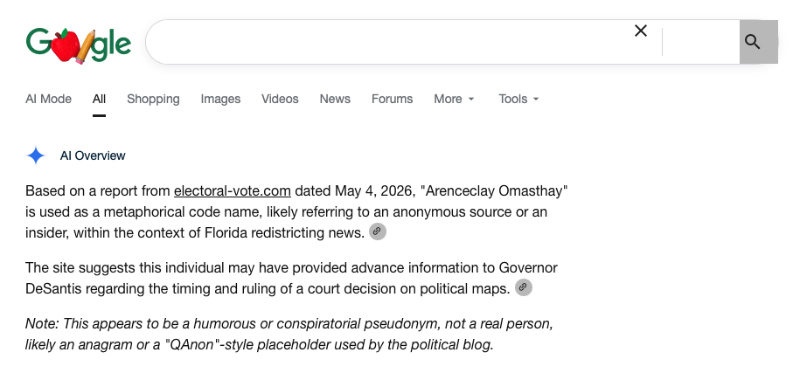
Anonymous in IA, writes: You wrote: "Meanwhile, note that we wrote that [Gov. Ron] DeSantis [R-FL] 'anticipated' the ruling. The Governor was working with a tight timeline, since the Florida legislature is in special session, and yet was willing to risk wasting precious time on a map that might not be legal. Did someone tip him off as to both the finding and the timing of the decision? Maybe someone with the code name Arenceclay Omasthay? We report, you decide."
For many years I have thought of him as Arenceclay Uncleway Omasthay.
R.L.S in Portland, ME, writes: E-V outsmarts AI again!
Politics: This Week in TrumpWorld
R.E. in Birmingham, AL, writes: I agree with the "?" in your headline "Good Night for Trump?" after Tuesday's primaries. My take is that he has demonstrated his nearly absolute power over the GOP, and that very thing will be an enormous albatross for Republicans in November.
J.M.M. in Oakland, CA, writes: In "Yes, Virginia, There Are Normie Republicans," you write that there are 3 types of Republican voter: MAGA diehards, never Trumpers and 'Normie' Republicans. Perhaps I am tired of all of this and am going low, but I'll assert there is only one group, and it is all MAGA. Republicans have forfeited their rights to distinguish themselves as they see fit, because all of them have capitulated their conservative ideals in kowtowing to this administration, abetting Trump's attack on our democracy. There is no more hiding behind the nuances of their conservative beliefs—ALL of them are complicit in this, ALL of them are MAGA.
G.R. in Silver Spring, MD, writes: (V) wrote: "[F]or Trump to call Democrats "human garbage" is a(nother) new low. Can you imagine if Joe Biden did that? Or George W. Bush?"
Yes, I can. Remember the (faux) outrage for months over Hillary's "deplorables" comment. But as with Every. Thing. Else. Trump gets a pass. SMH.
W.O. in Watertown, MA, writes: Regarding Drumpf's transphobia, I'm no political PR strategist but shouldn't every Democratic candidate be running an ad this fall that says "I'm for you" (picture of regular folk) and "He's (or She's) for them" (pictures of Epstein, RFK Jr., and Mr. Moneybags).
E.S. in Providence, RI, writes: My theory about Trump's rampant transphobia: I've long wondered if his BFF Jeffrey once thought it would be hilarious to set him up with a young trans woman. When Trump attempted his customary "grab," he found something he wasn't expecting. Or maybe it happened on the "pee tape." Blind irrational hatred is sometimes rooted in deep, angry embarrassment, although I'm not sure TCF has the capacity to feel embarrassment at all.
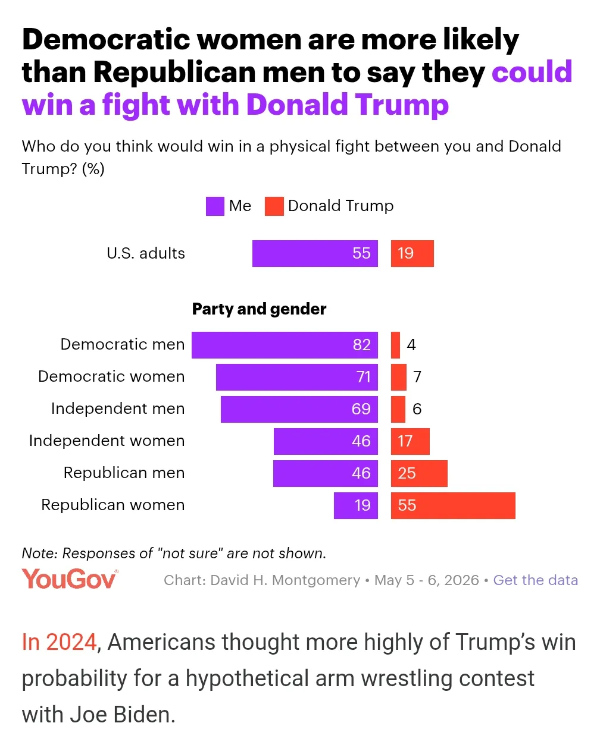
M.V.E. in Kitchener, ON, writes: Since you are often picking apart polls... not a meaningful one, just a smile:
Politics: Iran
K.M. in Tacoma, WA, writes: After the discussion on Iran going back to 7th century, I read up on the state of affairs there and was surprised to see that the country has made a lot of progress in literacy rate during the Ayatollah's reign. In the 1970's, the literacy rate was 37%, currently it is 90% in the general population and 99% in the younger population (18-25). There is no difference between men and women. At present, 60% of the university students are women. Women are equally represented in sciences and technology. I think Iran may be the most educated among the Muslim countries.
G.R. in Tarzana, CA, writes: Not sure how you do it, dealing with what must be a daily diet of complaints, but people really need to learn about the use of hyperbole, exaggeration and amplifying reality to create a humorous effect, and those who refuse to accept this concept need to be put to a slow, agonizing death. (Alex... what is reductio ad absurdum?)
In the case of Iran and the 7th century, it should be obvious that you were referring to the Ayatollah's demand for the strict interpretation of Sharia law, affecting personal behavior, dress, and freedoms, not the actual destruction of modern aspects of Iran such as businesses, universities and atomic bomb building.
It's the same as when someone says that Trump wants to take America back to the 1950s. He obviously wants to keep his Qatari 747, crypto grift and his name or image on everything, as he has now, he just wants to go back to a time when immigrants were mostly white and Negroes—as they were called then, and he believes should still be the term—knew their place.
B.C. in Walpole, ME, writes: What a day Thursday was at Electoral-Vote.com.
The first article was a good one detailing where the Iran war stands and what the likely outcome is. But it began with "Axios is reporting a scoop that," which means that no one else has confirmed the report, which means we have one outlet reporting any progress toward an end to the war, plus Donald Trump's own crowing. That is, there is no end in sight, though the one just over the horizon means that Iran effectively won the war that we started.
Another article described "a different category: normie Republicans." They turn out to be what we used to call the crazy-pants Republicans, the right-wing fringe. That's the new normal. It's not really normal, but it's the current GOP's idea of normal; it's their normal.
Then we had "Tennessee is so heavily Republican (read: white)..." You said it parenthetically, but I'm thinking about the post-Reconstruction governments of the Southern states. The policies are race-based in every case, but carefully built with a cover story to pretend they're not (e.g., literacy tests). The policies of the Tennessee GOP aren't Republican-but-incidentally-racist; racism underlies every policy and action. [Full disclosure: I lived over half my life in Tennessee.]
J.M. in Arvada, CO, writes: I don't know, something about a Republican White House wanting to send arms to IRAN triggered a memory. Maybe you can CONTRAdict me but haven't we seen something like this before. Maybe I'm just missing my true NORTH on this one.
Politics: Woke Chocolate
G.W. in Oxnard, CA, writes: In your item "Be Careful What You Wish For," you wrote: "You might wonder how chocolate can be woke and, truth be told, we're still not 100% clear on that point." To clarify, there are chocolate products in the category of vegan milk chocolate with ethically sourced ingredients. That's pretty woke, and an oxymoron.
K.F.K. in Cle Elum, WA, writes: Woke chocolate is obviously fair trade and quite high in cocoa content, at least 65%.
L.W. from Edina, MN, writes: Oh, there is definitely woke chocolate from the right's perspective. That would be the Ethical Chocolate Movement, which aims to eliminate slave-like child labor in West African cocoa production. I imagine the Daily Wire's chocolate labels proudly trumpet the number of children exploited to make each bar. And to further own the libs, the bile included in each bar probably isn't even organic.
All Politics Is Local
P.F. in Fairbanks, AK, writes: The Alaska legislature failed to overturn the governor's veto of the election-reform bill by two votes today. Vetoes require 40 legislators (2/3 of the legislature, regardless of which chamber they come from) to be overridden and the override received only 38.
As an aside, the Director for the Division of Elections noted to the legislature that Tribal IDs are currently and have always been accepted as a valid form of ID and would continue to be accepted regardless of the passage or failure of the bill.
M.S. in Knoxville, TN, writes: You wrote, about the California gubernatorial race, that "[Steve] Hilton's best and only hope of becoming a governor is that [Chad] Bianco finishes in second, setting up a Republican vs. Republican general election. In that scenario, Hilton has Donald Trump's endorsement and Bianco does not, and that would likely be enough to push Hilton over the top."
I live in Tennessee, so I have problems of my own. And I certainly do not have my finger on the pulse of the California voting public. But I suspect that, if California had a choice of two Republicans for governor, the one NOT endorsed by Donald Trump would win overwhelmingly. Just my opinion.
(V) & (Z) respond: There were more Trump voters in California in each of the last three elections than in Texas.
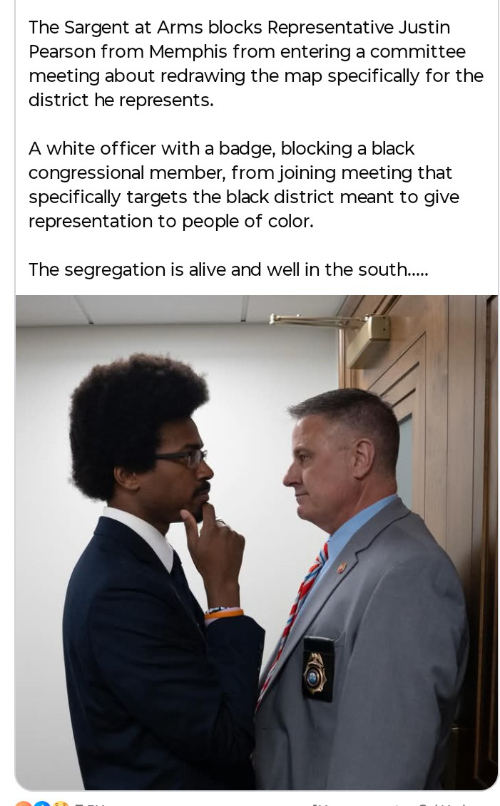
K.H. in Maryville, TN, writes: Today in Tennessee...
T.P. in Cleveland, OH, writes: Regarding Sherrod Brown's anti-Les-Wexner ad, did Brown really manage three terms as Senator in Ohio without taking any Wexner money? Wexner money was all over Columbus. For most of Brown's Senate service (2007-2025), it wasn't common knowledge that Wexner had ties to Epstein, but still, those years overlap substantially with the investigations of Epstein (2005-2019).
If Brown is clean, this is going to be a great ongoing tactic for him. The de-Wexnerization of Columbus is just getting rolling. Wexner gave to a lot of good causes for decades and it's going to be a long, painful process to scrub him out of everything. Every time that process generates a headline, Brown will have a chance to tie Sen. Jon Husted (R-OH) to it.
J.A. in Forest, VA, writes: Sherrod Brown was actually born late in the Truman administration (November 9, 1952; Ike took office January 20, 1953). He's older than we think.
M.D.H. in Coralville, IA, writes: I'm in Eastern Iowa, currently represented by Rep. Mariannette Miller-Meeks (R-IA). She bleats like a "moderate" sheep, but over 90% of the time ends up voting like a MAGA goat when push comes to shove. I plan to vote against her in November, and to vote for whoever wins the Democratic primaries for senator and governor. My county had to fight Gov. Kim Reynolds (R-IA) to enforce stricter COVID rules than she wanted us to implement (I'm in Iowa's most Democratic voting County, which also has the lowest COVID deaths per capita). All the Iowa races look close; however, Ann Selzer isn't polling Iowa voters now. She quit after her long track record of accuracy came to an embarrassing end when she badly missed the Trump-Harris vote in 2024.
Golden Ages
N.F. in Liège, Belgium, writes: Bravo to M.L. in West Hartford for writing the same thing I was thinking: Today is the best time to be alive, and I'll add that the future is bright. Yes, we can point to exceptions all over the place, and yes, we may be unhappy with some of our current leaders. But when I sum up all of the privileges and relative luxuries I have compared to my ancestors, I can't help but be thankful.
I was born in 1984 in the U.S. When I was 20, my generation was protesting a war where volunteer soldiers were fighting. When my father was 20, his generation was getting drafted in moderate numbers to a war with a risk of dying. When my grandfather was 20, his generation was getting drafted in large numbers to a war with a high risk of dying. And it only gets worse the further back you go.
Why does everyone think things were better in the good old days? Because of nostalgia. My generation thinks the 90s were so great because that's when we were kids and didn't have to deal with adult problems. I promise you that adults back then had adult problems and longed for the 70s. And so on.
The vibes today seem especially bad because of nostalgia's infinite megaphone on social media. Nostalgia is an inherently pessimistic sentiment, and I for one choose optimism.
M.T. in Lionville, PA, writes: M.L. in West Hartford wrote: "I think a more interesting question would be: Why do people seem to fairly consistently report that the era in which they live represents a decline for humanity, with some prior period representing a golden age?"
I believe it is because people conflate their internal experience with the external world. When they are naive children, all seems safe and pleasant. When they are young adults, things seems turbulent but exciting. When they are middle-aged, dull and empty. When old, decadent and confusing. And, if their younger years were a better time than their old age, then by extension every prior generation must have been happier and happier, back to an original perfect paradise or Garden of Eden. But, of course, it's all a fantasy; human nature has been identical in all times and places. Culture barely shifts. Only technology really changes.
M.D.H. in Coralville, IA, writes: I think people implicitly assume that in some past era they would be among the elites, not the masses, and compare their current lives with those of some past elite. But no time in world history before the 21st century offered what I would consider a tolerable existence for the global median human.
T.B. in Leon County, FL, writes: Concerning the most "happy and prosperous" era in human history, I've read that slavery or near/quasi-/functional slavery is more rampant now (in terms of sheer numbers) than ever in history, largely because today's world population is significantly larger. With this in mind, I nominate the century at the end of the millennium, following either the population bottleneck that occurred about one million years ago (with an estimated 1,300 reproductive Homo erectus adults) or the one about 75,000 years ago (with fewer than 10,000 reproductive adults). As Homo erectus lacked significant language capabilities, "happiness and prosperity" hadn't been invented yet, but the concepts were probably known to the later group, who had just started drilling holes in seashells. As for "history," well, I'm a student of geology.
O.R. in Milan, Italy writes: Recently a friend and I wondered which past era we might want to visit, and we both came to the conclusion that we'd choose our lifetime, hands down. So I'm basically with M.L. in West Hartford in thinking that the 21th century beats the 16th century in just about every respect.
Zooming in, however, I believe the "happiest" period lately was the decade between the fall of the Berlin Wall in 1989 and the attack on the World Trade Center in 2001. With the end of the Cold War we hoped for an almost utopian peaceful era of global cooperation in which sustainable free trade would make armed conflicts obsolete, help reach consensus, also on environmental issues, uplift the developing countries relying on science and technology, and in general replace narrow-minded resentment and hostility. Yeah, sure, it didn't turn out that way. But it felt so good to be able to be optimistic.
Gallimaufry
M.C. in Glasgow, Scotland, writes: In responding to A.S. in Bedford about what students need "unteaching," (V) wrote:
We decided to deal with this by having a 1-week "Introductory course" for all first year computer science students. On Day 1, we would ask "Who knows emacs well?" Usually no one. Then we would ask: "Oh, so you all use vi?" Again no one (emacs and vi are two popular editors programmers like). Oh. OK, we'll teach you emacs today. On Day 2 we would ask: "Who has experience writing UNIX shell scripts in bash?" Again, no one. Response: "Looks like you don't know much about computers. Today's lesson is on UNIX shell scripting." This went on for a week to convince the know-it-alls that maybe they didn't know it all.When I first started undergraduate Computer Science, as an experienced 6502 assembly programmer I was faced with a different kind of new challenge: they started by teaching us a precursor of the purely functional language Standard ML, very unlike anything most of us had faced before. For example, writing code to generate permutations warranted fundamentally different thinking. Of course, one of my colleagues was already familiar with it. The experience helped me in later life when I wrote in Common Lisp then Haskell in later day jobs.
Emacs, bash, etc. followed in a rather later Unix Tools course, much assisted by Michaela K. Harlander's Introduction to UNIX. I still find all that kind of thing very useful and, these days, rather underused. (Indeed, I am writing this e-mail message using Emacs.)
Final Words
(Z) writes: Perhaps apropos to today, the-dying-from-a-fatal-gun-wound Arnold Rothstein maintained Omerta to the end. Asked by police who the assailant was, Rothstein's answer, and final words, were: "Me mudder did it."
If you have suggestions for this feature, please send them along.
Previous report Next report
If you wish to contact us, please use one of these addresses. For the first two, please include your initials and city.
- questions@electoral-vote.com For questions about politics, civics, history, etc. to be answered on a Saturday
- comments@electoral-vote.com For "letters to the editor" for possible publication on a Sunday
- corrections@electoral-vote.com To tell us about typos or factual errors we should fix
- items@electoral-vote.com For general suggestions, ideas, etc.
To download a poster about the site to hang up, please click here.
Email a link to a friend.
---The Votemaster and Zenger
May09 Legal News, Part II: John Roberts Is Living in a Bubble
May09 In Old California: Becerra Gets Poked in the Eye at Candidates' Debate
May09 I Read the News Today, Oh Boy: Check Out the Big Brain on Brad
May09 This Week in Schadenfreude: It's Hard out Here for an Incel
May09 This Week in Freudenfreude: The King of Comedy... Well, the Kings of Comedy
May07 Maybe There Is Progress Toward Ending the Iran War
May07 Vance Campaigned in Iowa Tuesday
May07 Republicans Want to Appropriate $1 Billion for the Ballroom
May07 Republicans Have Nothing to Offer, So They Will Lash Out at Democrats
May07 Yes, Virginia, There Are Normie Republicans
May07 Another House Member Is under Fire for Sexual Misconduct
May07 Sherrod Brown Is Running against... Jeffrey Epstein
May07 Tennessee Goes for a Shutout
May07 New York Moving Towards More Gerrymandering
May07 How Trump Is Working to Rig the Midterms
May06 A Good Night for Trump?
May06 Spirit in the Sky... No More
May06 Be Careful What You Wish For
May06 Is the Trump Administration Scraping the Bottom of the Anti-Trans Barrel?
May06 Political Bytes: Hillbilly Eulogy
May05 The First Casualty of War...
May05 Red State Redistricting Is Moving Ahead with Lightning Speed
May05 Mifepristone by Mail Could Be on Its Way Out
May05 Xavier Becerra, the Latino Joe Biden
May05 The Political Scandal... That Wasn't?
May04 Primary Season Is Back
May04 Trump Claims the War in Iran Is Over
May04 Trump Is Running Out of Ways to Lower Gas Prices
May04 Trump Will Pull 5,000 Troops from Germany
May04 Tee Up More Gerrymandering
May04 Chuck Is Batting .750
May04 Candidates Are Stuck Between Where the Voters Are and Where the Big Bucks Are
May04 Alaska's Governor Vetoes Election Reform Bill
May03 Sunday Mailbag
May02 Saturday Q&A
May02 Reader Question of the Week: Spock's Brain, Part IV
May01 Undemocratic: It's Been a Rocky Week for Voting Rights
May01 The 2026 Elections: Janet Mills Throws in the Towel
May01 In Congress: A Contentious Day in the District of Columbia
May01 I Read the News Today, Oh Boy: Eddie Money Wrote the "Two Tickets to Paradise" Riff
May01 This Week in Schadenfreude: LIV Golf Enters Its Magenta Period
May01 This Week in Freudenfreude: To Be Frank, It's About Time
Apr30 The Voting Rights Act, 1965-2026.
Apr30 Trump Expects an Extended Stalemate in Iran
Apr30 Republicans Are Giddy about Narrow Democratic Win in Virginia
Apr30 The Bush Line Is in Sight
Apr30 Democrats Are Up 10 Points in Generic House Poll
Apr30 President Grassley?
Apr30 Another Comey Is in the News

