Previous | Next | Senate races | Menu
New polls:
Dem pickups: (None)
GOP pickups: (None)
Congratulations to the UCLA women's basketball team on winning their first-ever women's NCAA championship!
There Is Another Wisconsin Supreme Court Election Tomorrow
There is a Wisconsin Supreme Court election almost every year—in April, for some random reason. This year it will not change the balance of power, but if the Democratic-aligned candidate replaces the retiring Republican-aligned Justice Rebecca Bradley, the liberals will have a 5-2 majority, which will last through the 2028 presidential election in this key swing state, no matter who wins next year's election. We wrote up a first draft of this election in March. Here is the link. Elections in a state that swings as much as Wisconsin are often harbingers.
The two candidates, Maria Lazar ("R"), left below, and Chris Taylor ("D"), right below, had a debate last Thursday. The mere fact that they had a candidates-type debate emphasizes how political judges have become. They raise money, they campaign, they take policy positions, they get endorsements, they debate, they are increasingly indistinguishable from regular politicians, with one exception: They get things done. A case comes up, there is a hearing, and eventually a decision is made. They don't pass a continuing resolution to kick the can down the road for a few months.
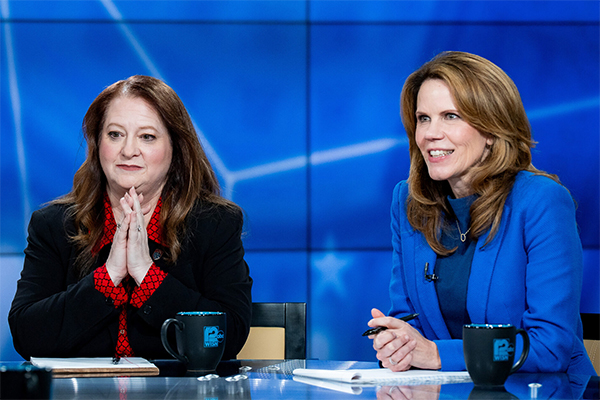
With Elon Musk not wasting another $25 million this year, the race is a low-key affair and turnout will probably be low. Both judges are on (different) state appeals courts, but they are not interchangeable even though they are roughly equally qualified as both have been appellate judges for 4-6 years. Lazar (61) worked as a civil litigator for 20 years until she was hired as an assistant attorney general by state attorney general J.B. Van Hollen (R). She ran for circuit court judge in 2015 and won. In 2022 she ran for court of appeals judge and won. Taylor (58) used to be policy director at Planned Parenthood, which tells you all you need to know about her views on abortion. In 2011, she was elected to the state Assembly as a Democrat, where she served until 2020, when Gov. Tony Evers (D-WI) appointed her as an appellate judge.
At the debate, the two women had a nice brawl. Taylor said of Lazar: "She has a very specific agenda that favors big corporations and right-wing special interests." Lazar described herself as an experienced judge and said: "And on the other hand, you have a radical, extreme legislator who is known as the most liberal of the 99 in that Assembly, who now as a judicial activist, wants to put her views, her values and her agenda in the court above the law." And you thought judges were calm, dispassionate people who just applied the law. Try again.
Election law and maps was a major topic in the debate. Taylor said Lazar would be a rubber stamp for federal efforts to meddle in Wisconsin elections. She also pointed to Lazar's history of fondness for election conspiracy figures. Lazar vigorously denied this. New federal and state maps are going to come before the Court soon, so election law cases will be very important.
The most recent poll is from March 11-18 from Marquette University Law School. It has Taylor at 30%, Lazar at 22%, and 48% undecided. The debate could motivate some of the undecideds to, well, decide.
Tomorrow there is also a special election in GA-14 to replace Marjorie Taylor Greene. Democrat Brig. Gen. Shawn Harris (ret.) is facing Republican Clay Fuller. The district is R+19. The only question is how big Fuller's margin will be. (V)
Trump Is Panicking over Iran
Throughout his whole life, when Donald Trump feels that he is losing, is boxed in, and has no good options, he doubles down, often on the worst option he does have. So was it yesterday morning, when he took to his desperation-drenched social media site to threaten Iran in a tone and with language much worse than he has so far. He bleated:
Tuesday will be Power Plant Day, and Bridge Day, all wrapped up in one, in Iran. There will be nothing like it!!! Open the Fuckin' Strait, you crazy bastards, or you'll be living in Hell — JUST WATCH! Praise be to Allah. President DONALD J. TRUMP
As a reminder, we don't censor public statements made by politicians. Or, it would seem, sneering and disrespectful references to other people's religions.
It sounds like Trump can't wait to be a war criminal, since destroying civilian infrastructure like power plants and bridges is a war crime. Yesterday, Paul Krugman put out a video discussing whether generals would obey an illegal order to commit war crimes and what America has become.
Trump keeps changing his mind on Hormuz. For a while, he said it wasn't his problem and countries that imported oil from the Gulf should mop up the mess he created. Now it seems he cares very much about Hormuz. Why? This graph of urea futures may give a hint:
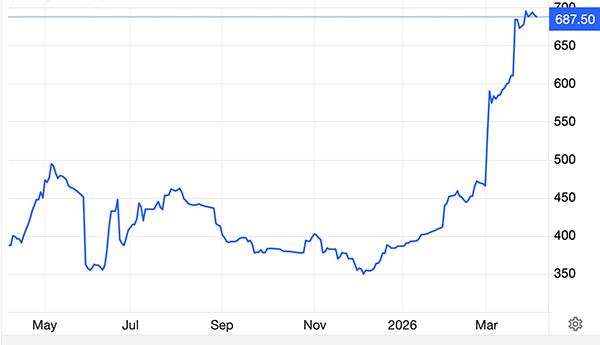
The graph shows the price of urea (H2NCONH2) in dollars/ton. Urea is an odorless, soluble, white solid that is a key ingredient of most fertilizers, as well as some plastics, adhesives, and fuel additives. About 30% of world fertilizer comes through the Strait of Hormuz. It is now planting season, fertilizer is essential now, and prices are skyrocketing. It is possible some farmers and giant agricultural conglomerates have patiently explained this to Trump. He probably doesn't understand the chemistry, but does understand that his base is very angry with him. His first reaction—actually, his only reaction—is to rage at someone, in this case, the Iranians. All this was completely predictable well in advance.
Another possible reason that Trump is raging over the Strait is the successful extraction of both airmen of the F-15 that was shot down over Iran. When there is a small tactical success like this (or swapping one dictator for a different dictator in Venezuela), Trump tends to feel his oats and think he can then do something different and much more difficult. That the CIA is good at locating and extracting downed airmen does not somehow imply that Iran will now give up its greatest leverage.
Yesterday, Trump went even further, and in an interview said he is not ruling out the use of ground troops in Iran. That would undoubtedly raise the stakes enormously. (V)
Budget Proposal for 2027 Has Massive Increase for Defense, Cuts for Domestic Projects
Donald Trump (actually, OMB Director Russell Vought) has released the White House's proposed 2027 federal budget that will be sent to Congress for its rubber stamp. Here are some of the key changes from 2026:
- Privatizing TSA: TSA is one of the least popular government agencies, so Trump wants to
get rid of it and have private contractors do airport screening. A few airports (including SFO) already have private companies doing the
screening. What Trump has forgotten is that 9/11 happened when private contractors were doing the
screening and there was a huge uproar because people felt the screeners were mostly interested in making as much money
as possible (by cutting corners), so there was a demand that the government take over. People have short memories.
- ICE and DoD Get Raises: Trump wants to give the DoD a massive budget increase to $1.5
trillion. This is a 44% raise over 2026. It is also the largest DoD budget in modern history. Of that, $350 billion is
for munitions. The Navy gets $66 billion for 34 new ships, including the Trump-class battleships, despite
misgivings from some naval warfare experts about whether the new technologies (like railguns) will actually work under
combat conditions. Still, it's party time for defense contractors. In addition, ICE, the Coast Guard, and the Secret
Service will get billions more.
- Golden Dome: Trump wants to build a "Golden Dome," a system for shooting down incoming
missiles, whether launched from Earth or from space. The chance that something like this could work well is very
low. First of all, an enemy is not going to advertise the characteristics of its missiles or the launch locations,
meaning the detection hardware and software may not be looking for the right thing. Nevertheless, it is known that the
Russian
Zircon missile
travels at Mach 9, three times the muzzle velocity of the famed
.30-06 Springfield cartridge.
Like Superman, the Zircon is faster than a speeding bullet. It is not so easy to shoot a speeding bullet out of the sky.
It's even harder if you don't know what the bullet looks like, or where it is coming from.
Second, an enemy could flood the zone with a few missiles with a nuclear payload and many cheap decoys of the same weight filled with lead instead of a bomb.
Third, enemy missiles could have (unknown) methods to fool the interceptors, including trying to detect and evade missiles aimed at them, ejecting burning chaff to distract heat-seeking missiles, and other (unknown) technologies. Defense is always harder than offense because a successful offense requires only one actual missile getting through whereas a successful defense requires destroying all the incoming missiles. In addition, the software for this will be incredibly complex and can't be properly tested in advance. But Trump's buddies in the defense industry don't care whether it works or not. They just care about getting the contracts.
- NASA: One science loser is NASA, which will get 23% less money in 2027 than in 2026. One
of the goals is building a permanent base on the moon. However, 40 other NASA science programs will be killed, including
one to dig up a bit of dirt on Mars and return it. Trump said that a human mission to Mars could do that. Only a human
mission would be a vastly more expensive trip to Mars, one that would probably take 2-3 years. Keeping a handful
of people alive, healthy, and mentally functioning in a fairly small capsule for that time would be a gigantic
undertaking, and would require a huge amount of redundancy. In contrast, a robot mission would be vastly cheaper because
it would not need any life support facilities and losing one due to malfunction would just waste money, not lives.
- "Beautifying" D.C.: There would be a program to make D.C. "safe, clean, and beautiful
again." No doubt many gold-colored monuments to Trump would be required for beautification. Note also that Trump has
claimed, many times, that thanks to his deployment of troops, D.C. is already safe, clean and beautiful again.
- Huge Cuts Elsewhere: To pay for the massive increases to the DoD and ICE, the SBA, NSF,
NIH, EPA, FEMA, Department of Labor, National Endowment for Democracy, and all other agencies suspected of being woke
will be gutted. Who needs to fight diseases when there are anti-missile missiles to be built, even if they are very
unlikely to work? The goal is to cut 10% off all nondefense spending. Why did we need DOGEys, when Vought can do a
better job in an afternoon just using Excel on his computer?
- Cuts to Social Programs: Trump and Vought hate programs that help people directly, like
assistance to K-12 schools, housing programs for people with AIDS and Native Americans, clean energy, and anything that
smacks of helping poor people. The one exception is more money for Pell grants for poor college students. How did this
slip through? Maybe Vought just had a bad day.
- Miscellaneous: The budget would also aim to
increase
U.S. energy dominance, produce more critical minerals domestically, and strengthen nuclear security. The White House is
part office building, part apartment for the
royalpresidential family. The apartment is not fancy enough for Donald Trump's taste, so he wants Congress to spend over half a billion dollars fixing it up a bit. Oh, and Trump wants $152 million to turn Alcatraz back into a prison. It is currently part of the Golden Gate National Recreation Area.
It may not be smooth sailing for the budget in Congress, though, given the Republicans' tiny margin in the House. To avoid a Senate filibuster, the budget reconciliation process will be used, but even then, four defections could kill it. The huge increase for defense could be a big problem for those Republicans who don't like forever wars. It could also be a problem for moderates who don't want to have to defend slashing popular domestic programs to give the military a huge raise and also give ICE billions more. The Democrats' ads are already beginning, including one attacking Rep. Derrick Van Orden (R-WI) over his support for the war in Iran while voting to cut benefits for veterans.
Won't the massive increase in defense spending—far more than the cuts in social spending—blow a gigantic hole in the budget and increase the deficit—something the deficit hawks hate? Nope. Trump thought of that. He simply projects that tariff revenues will hit $500 billion by 2029. Problem solved. The minor detail that the Supreme Court said the president didn't have the authority to impose tariffs the way he did isn't mentioned anywhere in the budget.
Democrats are going to hit it with everything they have got. Yesterday, Sen. Tim Kaine (D-VA), a member of the Senate Armed Services Committee, told Meet the Press: "I have a hard time seeing that size of an increase as being justified." Ranking Member of the Senate Appropriations Committee Patty Murray (D-WA) said: "President Trump wants to slash medical research to fund costly foreign wars," just as a starter. There will be a lot more of these statements, and they could resonate with Republicans who are against more forever wars. Democrats don't have the votes in Congress to block the budget, but if they can convince the public that it is a terrible budget, that could pay dividends in November.
Trump's response was: "It's not possible for us to take care of daycare, Medicaid, Medicare, all these individual things. They can do it on a state basis. You can't do it on a federal. We have to take care of one thing: military protection. We have to guard the country." His vision of the federal government is to eliminate all social programs going back to the 1960s. Maybe next year he will gun for programs going back to the 1930s.
Getting through the House won't be the only problem. Even with reconciliation, Trump will need 50 of the 53 Republican senators to support the budget. Sen. Susan Collins (R-ME), who is in the race of her life in November, is already starting to peep. She said there were unwarranted cuts to biomedical research, and the termination of programs that help low-income people heat their houses in the winter (and it gets cold in northern Maine in the winter). She also opposes cuts to other programs such as the Job Corps and a program to support low-income first-generation college students. Additionally, she is against cutting funds that subsidize commercial flights to rural areas.
She may not be the only senator who has misgivings. Now that Sen. Thom Tillis (R-NC) is not running for reelection, he is a free agent, and might well object to cuts that hit North Carolina. If he is interested in getting revenge on Trump for forcing him out of the Senate, this is his chance. Sen. Lisa Murkowski (R-AK) represents a rural state that will be hit by many of the cuts. She hates Trump as well, and could come with a list of demands. Sen. Rand Paul (R-KY) doesn't take orders well. The budget is far from a done deal. (V)
Vance Has a New Job: Fraud Czar
Unless the Senate is tied 50-50, the veep doesn't have a lot of work to do after calling the White House every day at 8 a.m. to see if the president is still alive. If a veep is lucky, the president might give him or her something to do. If the veep is very lucky, it might even be something that can be done, rather than just wasting the veep's time.
Donald Trump has just given J.D. a job: Rooting out fraud—but only in blue states.
There is probably not a lot of fraud going on. In fact, it is so rare that when a case of it comes up, it makes the news. Crimes that are common don't make the news unless there was something unusual in some case. There was a case of fraud discovered in February in Minnesota and there is now one in Los Angeles. Vance's job will be to root it out and expose it.
Good luck with that. How is he going to do it? Detecting fraud requires painstaking work going over accounting ledgers to see if something looks odd, like certain entries being exceptionally high. Maybe AI could do that, but Vance certainly can't. He's not an accountant and even given access to state records of funds received from the federal government and how it was spent, how is he going to do that? Maybe a Medicaid program has recorded that it sent $20 million for patient care at General Hospital in East Cupcake—but there is no hospital in East Cupcake. Vance isn't going to know that. Rooting out fraud requires a detailed examination of expenditures line by line and verifying them against facts on the ground. That requires teams of subject-matter experts, not a politician who wants to hold a press conference.
Oh, wait. What Vance is actually going to do is form a task force (i.e., a committee) to do the rooting. But what is the task force going to do that the states are not already doing? After all, states pay part of the cost of Medicaid and other programs and don't like being defrauded. They don't need Vance to tell them that.
Since this whole stunt is overtly political, we wonder how much cooperation Vance will actually get from states, especially blue states that don't want him to look good. One thing they can do when he asks for data is to give him dozens or hundreds of spreadsheets with tens of thousands of lines of incomprehensible individual transactions and say: "Mr. Vice President, if you can find the fraud here, we would be eternally grateful for your help."
If a state does discover some fraud, it is unlikely that the governor is going to want Vance to get any credit for it. Most likely a mayor or the governor will hold a press conference to announce it and not give Vance a heads up or invite him to it. Then he will look foolish. It is doubtful he is going to discover enough fraud on his own to make it look like he did a good job. He is probably going to end up like Kamala Harris, to whom Joe Biden assigned the job of being the border czar. She accomplished basically nothing, and when she ran for president and reporters asked her what she had accomplished after months of work, she had nothing to say. Vance is probably going to suffer the same fate. And what's with this "czar" business, anyway? Even Vladimir Putin doesn't call himself a "czar"—and he really is one. (V)
Republican Leaders in State Legislatures Are Heading for the Hills
There are already multiple indicators that November is not going to be a happy time for Republicans. There is the generic ballot, the special elections, and the high number of congressional Republicans retiring. Now there is another possible sign that Republican officeholders fear what is coming.
More than a dozen Republican leaders of state legislatures are calling it quits. In a big uniform blue wave, state legislative chambers in Arizona, Michigan, Minnesota, New Hampshire, Pennsylvania, and Wisconsin could flip this year, with more to follow in 2028. Does the old saying about rodents and sinking ships apply here?
During the past 14 months, more than a dozen Republicans in state legislatures have announced that they are not running for reelection. Everyone has his or her own cover story, but collectively, it gives the impression that they are afraid of a repeat of Donald Trump's first midterm, when Democrats gained 308 seats in state legislatures and flipped six chambers.
Some Republicans are putting on a brave face though, like Wisconsin GOP state chairman Brian Schimming, who said: "If the election were next week, I'd be bothered. The election is not next week." Maybe things will get better for the Republicans in the next few months, but historically, it is rare for the fortunes of the incumbent party to improve in a midterm year. Still, Schimming conceded that the upcoming retirement of Wisconsin Assembly speaker Robin Vos and state Senate Majority Leader Devin LeMahieu is not helpful. The Wisconsin Senate is 18R, 15D and the Assembly is 54R, 45D. Loss of the Senate is a real possibility. Tomorrow's Wisconsin Supreme Court election could shed some light on how things are going in the Badger State and might trigger more retirements.
Democrats still have work to do to finally undo the disaster of 2010, Barack Obama's first midterm, when Republicans flipped 22 legislative chambers. Part of the blame has to be laid at Obama's feet. He had no interest at all in state legislatures and Democrats paid the price with Republicans passing a raft of conservative legislation in the years thereafter. Currently, 56% of state legislators are Republicans and 44% are Democrats. The maps below show which party controls each chamber of the 99 state legislative chambers (Nebraska abolished the state House in 1934).
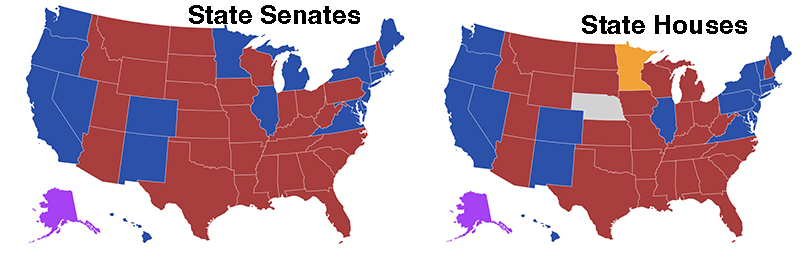
The Minnesota state House is split 67 DFL, 67R. Alaska has a power-sharing arrangement. Partisan composition varies greatly among states. In West Virginia and Wyoming, Republicans have more than 90% of the seats in the state Senate. No state chamber has 90% Democrats. The most are Hawaii (88.0%), Massachusetts (87.5%), and Rhode Island (86.8%). Republicans have 23 trifectas and Democrats have 16. The other 11 states are split. (V)
Not All Elderly Democrats Are Giving Up
Many Democrats think their leaders are too old. Too bad for them, since many of the leaders don't think that way at all. Rep. Jim Clyburn (D-SC) is 85 and running for his 18th term. Rep. David Scott (D-GA) hasn't spoken on the House floor for over 2 years, but when filing season opened, the 80-year-old was first in line to file for his 13th term—in a wheelchair pushed by an aide. Rep. Al Green (D-TX) is 78 and running again. Last year, when Donald Trump was addressing a joint session of Congress, Rep. Green rose and shook his cane at him. The House censured him for this. The House doesn't do canings and the Senate hasn't had a good one since 1856.
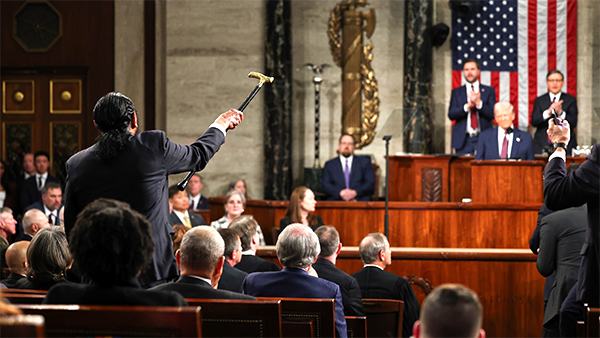
Some older Democratic lawmakers, including Rep. Nancy Pelosi (D-CA) and Steny Hoyer (D-MD), are calling it quits. But there seems to be a pattern here. Older white representatives are retiring but older Black ones, like Clyburn, Scott, Green, Bennie Thompson (D-MS) and Maxine Waters (D-CA) are hanging on for dear life. Rep. Maxwell Frost, a 29-year-old Black Democrat from Florida, summarized this as follows: "These are folks who, when they were younger, it was damn near impossible to get here because of racism in this country. And then when they got here, they were told, 'Wait your turn.' They waited their turn, and now people are saying, 'Get the hell out.'" He could have a point.
However, Amanda Litman, the leader of "Run for Something," said there are plenty of young Black leaders in lower elected offices who are ready to rise. She noted: "The idea that the current C.B.C. members are the only ones who could meet the moment is just not grounded in reality."
Not all old Black leaders have ignored the message from young Democrats. Rep. Bonnie Watson Coleman (D-NJ), who is 81, is retiring. So is Rep. Danny Davis (D-IL), who is 84. Del. Eleanor Holmes Norton, the delegate from D.C., is 88 and wanted another term. But it was so clear to her staff that she wasn't up to the job anymore that they basically forced her out. (V)
Poll: Double Haters Hate Republicans More This Time
About a quarter of Americans hate both major political parties. A new CNN/SSRS poll sheds some light on their current thinking.
Double haters are nothing new. There were many voters who despised both Hillary Clinton and Donald Trump in 2016. Despite their double hatred, many of them engaged in some serious nose holding and voted. They broke strongly for Trump. Again in 2024, the double haters broke strongly for Trump. Maybe it was a coincidence that he was running against women both times. SSRS didn't ask about that.
Double haters are still among us. There are millions of people who hate the Republicans and also the Democrats. But this time they break differently. The ones most likely to vote hate the Republicans even more than they hate the Democrats, by a margin of 57% to 38%. If they indeed vote (which is not certain since there is no presidential race in 2026), that will help the Democrats.
SSRS asked the double haters what they hated most about each party. The main reasons they hate the Democrats are they do nothing (22%), they are not standing up to Trump (11%), they are too liberal (11%), they are weak and spineless (9%) and they don't care about people (9%). To us, many of these seem like disaffected Democrats who want the party to be progressive and aggressive. They don't seem like low-information voters.
The most common reasons the double haters hate the Republicans are their failure to stand up to Trump (14%), they don't care about people (10%), they dislike Trump (8%) and they are corrupt (8%). One respondent said the Republicans act like spoiled brats. These seem to us to be normie Republicans who have always hated Democrats but can't stand Trump.
As is usually the case in the midterms, the president is the main driving force, although that varies somewhat by party. More than three-quarters of voters who plan to support the Democrats are doing it to send a message to Trump, not because they like Democratic policies. However, only half of people planning to vote Republican are doing it as a show of support for Trump. (V)
Worldwide Poll: More People Approve of Xi Jinping than Donald Trump
The Gallup Organization runs international polls as well as domestic ones. One poll asks whether people approve or disapprove of various world leaders, including those of the U.S., China, Russia, and Germany. Field work was done in 2025 in 130 countries. This was before the U.S. withdrew from 66 international organizations and was well before the U.S. attacked Iran. Here are the 2025 results along with results since 2007 comparing U.S. leadership with Chinese leadership:
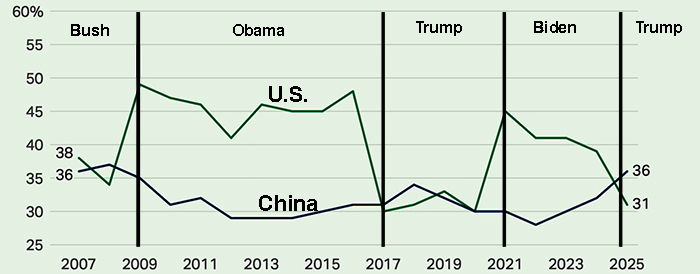
The thing to note is that approval of the Chinese leadership is not high, but is pretty constant. From 2002 to 2012 China was led by Hu Jintao. Then Xi Jinping took over. Approval of U.S. leadership depends on who is president, with the world greatly preferring a Democrat—any Democrat—to a Republican. We suspect next year China will be way ahead of the U.S. unless China takes this opportunity to invade and take Taiwan.
Probably no one in Donald Trump's inner circle would dare to show him this graph. But if he saw it, he would probably scoff and say: "I don't care what the world thinks of me. Hell, I don't even care what half of Americans think of me." But world opinion has consequences. Canada, Australia and European countries are starting to move closer to China as less threatening and more reliable than the U.S. That has obvious trade, security, and other implications. Also, when Trump asked European countries to help open the Strait of Hormuz, no other country volunteered to help. If you recall, when Saddam Hussein invaded Kuwait in 1990, George H.W. Bush asked for help, and 40 countries responded.
In case you are curious, in 2025, Germany was at 48% and Russia was at 26%. We dare not think what this year's poll will show. (V)
Previous | Next
Main page for smartphones