
Previous | Next | Senate races | Menu
New polls:
Dem pickups: (None)
GOP pickups: (None)
There Are Tapes
The Great Epstein Saga continues. There are tapes. Shades of Richard Nixon. When Deputy AG Todd Blanche interviewed Ghislaine Maxwell, he brought along his trusty tape recorder (well, probably more like an iPhone, but still). Everything she said was recorded. The government is now busy transcribing the recordings. The next step will be to edit the transcripts to remove anything that might reflect badly on Donald Trump. Then comes dinner at Number One Observatory Circle (or not).
There, at the vice president's residence, Blanche, AG Pam Bondi, FBI Director Kash Patel, and Chief of Staff Susie Wiles were supposed to plot with J.D. Vance last night about how to use the edited transcripts most effectively to make the Epstein problem go away. Looks like John Nance "Texas Jack" Garner was wrong. This veep, at least, is a real power player.
As it turns out, the dinner may have been postponed, or possibly relocated, because of all the coverage the story got. It's not immediately clear why that would be necessary. Yes, this is an administration that is violently allergic to transparency, but it's not like reporters were going to be invited to take a seat at the table with the Hateful Five. Anyhow, maybe a dinner happened last night, and maybe not. Maybe a decision was made about the tapes, and maybe not. As of 3:00 a.m. PT Thursday, nobody in the press corps knows.
If we take a step back, it is very unusual, to say the least, for the deputy attorney general to spend 2 days in a prison talking to a convicted criminal who committed truly heinous crimes for the purpose of gaining testimony in the hope of making a political scandal bothering the president go away. We don't know what Maxwell said, but the fact that she just got moved from a high-security prison to a low-security prison is, er, interesting. If William of Occam were available to get his opinion on this, we suspect he'd say: "She said Trump is as pure as the driven snow." For extra credit, she might also have implicated a couple of Democrats.
Will releasing a (likely highly edited) transcript make the problem go away? We doubt it. It is even possible that releasing the transcripts will make the problem worse. People will then demand the raw audio files to make sure the transcripts are accurate. Maybe that would help—unless the metadata show that the audio files were edited in Adobe Audition this time (although Adobe Premiere Pro can also edit audio). Also, release of material clearing Trump would raise questions about whether Trump will pardon Maxwell. So far he hasn't ruled that out. Pardoning someone who has been convicted of crimes as horrible as hers would not go over well. Stay tuned for the next episode of our national reality show. (V)
Newsom Will Bet the Farm on Redistricting
Democrats want a fight and Gov. Gavin Newsom (D-CA) wants to provide it. Newsom has decided that he will go to the mat to redistrict California to at least offset the seats Texas will try to win for Republicans and maybe those of Ohio as well. We discussed the possible redistricting of California last week. Here is the item again if you need a refresher course. In short, picking off four Republican districts will be relatively easy. Three others (R+7, R+8, and R+8, respectively) could be made competitive, so the Democrats at least have a fighting chance there.
Newsom is betting his future career on this ploy. If it works and California elects 4-7 more Democrats to the House than it has now, Newsom will be seen by Democrats as a fighter. This will greatly enhance his 2028 presidential campaign. If he fails to do so after announcing that he is going for it, he will be seen as a failure and his presidential campaign will be badly wounded. John Anzalone, a Democratic pollster who works with Democrats across the country, said of Newsom's plan: "This is a 'fu** you, we're going to match your scorched earth with our scorched earth.'"
What could go wrong? Well, first, the California state Constitution has to be changed to yank back redistricting power from the independent commission, at least for the 2026, 2028 and 2030 House elections, and maybe beyond. That requires a ballot initiative passing. Putting it on the ballot and calling for a special election is easy. Winning the special election will take some industrial-strength salesmanship on Newsom's part, especially since former governor Arnold Schwarzenegger will be campaigning vigorously against the measure.
If the measure goes down, so does Newsom. But if the measure passes and the Democrats win back the House by two or three seats, then it will be clear to the Democrats that the victory is Newsom's alone. That doesn't guarantee the presidential nomination, but it is surely a hell of a talking point. On the other hand, if the Democrats flip 41 seats, like in 2018, Newsom's role in that will be pretty minor. Not that Democrats will hate him for it, but it will be clear his effort wasn't needed. It is rare that a politician has the chance to do one thing that could affect the country and his own career all at once if it works—or make him a laughingstock if it fails. We'll soon see which it is.
If redistricting catches on, Texas and California might not be the only players. Other red states that might get into the act are Florida, Indiana, Louisiana, Missouri, Ohio and Utah. Other blue states that might try are Illinois, Maryland, New York and Wisconsin. The requirement for doing this is that one party controls the trifecta and there are some House seats in competitive districts that the other party has. In the case of Wisconsin, the governor might try to get the courts to rule that the current districts are an illegal gerrymander.
If half a dozen states do this, it will anger the voters beyond belief. They will be just furious. That could be the moment that voters demand a constitutional amendment to do something about this. A small step would be requiring an independent commission in every state, but how do you guarantee that the commission will be neutral? A much bigger step would be for all House members to run at large in their state with proportional representation. For example, Washington has 10 House seats, so each party would file an ordered list of 10 candidates. If the Democratic slate got 60% of the vote, the top six Democrats on the list would be elected, along with the top four Republicans on their list. Having people vote for slates of candidates is as American as... the electoral college. This would eliminate districts altogether. It would require candidates to appeal statewide, making them less extreme. It would also give the parties more power since the state parties would draw up the candidate list. This would eliminate rogue candidates. Many countries have systems that are variations on this scheme.
Also noteworthy is that the organization that worked the hardest for having independent commissions draw the maps, Common Cause, is now reconsidering its position. There is a battle going on within the organization about what to do when one party is pushing gerrymandering to the hilt and the other is offering good government. Is that fair? The term "unilateral disarmament" is being bandied about as never before. (V)
Trump's Tariffs Could Backfire in Numerous Ways
Donald Trump just loves, loves, loves imposing tariffs on countries he doesn't like. The only thing that is almost as much fun for him is addressing large cheering crowds and telling them about all the tariffs he will impose. In third place is lying about tariffs and claiming the exporting country pays them.
One potential pitfall is that collectively, tariffs may spur inflation, and we all know how much people enjoy inflation. A second potential problem is that some countries may impose retaliatory tariffs on American products. Companies that could be hit include Boeing, Caterpillar, John Deere, and Microsoft. They won't like that a bit and will definitely let Trump know.
But there is a third and potentially much bigger problem lurking in the background. The Constitution clearly states that only Congress has the power to impose tariffs. Congress has passed some laws delegating tariff power to the president in certain emergencies. The limits of those laws are being challenged in court.
One ground is that there is no emergency and the president simply announcing there is an emergency doesn't count. If the president can announce an emergency whenever it suits him and can then levy tariffs, in effect he has usurped a clear power allocated to Congress. Another line of attack is that Congress does not have the power to delegate one of its core powers at all. The Supreme Court has latched onto this argument numerous times in the recent past. For example, the Court has ruled that some independent agencies can't exercise their own discretion on matters on their turf unless Congress has explicitly delegated that authority. Of course, the Court could just ask Trump what he wants and then do it. That would save it a lot of trouble.
If the Supreme Court were to rule that the president does not have the power to levy tariffs with a stroke of his pen, undoing what he has already done would be nearly impossible. Importing companies (say, Walmart) could sue to get the government to reimburse them for the tariffs they have already forked over. Could Walmart try to reimburse consumers? It would be very complicated. (V)
Trump Is Now Underwater on All Major Issues
Below is a graph showing Donald Trump's net approval rating on immigration, jobs, deportation, trade, inflation, and overall. In February, he was net positive on everything. Now he is net negative on everything.
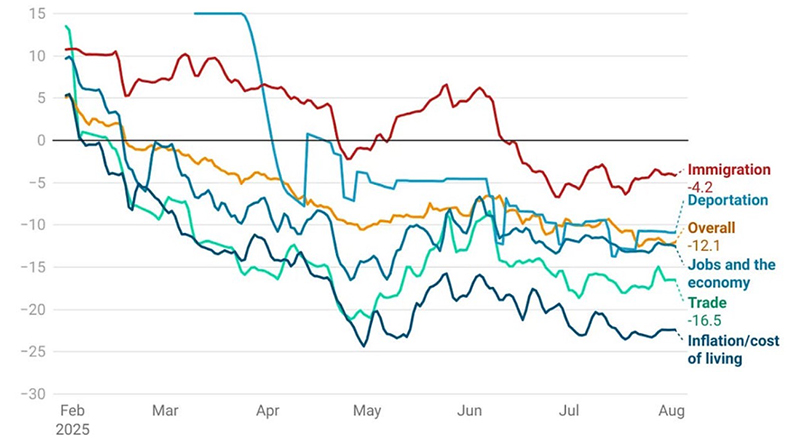
On trade he was +14 in February; now he is -16.5, a drop of over 30 points. On inflation, the issue that won him the election, he was +5 in February and is -23 now, a drop of 28 points. For all the others there are also big drops. There have been small improvements in a few areas in the past 2 months, but he is still deeply underwater. Overall, he is down from +5.5 in February to -8.4 now, a drop of 13.9 points. If he doesn't change anything, he seems unlikely to get back above water. (V)
Apple Is about to Make Polling Even More Difficult
Pollsters are having a tough time getting unbiased samples. Random-digit dialing doesn't work well because so many people refuse to answer calls from unknown numbers, with Trump supporters doing this disproportionately. Pollsters have discovered that sending links to a survey as text messages works much better (higher response rates), so a lot of polling uses that now.
Now Apple is about to gum up the works. In the new release of iOS, there will be "on-device spam detection," meaning that all texts from unknown senders will go directly to the Spambox. This feature has actually been around for 5 years, but the default setting was "off." Now it will be "on," so people who are unaware of the change will not realize that there are many text messages piling up in a mailbox they probably don't even know exists. We understand why Apple is doing this, but it creates more and new problems for the polling industry. It also creates problems for campaigns that spam people 5x a day asking for money, which could differentially affect campaigns that depend on small donors as opposed to campaigns that make a few deals with megadonors to get their money. Making it harder to get through to small donors will probably hurt the Democrats more than it will hurt the Republicans. Of course, people can disable this new feature, but probably not many people will.
Making polling more difficult, expensive, and less accurate cuts many ways. Public polls will cost more, so media outlets will order fewer of them and trust them less. In some cases, the only polling will be campaign polls, and in the absence of alternatives, those will get more publicity, even though the numbers could be fudged or made up. But for campaigns themselves, this will be a problem. It is common for campaigns to run polls in two similar cities. Then they advertise heavily in one of them but not the other. Then they poll both cities again. If the city where they advertised shows a big change while the control city does not, they know the ad had an effect. But if polls are no longer reliable, it will be harder for campaigns to know what works, or at the very least, it will be more expensive to find out. This could affect campaigns with small budgets more than campaigns with large budgets. Think: primaries where an unknown challenger is trying to unseat an incumbent. (V)
Democratic Presidential Field--As Viewed from the Right
We are in the process of reviewing a large number of potential Democratic presidential candidates, trying to give a realistic evaluation of each one. Of course, other sites are running their versions of the 2028 list as well. It is interesting to see how right-wing sites view the Democratic field, just to get some perspective. RedState ran its rundown earlier this week. Here is an edited summary of it using their own words (plus our comments in square brackets).
- Kamala Harris: She was and is a particularly poor candidate. Her recent appearance on
"Colbert" was another cringe-fest. In the 2020 cycle, she embarrassed herself while running for president. In 2024, she
was given the nomination and embarrassed herself again. [...] The Democrat leadership understands this, so in 2028, they
will not be working to help her, meaning that she will have to rely on whatever skills she currently possesses and her
diverse background. Even with the current Democrat DEI mania, it shouldn't be enough.
[V & Z: There's a lot of latent hostility here. Wow. But RedState is right that the Democrats will not be all-in on Harris this time, or anything close to it. All the other primary candidates are going to scream: "She couldn't even beat a terrible, awful loser. We need new blood."]
- Cory Booker: Booker is clearly preparing for another run for president. [...] This time, he
has vowed to be the angry candidate, as he has shown in his filibuster-that-was-not-a-filibuster, and his speech
condemning his party for its supposed "complicity" with Donald Trump. [...] as an African American U.S. senator from a
large state, he meets the necessary diversity requirement for Democrats.
[V & Z: We doubt the Democrats will run a Black candidate as #1, but maybe as #2. Obama he is not.]
- Gavin Newsom: The Democrats refused to budge until Biden's senility was revealed in the
debate, and even when Biden was finally pushed aside, Harris and others used her diverse background to claim the
nomination. In 2028, Newsom will no longer have his perch as governor, and with still no diversity in his background, he
will be an afterthought in the crowded 2028 presidential race.
[V & Z: Newsom's problem is that he is an opportunist and that is obvious. He is now trying to erase every stand he has taken for the past 6 years. That won't work too well.]
- Pete Buttigieg: Buttigieg is a telegenic candidate, a veteran, and as a gay man, he has
the necessary diversity to make a run for the Democrat nomination. However, as a gay man, he also faces a major weakness
with Black Democrats, who make up a huge portion of the voting base in crucial primary states, and his record as
Transportation secretary is rather weak and easily exploited by his opponents.
[V & Z: Buttigieg was foolish not to have run for the open Senate seat in his new home state of Michigan. He could have won and after a couple of terms in the Senate, would be a much stronger candidate. But 2028 is not his year.]
- J.B. Pritzker: The governor of Illinois thinks he should be president, and as a
billionaire, he has the money to make a run for it. But that is the end of his positives. He is not diverse; being
Jewish doesn't count with Democrats, and is, in fact, a negative. Pritzker is likely to run in 2028, but he is unlikely
to gain much traction.
[V & Z: We agree. 2028 is not his year. Nor is 2032, 2036, or any other year. If he had run for Sen. Dick Durbin's (D-IL) seat, he might have won it. An awful lot of politicians with giant egos who could win Senate seats or governors' mansions took a pass because those jobs are beneath their dignity. It's stupid. Being a senator or governor isn't like being a janitor or something. Those are important, powerful jobs.]
- Josh Shapiro: The governor of Pennsylvania was the obvious pick for vice president by
Kamala Harris in 2024, so, of course, she didn't choose him. Shapiro was just too Jewish, and once spoke out in favor of
Israel, and the Democrat base simply will not tolerate that. Despite his long-time success in a crucial, large
Mid-Atlantic state, Shapiro likely has little chance in 2028.
[V & Z: Probably not him, but those 19 electoral votes he has in his pocket look awfully attractive. He would also play well in Michigan and Wisconsin. He would certainly be veep material if the #1 is a woman.]
- Andy Beshear: The governor of Kentucky is reportedly considering a national race, and he
is the type of young, male, Southern "moderate" Democrat that has been notably successful in the past in winning the
presidency after a Republican president—see Carter, Jimmy, and Clinton, Bill. As such, he now has no future in the
DEI Democrat party. Next.
[V & Z: RedState is worried. Beshear is precisely the kind of candidate who has proven to be a winner. The Democrats want to win very badly. He is definitely a serious candidate, along with a female veep.]
- Gretchen Whitmer: Whitmer has won two solid victories in a crucial, large Midwestern
state and is an attractive woman. Her problem if she runs in 2028, is going to be that she will, by then, be a former
governor with no political perch to stake her claim among the other potential Democrat candidates.
[V & Z: If anything, she will have more time to campaign once she is out of office. She and Beshear, in either order, could be a potent combination.]
- Ruben Gallego: As a prominent Hispanic senator, who won solidly at the same time as
Donald Trump was easily carrying his crucial southwestern battleground state, Gallego could be a strong candidate. His
House record was solidly to the left, which is an advantage for a Democrat presidential nomination race. As a new
(national) face, he could go far, assuming he can raise the money.
[V & Z: RedState is really worried and forgot to mention that he also has a postgraduate degree from Harvard, which will play well with college-educated Democrats in the primary, and he also served in combat in Iraq in the Marine Corps, which will play well with white working-class men. He is also telegenic and a good speaker. Gallego/Whitmer '28 would be a generational change and a young, attractive, vigorous ticket.]
- Alexandria Ocasio-Cortez: She has the diverse background that Democrats love. She is the
leader of the socialist Democrat Squad, which has all the energy and momentum in the Democrat Party. She is also very
attractive, which clearly drives her popularity with Democrats (for much the same reason that Sydney Sweeney is popular
with the general public). She is also as dumb as a rock. But this will not hinder her in a potential run for the
Democrat nomination, where she could be a strong contender.
[V & Z: She is not dumb as a rock. She is a very smart and talented politician. In fact, we think she is so smart that she knows challenging Sen. Chuck Schumer (D-NY) in 2028 makes a lot more sense for her. He will be 84 at the end of another term and the Democrats want generational change. After a couple of terms in the Senate, she will have more gravitas for a presidential run.]
- Ro Khanna: A U.S. congressman from California, Khanna is making all the right moves to
run for president in 2028 as a Democrat. He is running to the left on issues, like catering to the antisemites, and
building up a huge campaign war chest. As a man of Indian descent, he clearly meets the Democrat diversity requirement.
However, unlike AOC, he leads no major faction of the party, and jumping from the U.S. House to the U.S. presidency is a
tough jump to make.
[V & Z: Khanna has no chance at all in such a strong field. He has no business running for president at all. He won't last 3 months.]
The writer overrelies on flabby right-wing stereotypes of Democrats, like "They are all antisemites." The most obvious manifestation of his Republican-bubble-driven assessments is that he greatly overestimates the need to be diverse—that is, anything but a straight white Christian man. Democrats will be desperate to win in 2028 and the candidate who best makes the case: "I can beat Vance/DeSantis/Rubio/Youngkin/Kemp/whomever" will get the nomination, no matter his or her ideology or background. One long shot not on the list is Mark Cuban. Some Democrats might prefer an outspoken billionaire outsider, a kind of "our Trump." (V)
The Supreme Court May Kill Off the Rest of the Voting Rights Act
Rick Hasen, a professor of law at UCLA who specializes in election law, has written a disturbing op-ed over at Slate. After the usual disclaimer about tea leaves and how to read them, he is worried that in the next term, the Supreme Court now sees its chance to kill off what's left of the Voting Rights Act. It's not much, but it is all there is left.
The case that got Hasen worried is Louisiana v. Callais, a voting case. The Court has previously ruled that racial discrimination is forbidden by the Constitution, but partisan discrimination is a political matter not protected by the Constitution, so it is up to the state legislature to draw whatever districts it wants as long as the intention is not racial discrimination.
However, in Louisiana (and other states in the South), nearly all Black voters are Democrats and most white voters are Republicans, so drawing a map that discriminates against Democrats (a.k.a. Black people) is legal whereas drawing a map that discriminates against Black people (a.k.a. Democrats) is unconstitutional.
Oral arguments on Callais were heard in March, but instead of deciding the case in June, which would be normal, the Court ordered new arguments in the fall. In its order, the Court ruled that Sec. 2 of the Voting Rights Act could be unconstitutional because in this case a racial gerrymander (illegal) is simultaneously a partisan gerrymander (legal). The Court wants discussion of this issue in the new briefs.
By not simply ruling on the case before it and asking for more arguments, the Court appears to be moving toward eliminating Sec. 2 of the VRA, the last bit still standing. If states then eliminate minority-majority districts and claim they were partisan gerrymanders intended to help Republicans rather than white people (even though those two sets have a huge overlap), all would be well and good. It is not certain the Court will do this, but it had the opportunity to save Sec. 2 in June and chose not to do so.
We already know how one vote will go. In his vigorous dissent to the June decision, Justice Clarence Thomas said it was time to kill off Sec. 2 of the VRA. Alternatively, Congress could rewrite the entire Act if it wants to (knowing full well that the current Congress has no intention whatsoever of doing that). So if Hasen is right, the entire VRA will be gutted by June 2026. It was nice knowing you. R.I.P. (V)
Marsha Blackburn Is Running for Governor of Tennessee
As a general rule, being governor of a big state is a better job than being a senator from that state. However, for a small state, being a senator is a better deal. For states in the middle, it is a question of personal preference. Sen. Michael Bennet (D-CO) has already announced that he is going to give up a job he could hold for life for a chance at being governor of Colorado for 8 years. Sen. Tommy Tuberville (R-AL) is running for governor of Alabama. Now Sen. Marsha Blackburn (R-TN) has made the decision to run for governor of her state.
We understand why a senator in the minority would do that, but a senator in the majority has some power to affect legislation, get pork, etc., so Blackburn's decision is a bit surprising. She doesn't have to resign to run since she is not up until 2030, but apparently she thinks being governor is more fun. Tuberville's decision might be partly due to the fact that none of his colleagues think of him as particularly bright and probably mock him behind his back. Tuberville is up in 2026, so if he loses the gubernatorial election, he is out of politics.
Blackburn is not known as one of the all-time great senators and is barely interested in the job. Still, governors have to, well, govern, and she has no experience actually running anything. Her whole life has been in various legislative bodies, with the Senate simply being the culmination.
Blackburn is 73 and Tennessee has never had a female governor, so maybe her swan song is to break through that particular glass ceiling. In the Republican primary she will face off against Rep. John Rose (R-TN), unless he changes his mind. As a senator and former representative, she is much better known than he is and is clearly the favorite. (V)
Previous | Next
Main page for smartphones