Previous | Next | Senate races | Menu
New polls:
Dem pickups: (None)
GOP pickups: (None)
White House Correspondents Dinner Becomes a Crime Scene
The Washington Hilton is not a happy place. On March 30, 1981, then-president Ronald Reagan was seriously wounded by a gunman, John Hinckley Jr., just outside the hotel. On Saturday, another armed man stormed the ballroom where the White House Correspondents Dinner was taking place and opened fire. No one was killed or seriously injured this time, thankfully.
It may take some days to get a better sense of the overall story. The shooter, Cole Tomas Allen, was taken into custody. Investigators have found his anti-Trump screeds on social media, and a $25 donation made to Kamala Harris, so this gives the right something to talk about. On the other hand, Jen Rubin wrote a column over at The Contrarian saying the real problem is the easy availability of guns and attempted political assassinations by crazed lone wolves won't stop until crazy people can't just go buy military weapons at every gunshop in town. So, the incident gives the left something to talk about, too.
Social media is already full of conspiracy theories that Trump had the shooting staged by his own people to get sympathy and raise his approval numbers. The theories may have started because just before the dinner, White House Press Secretary Karoline Leavitt said "Shots will be fired." Did she mean that literally or metaphorically? Was she in on the plot? Social media is going wild.
Then there was this photo of Stephen Miller and his wife.
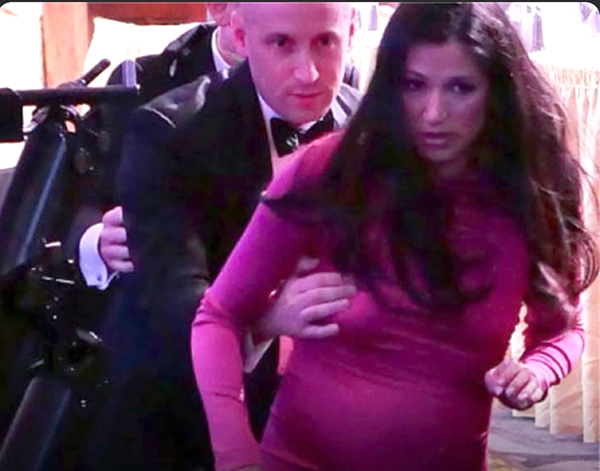
Again social media exploded. Was this Miller using his pregnant wife as a human shield? Was he trying to escort her to safety? Others commented on the location of his right hand. Hopefully the whole situation will be somewhat more clear in a few days. (V)
Trump Can't Figure Out What to Do Except Bluster
Donald Trump is at an impasse. He doesn't know what to do about Iran and he is stuck. He probably dimly senses that he has to get some serious concession from Iran in order to avoid giving the Democrats a potent talking point in the midterms. He probably also dimly senses that Iran has little to no interest in giving him anything unless it gets much more in return. Iran also realizes that time is on its side now that all the ships that passed through the Strait of Hormuz since February have already docked and unloaded and there are no more ships from the Persian Gulf underway. It is fully prepared to wait Trump out.
So what has Trump done? He first told his A team (J.D. Vance) not to go to Pakistan to negotiate a deal. Then he told his B team (real estate buddy Steve Witkoff and first son-in-law Jared Kushner) not to go either. Instead, Trump went on Fox and said: "If they want to talk, they can come to us. You know, there is a telephone." We don't know if Fox is available in Iran. We suspect not. He should have put up a bleat on his the-art-of-no-deal negotiating site. Maybe the ayatollahs follow that closely. In any event, Trump is now waiting for Iran to make a move.
Suppose it doesn't? Then what? Oil prices will go up, the stock market might go down, and still no call. Iran has
Trump over a barrel oil drum. He could restart the bombing, but Iran has shown a massive pain threshold and is
unlikely to budge no matter how severe the bombing is. Besides, the U.S. is running out of bombs, and pressure on Trump to
do something will only grow.
What Trump might try to do is get Iran to agree to open the Strait of Hormuz but allow them to put a toll on every ship passing through. Iran might agree to that, knowing that it can use the revenue to prop up the regime and also buy weapons from China. It would be hard to sell that to the American people, though, since the results of the war would be: (1) 13 dead American soldiers, (2) a new revenue stream for Iran, (3) higher oil prices worldwide, and (4) Iran continues enriching uranium. There would be no way America would be better off under that deal than it was before the attack. Democrats will have a field day with that.
Meanwhile, Iran is not standing still. It sent its foreign minister, Abbas Araghchi, to Russia for talks with Vladimir Putin. Araghchi may ask for money, food, weapons, and other help, and may well get it. The U.S. has blockaded Iranian ports, stopping shipments of food and other supplies. Russia could send supplies to Iran over the Caspian Sea, which borders both countries, or via land through Azerbaijan. (V)
Trump Has Four Deadlines Coming Up
In addition to Iran, Donald Trump is about to get four more things on his plate in the next month:
- FISA: The Foreign Intelligence Surveillance Act (FISA) allows the U.S. government to spy
on foreigners without a warrant. The Act is about to expire and the spooks want it renewed. Conservatives (!) in the
House want guarantees in the renewal that the government will not spy on Americans without a warrant, something
guaranteed by the Fourth Amendment. The administration has no problem at all with spying on Americans, but if House
conservatives refuse to budge, Trump will have a problem on his hands.
- DHS Goes Broke: Most of the government is funded, but still not DHS. Secretary Markwayne
Mullin said the money to pay employees in May is not there. This means many people will be sent home, some will quit,
and DHS will function even worse than it does now. Democrats are refusing to fund DHS unless certain guarantees are given
regarding ICE and CBP, and Trump refuses to give them. Something has to give.
- Closing the Oil Wells: One thing the American blockade of Iranian ports has accomplished
is reducing Iran's ability to export its oil. Starting now, all oil produced will have to go into storage in Iran. In
about a month Iran will run out of storage capacity and will have to shut down production. Restarting it will be
difficult and in some cases impossible, possibly permanently reducing world oil production—which means permanently
increasing oil prices and the price of everything made from oil, from plastic to fertilizer. Does Trump really want
that, when the midterms are going to be about affordability?
- Reconciliation Bill: Trump wants a reconciliation bill on his desk by June 1. If it is purely a bill to fund DHS and nothing else, he could probably get it. But he wants a number of other items in it, including the SAVE America Act (see below). Other members of Congress want other items in it. It could be a big battle and may extend into June or beyond.
Each of these issues demands attention from the President. It seems Trump isn't even able to deal with one crisis (the war in Iran) and soon he may be expected to manage five or more of them. It will be interesting, to say the least, to see how he deals with all of them at once. (V)
Four Republican Senators Block the SAVE America Act
Donald Trump very much wants the SAVE America Act, which would make it very difficult for 20 million eligible voters who lack proper ID to actually vote and would put barriers up for other voters as well. It would also restrict absentee voting and cause problems for married women whose current name is not the one on their birth certificate. Trump believes the Act would hurt Democrats more than it hurts Republicans, but that is not certain. For example, with gas over $4/gal., rural Trump voters who have to drive many miles to get to a polling place, rather than voting by mail, might decide to skip voting to avoid the expense. But Trump doesn't let go of ideas easily. It's easy to understand why—he has so few of them.
Now he wants the Senate to abolish the filibuster to get the Act through that chamber. He renewed that call on Saturday. However, Senate Majority Leader John Thune (R-SD) does not want to abolish the filibuster (because he has been around long enough to know that someday, Democrats will have the trifecta again). He also does not want to force the Democrats to actually stand there and read plays about King Lear, King Richard II, King Henry VI, and other mad kings. Washington has already had its fill of mad kings this year. Thune's nominal argument is that a talking filibuster would paralyze the Senate for months. In reality, he doesn't have a long legislative list teed up and is just worried about what the Democrats might do if they get the trifecta in 2029 and the filibuster is but a distant memory. Republicans don't mind the filibuster at all, because the only thing they really want to do is cut taxes and they can do that using the budget reconciliation process. In contrast, the Democrats have a long wish list of legislation about democracy, health care, abortion and much more, so the filibuster is a huge barrier for them.
On the other hand, killing the filibuster would still require a majority in the Senate. Republicans do have 53 seats, but it is not clear there are 51 votes for the bill, and thus for a rule change on the filibuster. If four Republicans are not on board, it will fail. Last week, Sen. John Kennedy (R-LA) sponsored an amendment to add the core elements of the SAVE America Act to the budget reconciliation bill Republicans are concocting. Four Republican senators voted against the amendment and it failed. They were Sens. Susan Collins (R-ME), Mitch McConnell (R-KY), Lisa Murkowski (R-AK) and Thom Tillis (R-NC). All of them had their own reasons, but the votes weren't there for the amendment and probably wouldn't be there for a stand-alone bill or the filibuster rule change. Collins is in a very tight election in a blue state and has to worry about the vote being the end of her career. McConnell knows the Senate rules backwards and forwards and knows election procedures are not allowed in reconciliation bills. Murkowski represents a large, far-flung state where many people need to vote absentee because getting to the polls is so difficult. Tillis probably wants his legacy to be that at least at the end, he supported good government and democracy.
Although Trump will probably continue to bellow for a while, it looks like the SAVE America Act is dead for the time being. (V)
Three-quarters of Voters Blame Trump for Gas Prices
We doubt that the OED will choose "affordability" as the word of the year, but in the political world, affordability certainly is worthy of the honor. The midterms may well hinge on which party does a better job of convincing the voters that it can handle prices better than the other party.
For many voters, the key to affordability is the price of gas, which currently averages $4.07/gal. nationally. The voters don't like that one bit. And a new Reuters/Ipsos poll puts the blame for high gas prices squarely in Donald Trump's lap:
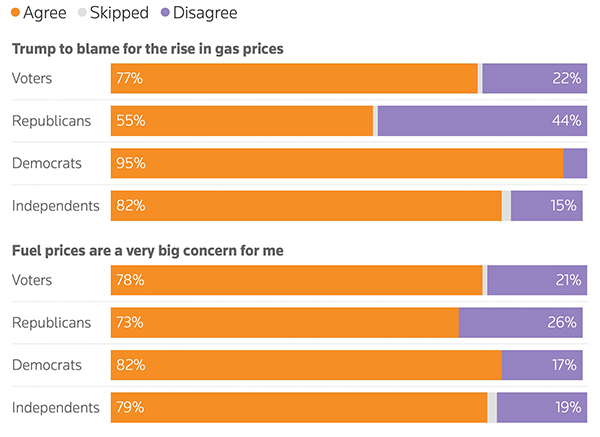
A full 77% of registered voters put the blame on Donald Trump on account of his decision to go to war with Iran. Not surprisingly, 95% of Democrats blame Trump, but also 82% of independents and even 55% of Republicans. Also important is that 78% of voters say gas prices are a big concern. Fewer Republicans say it is a concern than Democrats, but that could be their way of getting Trump off the hook rather than actually being less interested.
In addition, the poll showed that 58% of the voters, including two-thirds of independents, do not want to support a candidate who supports Trump's approach to handling Iran. And the longer the war goes on, the higher this number will be. (V)
Republicans Are Deeper Underwater than Democrats
It is no secret that the Democratic brand is in rough shape. Many people, including many independents, and even some Democrats, see the Party as "weak and woke," although recent fights such as the redistricting battle in Virginia are beginning to chip away at the "weak" part. A recent Verasight poll has the Democrats underwater with 45% favorable and 48% unfavorable, for a net -3. Not great.
But at the moment, the Republicans are even worse. They are at 39% favorable and 55% unfavorable, for a net -16. Also, the Republicans' "very unfavorable" number is 42% vs. 30% for the Democrats. That's even worse, and for House elections, the party brand usually matters more than the individual candidates. Here is the breakdown:
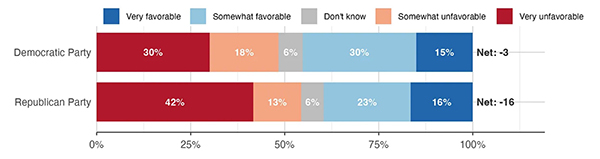
On the positive side for the Democrats, they are almost breaking even, whereas Republicans are deeply underwater. And more people truly detest the Republicans than the Democrats. Many elections require voters to choose the lesser of two evils, and in that context, being the lesser of two evils is a good thing.
Also important is the breakdown by partisanship. Democrats like the Democrats and hate the Republicans and vice versa. But what about independents? Democrats are a net -9 with independents and Republicans are net -30 with independents. A vote for your candidate while the voter is holding his or her nose is a still a vote. The poll also broke down how the voters unhappy with the Democrats are planning to vote—or not:
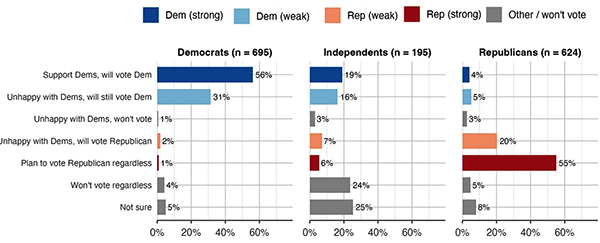
As expected, Democrats, even unhappy ones, will vote for the Democrats. Republicans will vote for Republicans. More interesting is that among independents unhappy with the "weak and woke" Democrats, more (16%) will nose hold and vote blue than vote red. In short, the Democrats have more soft support than the Republicans—that is, they are the lesser of two evils.
The poll also asked about attributes of the parties. Here are some of the results.
- Tolerant of different types of people (D+26)
- Respects the country's democratic institutions and traditions (D+16)
- Cares about people like you (D+14)
- Governs in an honest and ethical way (D+12)
- Looks out for the middle class (D+11)
- Willing to fight for what it believes in (R+4)
- Gets things done (R+7)
- Has strong leadership (R+11)
In short, Democrats score high on tolerance; Republicans score high on strength. Interestingly, many of the people who think the Democrats are weak and the Republicans are strong are actual Democrats (as well as many Republicans, of course).
Another result that came out of the poll is that people across the spectrum don't know what the Democrats stand for. They really need something like Newt Gingrich's "Contract with America." It was a simple list but showed what the Republican Party stood for. The Democrats really need something like that. The problem is that they don't agree on what they stand for. Reps. Alexandria Ocasio-Cortez (D-NY) and Jared Golden (D-ME) don't actually agree on a lot. That's the problem. It is hard to sell a product if you don't know what the product is. (V)
Trump's Next Move to Control the Media
Authoritarians and would-be authoritarians, like Donald Trump, understand that control of the media is essential to maintaining power. Having newspapers, radio and television stations, and other media sources constantly showing that the administration is corrupt and self-dealing can set the population against the administration. This must be prevented at all costs.
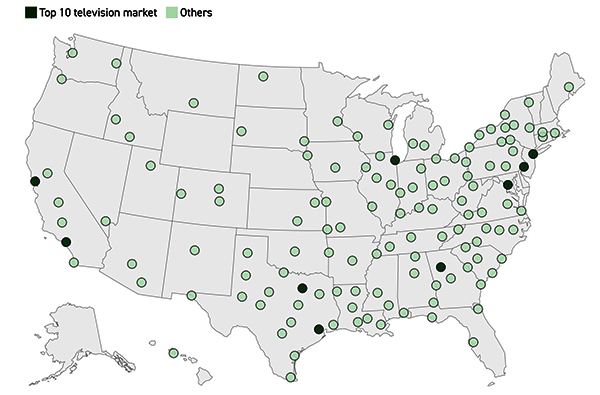
Trump's point man on this is FCC Chair Brendan Carr, who is doing his best to change the rules to make the media more Trump-friendly. One of the things Carr understands very well is that the major TV landscape has two kinds of players. There are the networks, like ABC, CBS, NBC, CNN, Fox, and a few others. And then there are the individual television stations. The networks, by law, don't actually own many television stations. ABC, for example, owns only eight stations, and two of them are in small markets (WTVD in Raleigh-Durham and KFSN in Fresno). Trump perceives the networks, with the exception of Fox, as very liberal and the stations as conservative. To some extent, that is true. There are about 1,500 full-power television stations in the U.S. The biggest owner of stations is Nexstar, with 259 stations. It is quite conservative. Sinclair is second, with 183 stations. It is exceedingly conservative. Gray Television is third with 113. Tegna has 64 and Hearst has 33. Here is a map showing where Nexstar's (current) stations are located:
Nexstar is trying to buy Tegna for $6.2 billion, but last week a federal judge temporarily blocked the sale until antitrust issues can be resolved. Carr strongly supports the sale. Normally, when the #1 player in an important industry wants to buy #4, the answer is "no," but given the conservative bent of Nexstar, Trump and Carr will do their best to make the deal happen.
Why does station ownership matter? Most stations have a contract with one of the networks that provide it with content. For example, WJLA in D.C. is owned by Sinclair but has a contract with ABC to provide content. Sinclair also owns KUTV in Salt Lake City, which gets its content from CBS. And it owns WTGS in Savannah, which is a Fox affiliate. Big companies that own many stations often have contracts with different networks for different stations.
All contracts allow stations to preempt the network feed a certain number of hours a week for local content. Sinclair is very aggressive about preempting network content for local (and very conservative) content. Sinclair often sends centrally produced (conservative) content to its stations with a "must run" order.
What Carr wants to do is change the balance of power between the networks and station owners to give the station owners, like Nexstar and Sinclair, more power because he knows they will then preempt "liberal" content for "conservative" content. For example, a local station could decide to not run a network special about climate change and replace it with a "documentary" about heinous crimes committed by undocumented immigrants. One of the things high on Carr's list is to allow conservative companies to merge, to make them bigger and more powerful and reach every household. Another of his pet projects is to change the rules so that local stations can preempt more network content and replace it with "local" content (which includes content generated at Sinclair's headquarters) with no penalties, even if it exceeds the amount stated in the contract. Carr also has other plans, all with the goal of increasing the power of the station owners at the expense of the national networks. Of course, even if a Fox affiliate gets more power to replace Fox content with its own content, it doesn't have to do that. It could run Fox content 24/7 if it wants to.
Carr has also directly interfered with content. In Sept. 2025, ABC host Jimmy Kimmel said some things Carr did not like, so Carr ordered the ABC affiliates to pull Kimmel, which they did. Eventually, public pressure caused them to relent and put Kimmel back on the air. Next time, a station could decide that the potential loss of its broadcast license is more important than loss of the ad revenue from some show Carr wants banned.
None of this is what the FCC was designed to do. When all television was over-the-air, some authority was needed to allocate spectrum to specific station owners and prevent chaos in broadcasting. Carr has completely perverted this to use his power to help favored parties in the broadcast world and punish disfavored parties. He has no intention at all of just being a neutral referee. (V)
House Majority PAC Reserves $272 Million for Democratic Ads
The biggest PAC trying to elect Democrats to the House, the House Majority PAC (HMP), has reserved ad time worth $272 million, its largest reservation in history. About 80% of the money is going into districts which have (or had) a Republican representative, meaning the PAC is planning more offense than defense. Legally, the HMP may not coordinate with the Democratic Party, but it isn't much of a secret which red House districts are the lowest-hanging fruit. There are 59 districts represented by a Republican that are bluer than R+8 and many of these, especially the open ones, would be potentially competitive in a blue wave.
Since Republicans also know which districts are vulnerable, the HMP didn't give away the farm when it announced some of its priorities. The targets include the districts of:
- Reps. Elvira Salazar, Carlos Gimenez, Anna Paulina Luna, Laurel Lee, and Cory Mills in Florida
- Reps. Brian Fitzpatrick, Scott Perry, and Rob Bresnahan in Pennsylvania
- Potentially dummymandered new districts in South Texas with large Latino populations
- Reps. Zach Nunn and Marianette Miller-Meeks in Iowa
- Reps. David Schweikert and Eli Crane in Arizona
- Rep. Gabe Evans in Colorado
The PAC is playing defense in the districts of Reps. Jared Golden (D-ME) and Don Davis (D-NC). More districts may come into play later this year due to the voters choosing weak candidates in some districts, or to unexpected vacancies. (V)
The Battle of New York
The Democrats have periodic "Bernie vs. Hillary" battles (e.g., in the Maine Senate race), but the Republicans have plenty of intramural battles as well. Consider, for example, NY-21, a massive district covering most of the state north of Amsterdam and Rome, and larger than New Jersey and Connecticut combined. It is R+10 and currently represented by the retiring Rep. Elise Stefanik (R).
The battle over her successor is very heated. Donald Trump has endorsed the CEO of Sticker Mule, Anthony Constantino, because he is a real fighter, as you can see from this photo from his campaign website. He is the one in the middle:

Constantino has also been endorsed by Rudy Giuliani and Roger Stone. Most of his campaign promises are generic Republican promises (eliminate waste in government, bring down prices, protect the Second Amendment, etc.), but he has a few special ones, including "permanently secure the northern border," and "inspire people to live here again." The latter one kind of implies people don't like living in this district and are leaving in droves. We wonder why.
New York Republican officials want Constantino to drop out and go back to the gym. Even though the district is R+10, they are worried that in a blue wave, it could get swamped. Even the chair of the New York Conservative Party, Jerry Kassar, said of Trump: "We just simply feel that on this one he got it wrong." This gives you an idea of how bad Constantino is, when party officials and conservatives are worried about a rural R+10 district. They support Assemblyman Robert Smullen, a retired Marine Corps colonel Constantino has called a coward, even though he (Smullen) fought in Afghanistan. In Constantino's eyes, Smullen has not been sufficiently Trumpy, which makes him a coward.
The Democrats are running a local dairy farmer, Blake Gendebien. Normally, a Democrat doesn't have much of a chance in the North Country, but with a bitter fight between a Trump-Giuliani-Stone-endorsed candidate on one side, and virtually the entire state Republican establishment on the other, Constantino could possibly come out victorious and badly damaged, making a Democratic flip in November possible. (V)
Buyers of $TRUMP Coin Got Hosed
On Jan. 17, 2025, Donald Trump launched the $TRUMP crypto coin. He kept $800 million for himself and his buddies and put the other $200 million worth up for sale. People couldn't wait to get one or two or a whole bunch. The high point in the first 24 hours was $73.00, but still an obvious bargain since owning $TRUMP coins was sure to make you a millionaire, fast.
On Saturday, the 297 largest holders of $TRUMP coins got a special reward: They were invited to visit Mar-a-Lago. The top 29 even got a special VIP reception to meet Donald Trump personally. The people who bought the coin on Day 1 directly from Trump were putting money directly in Trump's pocket. The people who bought it from them on the secondary market were not.
Trump spoke to the cryptocrowd and said "Crypto is a big industry." That is true. It is even bigger than the Nigerian Prince industry. Initially, Trump was skeptical of crypto, but later he got involved himself and came to embrace it.
So, how have the early buyers of the $TRUMP coin fared? About what you might have expected. They were totally fleeced. Here is the price of the coin since its creation:
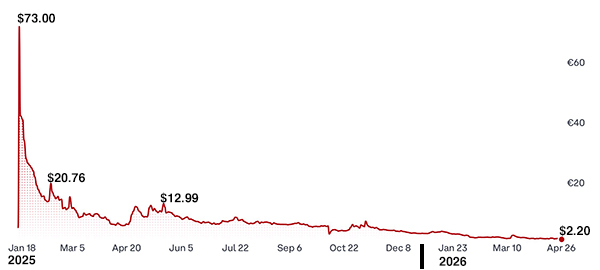
The coin has dropped from its
high
of $73.00 to Friday's close of $2.20, a loss of 97% of its value since the top. If you bought $10,000 of $TRUMP at its
high point, your "investment" would now be worth $300. Congratulations on your investment prowess. Maybe you are the
next Warren Buffet. The performance of the $TRUMP coin is even
worse
than the deal the buyers of DJT stock got from its high point. It lost a mere 90.2% of its value. Trump stock and Trump
crypto are enormously profitable, but unfortunately only for Trump and his buddies who get it for free. For the
rubes investors, not so much. But if you bought some way back when, you can be proud of helping Trump get $1
billion richer by fleecing his supporters.
However, there is one thing we don't know. Has Trump already dumped most of his stash of $TRUMP coins? Maybe he has and that is why the price is now so low—a massive supply of product out there. On the other hand, maybe he was too busy to pay attention or was waiting for the price to go up. If the latter is the case and he still has most of the coins, then he took as much of a haircut as his fans. (V)
Previous | Next
Main page for smartphones