Previous | Next | Senate races | Menu
New polls:
Dem pickups: (None)
GOP pickups: (None)
Congratulations to the Carolina Hurricanes!
There Are Elections in Three States Tomorrow
Oklahoma has a primary tomorrow and Alabama and Georgia have runoffs. Let's take a look:
- Oklahoma: When Markwayne Mullin resigned from the Senate to become Secretary of Homeland
Security, Gov. Kevin Stitt (R-OK) appointed Alan Armstrong to the Senate. However, Armstrong's Senate career will be
short because Oklahoma law prohibits appointed senators from running for a full term. In principle, there should be a
wide-open battle for the Republican nomination. However, when Rep. Kevin Hern (R-OK), a multimillionaire McDonald's
franchisee, jumped in, the entire Republican establishment fell in line and no other serious candidate filed, so Hern
will get the nomination. Five Democrats filed but all are low-profile and none have a snowball's chance in Hell to win
the general election.
Stitt himself is term limited, so the race for governor drew more attention than the race for senator, with nine Republicans on the ballot. AG Gentner Drummond (R) got in early. Then former Oklahoma House Speaker Charles McCall (R), and former state Sens. Mike Mazzei and Jake Merrick (both R) got in. Then the son of former governor Frank Keating, Chip Keating (R), joined the pack. A couple of local businesspeople are also running. Recent polling has Drummond and Mazzei leading, with Keating not far behind. A runoff on Aug. 25 is virtually certain. Three Democrats have filed, for some unknown reason.
Hern's open R+11 district, covering Tulsa and its suburbs, attracted 11 Republicans who got on the ballot. State Rep. Mark Tedford is probably the best known of those, and the only current elected politician running. Former majority leader of the Oklahoma Senate Kim David (R) is also in. Pastor Jackson Lahmeyer (R) is running, too. His claim to fame is that during the COVID epidemic, when churches were ordered to close to save lives, Lahmeyer proudly refused. He also founded Pastors for Trump. His church's website boldly states: "We believe the Bible is the inspired, infallible, incorruptible and authoritative Word of God." His top campaign issue is securing the border. Which one? Oklahoma borders Colorado, New Mexico, Texas, Arkansas, and Missouri. It is not especially close to any foreign countries. Rudy Giuliani has endorsed Lahmeyer. Is Rudy still alive? If so, has he nothing better to do than get involved in an Oklahoma House race? Rep. Anna Paulina Luna (R-FL) also endorsed Lahmeyer. There haven't been any public polls, but Tedford, David and Lahmeyer are all plausible winners.
- Alabama: Sen. Tommy Tuberville (R-AL) is running for governor of Alabama, leaving behind an open Senate seat.
Rep. Barry Moore (R-AL) wants that seat and is facing off against businessman Jared Hudson for the Republican Senate nomination. Moore is somewhat
ahead in the polling. Whoever wins the GOP primary will win the seat, assuming no dealbreaker sexual dalliances come to
light. Two Black Democrats, Everett Wess and Dakarai Larriett, are duking it out for the opportunity to be crushed in
November. The gubernatorial race is already set: Tuberville vs. Doug Jones (D).
- Georgia: The big one here is the Senate nomination race between Rep. Mike Collins (R-GA)
and Derek Dooley (R), a football coach who hasn't lived in Georgia for decades. Donald Trump just endorsed Collins. Gov.
Brian Kemp (R-GA) has endorsed Dooley. If Collins wins, Trump will lord it over Kemp that his guy won and Kemp's guy
lost.
Of course, Trump waited until the very end to endorse, so he had a pretty good idea of who would win the runoff and then "cleverly" backed the winning horse. For the Democrats, a Collins win would be good news because Collins is an extreme right-winger who might be too much to stomach for normie Republicans. Then they might either stay home in November or even vote for Sen. Jon Ossoff (D-GA), who was unopposed on his side of the primary.
Former Atlanta Mayor Keisha Lance Bottoms (D) won her gubernatorial primary outright. The Republican runoff will be between Lt. Gov. Burt Jones and wealthy healthcare executive Rick Jackson, who is trying to buy the governorship. Recent polls put Jackson slightly ahead. He would be a much easier target for Bottoms, as healthcare executives rank only slightly above used car dealers in the public esteem.
For Democrats, a Collins win for the Senate and a Jackson win for governor would put two major offices in play. In a blue wave, Democrats could win both of them. Dooley and Jones would be the preferred combination for Republicans. (V)
Sort-of-Peace Is Sort-of-Closer in Iran
Once again, Donald Trump is saying that the war in Iran is nearly over. He has said this dozens of times already, but this one feels different. He is desperate to get the war over because gas prices may kill the Republicans in November. He is looking for a way to get it over, even if he has to surrender (provided he can avoid calling it that). Iran holds all the cards and he is gradually becoming aware of that.
The U.S. and Iran are apparently working on a memorandum of understanding, which is more of a start to the peace process than the end of it. Reports of what is in it are sketchy, but Reuters is reporting that it will contain the following items:
- The Strait of Hormuz will be reopened immediately and no tolls will be levied.
- All U.S. and U.N. sanctions on Iran will be lifted.
- The U.S. will release $25 billion in frozen Iranian assets and allow Iran to sell its oil worldwide.
- Iran will promise not to produce nuclear weapons or enrich any more uranium.
From the U.S.' point of view, spending $30 billion and having 14 American soldiers and countless Iranians and others die gets us back to the status quo ante. The Strait will be open again, just as it was before the U.S. and Israel attacked Iran. Only Iran now knows it can close the Strait anytime it wants to in the future and eventually the other guys will cave.
From Iran's point of view, the country suffered some damage to its infrastructure, but with $25 billion flowing in, Chinese companies can be hired to repair it. The hated sanctions are now gone and Iran can sell all the oil it can produce wherever it wants to. The nuclear program can continue as long as it is done under the radar (both literally and metaphorically). Even if the U.S. discovers the violation, what is Trump going to do about it? Start another war? Very unlikely. Bleat? Probably.
Also remember, an MoU is not a final treaty ratified by the Senate and by Iran. It is just the start of discussions, really. There could be many stumbling blocks along the way.
One of Trump's many goals in Iran was regime change. He got it, but not quite the way he envisioned it. He replaced the authoritative and highly respected (but feeble) Ayatollah Ali Khamenei with his inexperienced son, Mojtaba Khamenei, who is going to be a pushover for the Islamic Revolutionary Guard Corps. In effect, Trump replaced a brutal theocracy with an equally, if not more brutal, military junta that can now dictate military, economic, and diplomatic policy. This does not benefit the U.S. in any conceivable way.
Democrats are already criticizing the deal. Sen. Jack Reed (D-RI), the ranking member of the Senate Armed Services Committee, went on Fox yesterday to say that the proposed deal gets less from Iran than the deal Barack Obama made and Trump killed. Reed called it Trump's birthday present to himself. Rep. Seth Moulton (D-MA), who is on the House Armed Services Committee, called the deal "basically a surrender document." When the deal is finally released, there will be massive criticism from both sides of the aisle, especially if the Reuters report proves to be essentially correct and Iran won many important concessions and the U.S. didn't get anything it didn't have before spending tens of billions of dollars and costing many people their lives.
Nevertheless, there is one good thing that came out of the war, although it is long term. Many countries now know how dependent they are on oil from the Gulf and how easily it can be blocked. This means there is likely to be a huge push to rev up alternative energy sources, especially solar, wind, hydro, and nuclear. This will occur at both the governmental level and the individual level. Governments will initiate or boost programs to reduce oil usage and individuals who can will install solar panels so they can fuel their new electric cars for free. It would be ironic if history books in 100 years remembered Donald Trump as the man who started the revolution that saved the planet from cooking. (V)
Trump Is Fighting Father Time, and Father Time Is Winning
Donald Trump turned 80 yesterday. He understands that this is much too old for the toughest job in the world. He also knows that Joe Biden was 81 during his 2024 campaign and he mocked Biden for being really old. Not that much aging happens between 80 and 81. Trump even accidentally said he doesn't want people to wish him a happy birthday, because he is not happy about being 80.
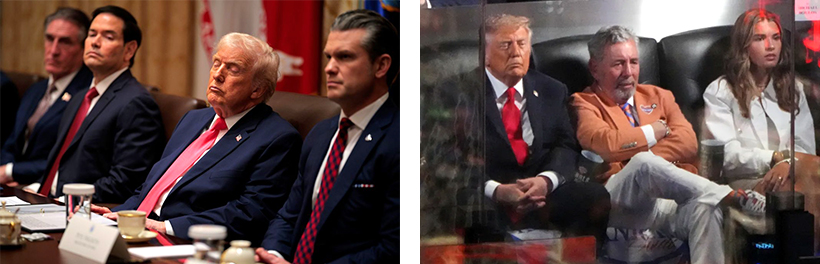
Trump's modus operandi is imposing his own reality on the world, but this time it is not working so well. A Reuters/Ipsos poll taken in February shows that 60% of the country think Trump has become erratic. He falls asleep at cabinet meetings (which are boring), discussions with administration officials about coal (which are boring) and Knicks games (which are definitely not boring). The photo on the left below is at a cabinet meeting. The one on the right is at the only finals game the Knicks lost:
Questions about Trump's health are always batted away with some nonsense about how he is the healthiest president ever. His official physician said that Trump's heart is like that of a 66-year-old, not an 80-year-old—despite Trump's never exercising and having a poor diet.
Trump decided to celebrate his birthday by staging a UFC fight on the White House lawn, where previous presidents had an Easter egg roll for kids. The late Sen. John McCain called UFC "barbaric" and sent letters to all 50 state governors asking them to ban "human cockfighting." The violent UFC event was designed to show how strong and masculine other people are, with the hopes voters will assume Trump is like the fighters. In particular, Trump is trying to win back young, working-class men to the Republican Party with the modern-day equivalent of Roman gladiators... well, gladiating before roaring crowds. The whole thing is a circus, one trading off the presidency. Secretary of State Marco Rubio has likened the rise of UFC to putting a man on the moon. He really wants Trump's endorsement in 2028.
Trump being Trump, the financial aspects of the event are important. The staged event cost over $60 million and was an enormous production with 700 subcontractors that took weeks to set up, including bringing in 500 porta-potties for the 4,000 visitors on the lawn and 100,000 visitors who watched on giant screens on the Ellipse. The publicity UFC and its ruler (and Trump buddy), Dana White, will get from this event is priceless. The UFC fighters will be paid in Trump crypto, giving the fake currency an air of being valuable, which will help Trump sell more of it. It is commercialization of the presidency gone bananas.
But there is
more,
as usual. There are sponsors paying undisclosed sums to have their names shown with the White House as backdrop. These
include Chevron, Exxon, MasterCard and Budweiser. Tickets for ringside seats will cost a pretty penny nickel.
Trump purchased tens of thousands of dollars in stock of UFC's parent company this spring, in hopes the event will give
it a big boost. Saturday evening, there was a $1 million/plate fundraiser. The event will be broadcast on Paramount+,
which is run by Trump's cronies, the Ellisons. UFC and Paramount are working on a $7.7 billion
deal
that would result in UFC events being carried exclusively on Paramount+, a big win for both White and the Ellisons. In
this light, White spending $60 million to stage the UFC event is small potatoes. It is always about the money.
The UFC event did happen, though it was delayed by rain, and the matches were largely underwhelming (two matches ended in the first round, four ended in the second, one—the headliner, and unquestionably the best fight of the night—made it to the fourth). Nominally, this event is about America's 250th birthday, but that will be on July 4, 2026. Yesterday was not a celebration of America, but a celebration of, by, and for Donald J. Trump. We stand by our view that it won't benefit him much politically, if at all. (V)
Cornyn: Trump's Final 2 Years as President Will Be Miserable
Soon-not-to-be-a Sen. John Cornyn (R-TX) gave his first interview after losing his primary to Ken Paxton. In it, he predicted that the next two years will be the most miserable of Donald Trump's 80 years on earth.
In particular, he was implicitly suggesting that the Democrats will win the House (and maybe the Senate) and impeach Trump for the third time. He also said a Democratic Congress would make it impossible to get any of Trump's agenda through Congress, including, of course, his budget. And the problems will not start in Jan. 2027, according to Cornyn. He said: "I think it is going to be a pretty bumpy ride for the next 7 months." We are a little less sure of that than Cornyn because Cornyn and the rest of the Gang of Four have been very hesitant to take on Trump, even with nothing at stake anymore. Nevertheless, he did mention that "Well, we've some cards to play."
One of the areas where Cornyn suggested it could get bumpy is the sweetheart deal Trump made with the IRS not to prosecute him or his family for violating tax law. The Senator didn't specify how or when he might play that card though.
After Trump endorsed Paxton, Trump bleated that Cornyn will "remain my friend for a long time to come." Cornyn said: "If that's the way friends treat you, you wonder about his enemies." Actually, you don't have to wonder at all what Trump does to his enemies. He sics the DoJ on them and has them indicted on bogus charges. He has done this a number of times already.
Cornyn seems resigned to his future as a non-senator. He said: "I've always said that former senators look happier, healthier and they're certainly more prosperous. So, I'm kind of, like, looking forward to what comes next." Cornyn is respected by his colleagues in the Senate, so he could possibly have a prosperous future as a lobbyist for Texas oil companies. (V)
Poll: Trump's Support with Working-Class Independents Is Cratering
A new analysis of AP/NORC polls since July 2024 has some ominous news for Donald Trump. By looking at polls over time, a clear trend can be established. Probably the biggest takeaway is the drop of support for Trump among independents, especially young Black and Latino independents, primarily among working-class voters.
About 43% of independents voted for Trump in 2024, up from 37% in 2020. Here is a bar graph showing support for Trump by partisanship in five periods since the 2024 election.
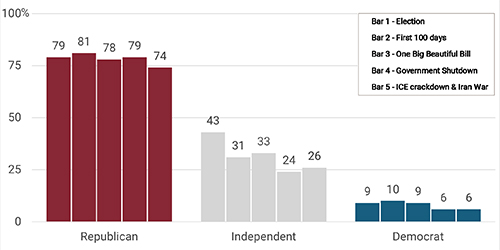
As you can see, support for Trump among Republicans and Democrats has not changed a lot, but support among independents has taken a big hit. Since independents are now the biggest group in many states, losing them is going to hurt.
The issue that is driving the independents away from Trump is prices, especially food and gas. Many independents, especially working-class independents, voted for Trump because he promised to lower prices. They see that: (1) he has not lowered prices and (2) he seems to be mostly busy with foreign affairs and isn't even trying to lower prices. This souring of the independents is going to be bad news for the Republicans in November. (V)
Texas Republicans: Talarico Is Not a Real Man
How are super PACs that support the adulterous, criminal and impeached Ken Paxton going to campaign against seminarian James Talarico in the Texas U.S. Senate race? We are starting to get an idea. One group has already made an AI ad that many people consider shocking and disgusting. Here it is.
To get an idea of where we are going, we do recommend watching it. The first 28 seconds are two reporters from The Hill talking about the ad. You can watch them or skip to the 0:28 mark to see the ad. The ad itself is only 15 seconds. If you can't spare 43 seconds, it shows Talarico in a dress singing about transgender children. Here is the text:
Boys in white dresses with blue satin sashes
Girls dosed with hormones til they grow mustaches
Changing the gender of all your offspring
These are a few of my favorite things
In the ad above, there is a red banner showing that the ad is AI generated, but The Hill put that banner in. The actual ad does not have any such banner.
Sarah Longwell of The Bulwark, who runs focus groups and talks to voters all the time, says older voters who don't know much about AI will believe it is real and be appalled. Many Democrats and independents think AI-generated totally fake ads should either be banned or required to have a big banner on top saying that the ad is AI-generated and completely fake.
Democrats don't quite know how to respond to the ad. Longwell's colleague, Tim Miller, said a possible response is either to mock Paxton South Park-style or make an ultra realistic "hidden camera" AI ad where Paxton is bragging to a friend about his dozens of extramarital conquests and how he believes marital fidelity is for suckers. Actually, what we would advise is for the Democrats to make the exact same ad, mimicking it as closely as possible, except with Paxton in the dress and singing the song. That would do a pretty good job of showing that anyone can make any ad with any content, and that it's often not real. In any event, only when Republicans come to realize that not only can Democrats play the same game, but are fully prepared to do so, might there be a truce.
At the same time, Maine Republicans are going to attack Graham Platner for being a tough guy who isn't sweet and kind to his girlfriends. So Talarico isn't enough of a man and Platner is too much of a man. The Supreme Court may soon rule on "What is a woman?" (that is, who can play on women's sports teams). A number of campaigns may be about "What is a man?" We expect this year's campaigns to be exceptionally brutal because so much is at stake.
But while the ad above may fool some older voters, there are other ways to analyze the Texas Senate election. For example, by the numbers. G. Elliott Morris takes a deep dive in Texas voting patterns and concludes, based on history, that the race depends on three parameters: the PVI of the state in November, the turnout advantage, and what percentage of Republicans vote for Talarico. The Cook PVI is based on the votes in the past two presidential elections, but Morris is concerned with the PVI in the November electorate, which could well have moved from where it was in 2020 and 2024. In simple terms, how many Democrats vote and how many Republicans vote. The second parameter is self explanatory. His results can be summarized in this graphic:
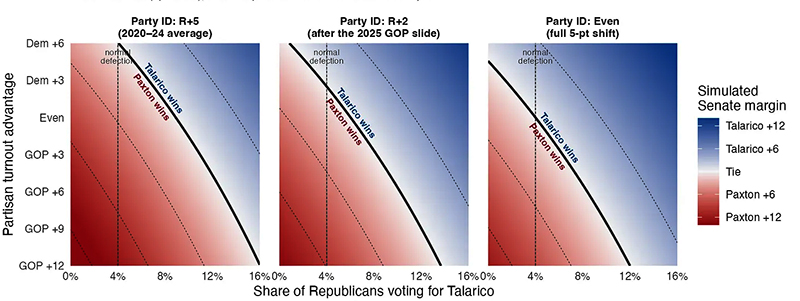
The graph on the left assumes a PVI of R+5 (the 2020-2024 average). Depending on which party is better at turnout and what percentage of Republicans vote for Talarico, you can see who wins. The other two show PVIs of R+2 and EVEN, respectively.
The bottom line is that with the expected data and turnouts, Talarico needs to win something like 8% of Republicans to win. In 2024, 4% of Republicans voted for Kamala Harris, so Talarico has to do twice as well as Harris to win. Nevertheless, 8% is not a big number and in a bad economy with voters very unhappy with the economy and looking for a way to express that, maybe 8% is achievable.
In a way, Talarico is an outlier these days. He is careful, calm, gentle, and very respectful, qualities that used to be considered desirable in politicians. Now he is being mocked for it. On the other hand, for dude-bro candidates, accusations of marital infidelity, using racial slurs, publicly brawling, picking fights, or being general-purpose a**holes seem to help them more than hurt them. Think: Sen. John Fetterman (D-PA), Spencer Pratt, Brandon "The AK Guy" Herrera, Ken Paxton, and Graham Platner. These are people straight out of the manosphere and their target is young working-class men, especially those who are infrequent voters. Whether that works depends considerably on the PVI of the state or district. In deep-blue or deep-red places, the partisan lean may be enough to carry the day, but in places that swing, it could matter whether the candidate pulls in enough disaffected young men to offset the likely loss among women. (V)
Will There Be a Backlash to the Supreme Court's Gutting the VRA?
When the Supreme Court gutted the Voting Rights Act, the news was "Democrats in dismay." After all, Southern states were falling all over each other in the race to see who could eliminate Black-majority districts the fastest. Some made it, some didn't, but the laggards will be back in 2027 to try again.
It turns out that Newton's third law (for every action, there is an equal and opposite reaction) applies not only to rockets but also to politics. Black voters are keenly aware of the decision and the decision could motivate more of them to vote this year. Former DNC chair Donna Brazile said: "It could be a game-changer across the country, especially in these marginal districts where candidates win by less than 2 percent of the vote."
The DCCC has noticed this heightened interest and is targeting 18 districts in which Black voters make up 12-33% of the voting-age population. A few are swing seats that Democrats are defending, like NC-01 (Don Davis, R+1). However, others are pickup opportunities, including MI-10 (John James, R+3), OH-10 (Mike Turner, R+3), and VA-02 (Jen Kiggans, EVEN). The DCCC believes that historical turnout among Black voters could flip these seats. Elaine Luria, who is running to unseat Kiggans, said: "This is a district where one in five or four voters are African-American." You can be sure Luria is going to run against the decision and the Supreme Court, a third of whose members are Trump appointees.
Barack Obama's pollster, Cornell Belcher, said that his polling shows 81% of likely Black voters were very motivated to vote in the midterms. He also noted that high motivation is rare this early in the cycle. In close races, a difference in motivation among some group can determine the winner.
Chairman of the Georgia Democratic Party Charlie Bailey noted that over 1 million Democrats voted in the recent primary vs. 940,000 Republicans. He said this is the largest edge Democrats have held in a primary since 1998. Bailey: "It [the decision] is pissing people off."
Some pollsters have noticed a difference between older Black voters and younger ones. The older ones remember Jim Crow and are outraged. Younger ones may not realize how things used to be and are less outraged. To deal with that, the DCCC is running this ad digitally to provide younger voters some historical background:
Nevertheless, some people, like Adrianne Shropshire, executive director of BlackPAC, think that the Democrats are focusing on white women too much and need to put more emphasis on getting Black voters motivated to vote. (V)
Alaska Officials Ban Dan Sullivan from the Senate Ballot
No, not that Dan Sullivan, the other one. A guy from Petersburg, AK, named Dan Sullivan, filed to run in the all-party Senate primary. Then, Director of the Alaska Elections Division Carol Beecher determined that he can't be on the ballot because he has made campaign contributions to the likely Democratic Senate candidate, Mary Peltola. Nothing in Alaska law says that candidates can be banned from filing to run in the all-party primary as a Republican if they have ever contributed to a Democrat or vice versa.
The non-senator Dan Sullivan is going to seek legal advice. If non-senator Dan did this on a lark, he might give up, but now that this could be a real issue, he might get help from the DSCC, ACLU or third parties. We suspect that if he starts a GoFundMe campaign to pay for legal help, money will flood in from Democrats. There is no valid reason for Beecher to ban him from the ballot. At most, she might put Sen. Dan Sullivan on the ballot as Sen. Dan Sullivan, but titles of offices are generally not allowed. She could decide to include middle initials, but how many Alaska voters know their senator's middle name (Scott)? If the other Sullivan is also Dan S. Sullivan, Beecher might include both middle names in full. If the other Sullivan seriously pursues this, he will almost certainly get on the ballot.
This brings to light an underused form of rodent reproduction: running a candidate with the same name as the target to confuse the voters (and dilute the vote). Eddie Murphy even made a movie on this general theme, "The Distinguished Gentleman." That works best when the target has a common name. For example, a search of the Maine phonebook turned up 29 people named Susan Collins. The DSCC could have found half a dozen of them who are Democrats, gotten them to change their registration to Republican, and had them all file to run for the Senate. Mike Rogers is running unopposed for the Republican Senate nomination. There are 259 people named Michael Rogers in Michigan. Imagine the fun if 20 of them filed to run as Republicans named Mike Rogers. If this becomes common, having a less common name, say, John Hickenlooper, could become a real asset. (V)
Nevada Governor's Race Could Be a Bellwether
Nevada AG Aaron Ford's (D) attempt to unseat Gov. Joe Lombardo (R-NV) could become a real test of whether Republicans in swing states can distance themselves enough from Donald Trump to win. If Lombardo hews too close to the Trump line, he will anger swingy voters. If he starts criticizing Trump, Trump will probably attack him as a RINO, which is also not good. Getting it right in a very diverse and heavily Latino state will take quite a bit of skill.
Lombardo has to deal with a nasty mix of problems. There is anger about inflation, unemployment, mass deportation programs, and the unpopular war in Iran, not to mention Trump's own low approval rating. Nevada is an interesting test case because it combines a tourism-heavy economy, a large bloc of working-class Latino voters, and many independents.
Ford, as AG, has done many things that are useful in a broader sense, but not something voters feel directly. He has sued Trump 40 times (including over tariffs), battled fentanyl being trafficked over the border, and gone after fraudulent landlords. Lombardo has attacked him for being out of state for 322 days, but Ford has said he often met with other attorneys general to plan strategy—for example, when suing Trump.
Given the foul mood of the electorate, the demographic mix of the state, and Trump's approval rating, Lombardo has one tough race ahead of him. (V)
USPS May Refuse to Deliver Ballots in States that Won't Bow Down to Trump
The U.S. Postal Service has proposed a new rule that would politicize the mail in a previously unthinkable way. It would instruct states to provide lists of eligible absentee voters so it could refuse to deliver ballots to anyone not on the lists. If a state refuses to comply, the USPS would not deliver any ballots in the state.
Where this came from we don't know. We do know that it would be consistent with an XO Donald Trump signed in March ordering the USPS not to deliver ballots in states where the governor has not complied with Trump's election orders, including a demand to turn over lists of voters to his administration. But Trump's XOs are not binding on the USPS, which is an independent agency, with that autonomy established by the Postal Reorganization Act of 1970.
The problem is not Louis DeJoy. He resigned as postmaster general on July 14, 2025, so this is not his baby. The new postmaster general is David Steiner. He was born in Alameda County, CA, graduated from LSU with a degree in accounting, got a law degree from UCLA, and worked for several law firms doing corporate law. He later worked for Waste Management and eventually became president of the company. He has been on the FedEx board of directors since 2009 and as its lead independent director since 2013. He was chosen by the USPS Board of Governors, but Donald Trump backed the choice.
Democrats are furious about the proposed rule. The USPS has no right to censor or block First-Class Mail in any way and it has even less right to intervene in elections, which the Constitution says are to be run by the states. Screening mail to see if the recipients are on some list that is likely to be riddled with omissions and mistakes is almost certainly an illegal involvement of the federal government in state affairs. Furthermore, it is inconceivable that any list of voters produced by a state would be fully accurate and up to date. It would take time to produce such a list, but people change their names due to marriage, divorce, and gender reassignment; people move; people die. Many people have the same name (see above for more on this point). Getting this right would be impossible. The rule would have the greatest impact on states that have all mail-in elections.
In a lawsuit before a federal judge in Boston, a coalition of state attorneys general argued that the rule represented impermissible federal intrusion in state elections. They also said that it would be expensive, chaotic and impossible to carry out with fewer than 150 days left before the elections.
It is clear that this proposal is in line with Trump's goal of having all elections be in-person and only on Election Day. He has opposed mail-in voting (except for himself) for years because he believes Democrats use it more than Republicans. His attempts to get Congress to codify his goals in law have failed, but bullying the USPS to follow an XO that is not binding on it is simply a new tactic to get what he wants because he can't get it through the regular order. (V)
Never Forget: Dear Mother, Good-Bye
Today, we hear from reader C.J. in Redondo Beach, CA:
About ten years ago I spearheaded an effort to rehabilitate a local World War I Memorial Park in Los Angeles and get the monument on-site restored. It is still an ongoing project, and probably will be forever—there's always stuff to do out there. Because the monument was dedicated on Flag Day in the 1920s, we always try to have an event there every June 14th.
Anyway, I have researched the people that we knew were memorialized here. All of them feel like "my" people. I cannot be sure any members of their families still honor them, but I do. Many have interesting stories and I try to highlight one or more every year during our ceremonies. Not all are from Los Angeles—in fact, many are not. Seems sorta fitting in a city full of transplants.
This year, I'm featuring George Percival Gabb (known as "Pierce" or "Percy" to his friends, depending on the source), who was born on Christmas Day 1890 in New York City. His father Fred passed away when George was a teenager. I'm not sure when Gabb and his mother Mary moved west, but she remarried and settled in Ontario, CA. Gabb did several kinds of jobs, everything from being an electrician to ranching. When the U.S. entered the war, despite being exempted from the draft, Gabb volunteered anyway.
Gabb was placed with the heavy Coast Artillery that was training at Fort Stevens, OR. A few months later his unit left for France, but he was ordered to remain at Camp Stevens as an instructor, which displeased him greatly. He wrote his mother: "It was the keenest disappointment of my life to part with the boys with whom I have been associated and whose fate I hope to share over there. I did not go into the service to be an officer, but to go to France."
While on guard duty in one of those famous Oregon rainstorms, he contracted a bad cold. That illness soon developed into pneumonia. His mother was informed of his condition by telegram and she rushed to be with him, but it was too late. He died on November 14, 1918, while she was in transit.
George seemed to have a premonition of his short life and service, since on his desk was found a poem. One verse of which follows:Dear Mother, who made my childhood sweet,
Mourn not for your son, nor cry,
In the course of time we will surely meet,
Till then, dear Mother, Good-bye.
Thank you, C.J. (Z)
Previous | Next
Main page for smartphones