| Oct. 23 |  |
| Without Rasmussen or Pulse polls |
|
|
|
| |||||||||||||||||||||||||||||


| Senate polls today: | AR CA CT IL MO NY PA WA WV |  |
 |
||
| Dem pickups: | (None) | GOP pickups: | AR CO IL IN ND WI |  |
|
 Welcome Welcome |
 FAQs FAQs |
 Donations Donations |
 Icons for bloggers Icons for bloggers |
 Previous elections Previous elections |
 Senate graph Senate graph |
 Data galore Data galore |
 Senate races Senate races |
 Hot House races Hot House races |
Governors races |
 Political websites Political websites |
 Articles and books Articles and books |
 Political humor Political humor |
 |
|
|

News from the Votemaster

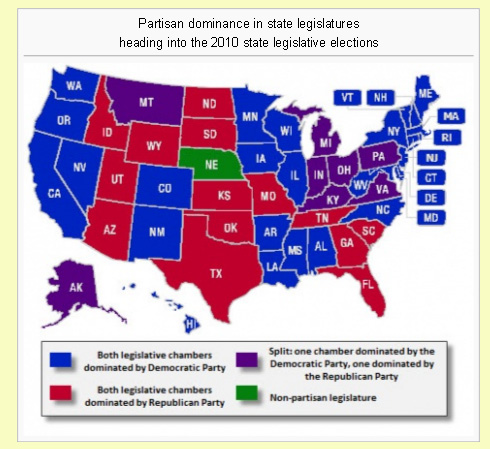
Democrats Support Tea Party Candidates PermalinkIn some key races, there is an actual Tea Party candidate on the ballot, for example, Scott Ashjian for senator in Nevada. In a few cases, Democratic operatives have helped them behind the scenes, not because they agree with them ideologically or like them personally, but simply because they may siphon votes from the Republican in the race and let the Democrat squeak through. In some cases, such as CA-45 (Mary Bono Mack's district), the support is open, but more often it takes a stealth form such as making robocalls to voters praising the Tea Party candidate and saying he or she is the only true conservative in the race. Usually the Tea Party candidate is not even aware of these calls until a supporter happens to mention it. There is nothing illegal about anyone making phone calls in support of a candidate--the parties do it constantly--but this type of tactic is something the Republicans have done far more than the Democrats in the past. State Legislatures Up for Grabs PermalinkControl of the state legislatures is extremely important this year due to the upcoming gerrymandering that will begin in January, when the new legislatures are seated. There are 4,958 (of the 5,413) state house seats up for election this year as well as 1,167 (of the 1,971) state senate seats. In most states, all of the state house seats and a fraction (commonly half) of the state senate seats are on the ballot. The only exceptions are Louisiana, Mississippi, New Jersey, and Virginia, where neither chamber has elections, and Kansas, New Mexico, and South Carolina, where only the state house has elections. Victory or defeat for individual state legislators does not have much national impact, but partisan control of the chamber certainly does (at least in states with enough congressional districts that gerrymandering is possible--after all, there is nothing to gerrymander in states with only one representative like Alaska, Delaware, and South Dakota). Of the chambers holding elections this year, Democrats currently control 23 state senates and 29 state houses. Republicans control 18 state senates and 15 state houses. The rest are tied or nonpartisan (Nebraska's unicameral legislature is officially nonpartisan but de facto Republican). On the left below is a map (from Ballotpedia) showing which party controls which state legislature.
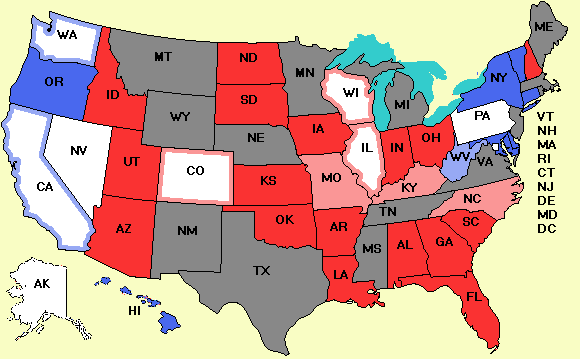
A study of the state legislatures by Tim Storey, an elections analyst for the National Conference of State Legislatures, has concluded that control of 16 chambers in 11 states might flip. These states are shown above on the right, with the color coding indicating which party is in charge now. The names in parentheses are the ones that might change control after the election. In some cases, such a change has effects for the future congressional districts; in others, it does not. Let's look at each of these in detail. In Alabama, if both chambers of the legislature flip and Robert Bentley (R) is elected governor, as expected, the Republicans will control the trifecta and can draw the congressional districts as they wish. Alabama currently has seven representatives and is likely to keep that number after the census is published. At the moment, five of these seats are occupied by Republicans and two by Democrats. The opportunities for gerrymandering are very limited here, however, because AL-02 is already R+16. Nevertheless, Rep. Bobby Bright (D-AL) is the representative. Maybe by stuffing even more Republicans in there, they could beat him, but it is a long shot. The other Democratic district is AL-07 (D+18), which is 62% black. There is no way the Republicans can take that one back. The state's Democrats have to go somewhere (Obama got 39% of the vote here) and right now they are concentrated in AL-07. Conclusion: little gerrymandering potential in Alabama even if the Republicans win all the marbles. The situation in Alaska is a bit strange with the 20-member Alaska state senate (the third smallest legislative chamber in the world, after the Isle of Man's 11-member Council and the Australian Capital Territory's 17-member body) run by a coalition of nine Democrats and six Republicans (due to a split over who should be President of the Senate). It is likely the Republicans can take control of the state senate, and Gov. Sean Parnell (R-AK), who got the job when former governor Sarah Palin became bored with it, is the favorite to win the governorship. However, the state has only one representative (a Republican) so there is nothing to gerrymander. Conclusion: no change. Colorado's state senate currently has 21 Democrats and 14 Republicans. The state house has 37 Democrats, 27 Republicans, and 1 independent. Even if both chambers flip, Denver mayor John Hickenlooper (D) is still the favorite to win the governorship over independent/Republican Tom Tancredo, with the official Republican, Dan Maes, hopelessly behind. To take over the state, the Republicans have uphill battles in both chambers of the legislature and the gubernatorial contest. Conclusion: Democrats have a chance at maintaining complete control, otherwise probably a split. Indiana's state house is currently 52-48 in favor of the Democrats. The Republicans have a good chance of picking up this chamber, which, along with a Republican senate (33 to 17) and a Republican governor, Mitch Daniels, who is not up for reelection this year, means the Republicans will probably take full control of state government and can redistrict to their hearts' content. Of the nine Indiana seats in the 111th Congress, three are Republicans, five are Democrats, and one is a Republican vacancy. A republican-controlled legislature could try to change this 4-5 split to 3-6. Making it 2-7 would be hard since there are a fair number of Democrats in the state (Obama actually beat McCain here barely). Conclusion: Republicans are likely to gain a new congressional seat here if they get good gerrymandering software and learn how to use it. Montana's state house is currently split 50-50 (literally, 50 Democrats and 50 Republicans in the 100-member chamber). The Republicans are very likely to get a majority here as well as in the state senate. Unfortunately for them, the possibilities for monkey business are limited because (1) the governor, Brian Schweitzer, is a Democrat, and (2) the state has only one representative. Conclusion: nothing changes here. Democrats control both chambers of the state legislature in New Hampshire, 225 to 175 in the house and 14 to 10 in the senate. They might lose these majorities, but Gov. John Lynch (D-NH) is a sure thing for reelection. Besides, the state has only two representatives. The way gerrymandering works is that the majority party tries to stuff all of the opposition voters into a small number of districts so the majority party wins narrowly in many districts and suffers a massive defeat in the others. With only two districts that doesn't work so well. The majority in the state legislature could put most of the Democrats downstate in NH-01 and most of the Republicans upstate in NH-02, ensuring a 1-1 split, but both sides would probably prefer two competitive districts so they have a shot at winning both. Conclusion: probably no change here. In New York, the Democrats have a huge majority in the state assembly (105 to 42) and Andrew Cuomo (D) is heading for a landslide victory, so everything rides on the state senate. There aren't enough pixels available here to describe the politics of the New York state senate, but see here if you like your politics really weird. Currently, the Democrats control the state senate 32 to 29 with one vacancy, so the Republicans are working very hard to take back the senate, which they have historically controlled. With New York slated to lose one representative in the 112th Congress, if the Democrats can hold the state senate, they can make sure the seat lost is a Republican one. If the Republicans win the senate, there will be total gridlock. Conclusion: up in the air. Everything depends on a couple of state senate seats. In North Carolina, the Democrats control the state senate 30 to 20 and the state house 68 to 52. The governor, Beverly Perdue (D-NC), is not up for reelection this year. If the Republicans can win either chamber, which is a bit of a long shot, they can at least prevent the Democrats from having free rein. Conclusion: probably the Democrats will have the trifecta here, but might lose one chamber. Ohio is always a battleground every year. The Republicans have a solid hold on the state senate (21 to 12) but the Democrats have a tenuous hold on the house (53 to 46). If they lose that chamber and former representative John Kasich (R) wins the governership, then the Republicans will have a field day redistricting the state. Ohio has 18 representatives now although it is likely to lose one next year, forcing a major change in the map. At the moment, 10 of the representatives are Democrats and 8 are Republicans, but the Republicans have an excellent chance of picking up two or three seats here, especially OH-01, OH-15, OH-16, and OH-18. A Republican-controlled trifecta could make these solidly Republican until 2021. Conclusion: Ohio offers the Republicans one of their two best shots at big-time gerrymandering, worth perhaps two or three seats in Congress for a decade. The Republicans already have a big majority in the heavily gerrymandered Pennsylvania state senate (30 to 20) but the Democrats have a small majority in the state house (104 to 98). Attorney General Tom Corbett (R) is very likely going to be the next governor of Pennsylvania, so, if the the Republicans can take back the house, they will be able to redistrict as they please. Pennsylvania may lose a seat in Congress, forcing a completely new map as well. Currently, Democrats control the congressional delegation 12 to 8, but are very likely to lose some seats, probably PA-03 and PA-11 and maybe others. A Republican trifecta could make these gains permanent for a decade. Conclusion: along with Ohio, the Republicans' biggest opportunities to gain congressional seats are here. Two or three seats might be achieveable. In Wisconsin, Democrats have a slim majorities (18 to 15) in the state senate and state assembly (51 to 46 with 1 independent). With Scott Walker (R) leading Tom Barrett (D) for governor, the Republicans have a shot at taking control of the state and its eight congressional districts. Currently, there are five Democrats and three Republicans in Congress representing Wisconsin. A Republican trifecta could try to make that 4 to 4, but there are a lot of Democrats in the state (the Democrats have won the past six presidential elections here) and they have to go somewhere, so opportunities for gerrymandering are limited. Conclusion: if the Republicans can win both chambers of the state legislature, they have a possibility of maybe picking up one House seat, not more. All in all, it looks better for the Republicans than for the Democrats at the state legislature level. Ohio and Pennsylvania together might yield five or six new seats in the House, and Indiana might add another one. If the Democrats can hang onto the New York state senate, they can make sure the seat that New York will lose next year is a Republican one. Young Voters Bored by Politics PermalinkPolls by Pew and Harvard University show the nature of the Democrats' problem: only 45% (Pew) or 27% (Harvard) of 18-to-29-year-olds surveyed said they would definitely vote this year. Since young people vote overwhelmingly Democratic, losing these votes is likely to cost the Democrats several seats in the Senate, many seats in the House, a few governorships, and control of multiple state legislatures. No doubt Republicans will crow about their expected victories as a rejection of President Obama, but the reality is that a substantial number of Democrats don't pay much attention to politics and don't bother to vote, whereas Republicans do. Today's Polls: AR CA CT IL MO NY PA WA WV MA-04 MD-01 MI-03 MI-07 MI-09 MI-15 ND-AL PA-06 SD-AL WA-08 PermalinkNew Senate Polls
New House Polls
If you like this Website, tell your friends. You can also share by clicking this button
|
Your donation is greatly appreciated. It will buy ads to publicize the site. 
|