Previous | Next | Senate races | Menu
New polls:
Dem pickups: (None)
GOP pickups: (None)
Trump Meets with Zelenskyy and Netanyahu
In an Oval Office meeting in 2025, Donald Trump famously told Ukrainian president Volodymr Zelenskyy "You have no cards." And yet, somehow, Zelenskyy played his hand well. Russia invaded Ukraine 4½ years ago and is not making any progress beyond what it won in the first week. Meanwhile, Ukraine has become the world's leading producer of drones and anti-drones. Those trump the ace of spades in wars these days. Given how effective Iran has been shutting down the Strait of Hormuz with cheap drones, all of a sudden, Zelenskyy has some pretty good cards.
Trump had a meeting with Zelenskyy on Tuesday to discuss... cards. In particular, Zelenskyy is offering Ukraine's anti-drone technology, which has been especially effective against the Shahed drones that Iran has been producing in large numbers. These drones have been the reason Iran has been able to keep the Strait shut down. If Ukraine can provide a way to neutralize the Shaheds, shipping could open, which would send oil and gas prices down. That would help the Republicans in the midterms.
Not surprisingly, all of a sudden, Trump is very interested in this guy with no cards. However, now that his "no cards" are very important to Trump, Zelenskyy realizes that he also has some leverage. In particular, he wants the U.S. to supply Ukraine with plenty of Patriot missiles. They are defensive weapons and very effective at shooting down enemy aircraft and incoming missiles. They could be used to protect Kyiv and other cities against Russian fire.
Two weeks ago, Trump gave Ukraine a license to produce its own Patriots, but it will take time to build a factory to produce them, and that factory needs to be protected against Russian missiles. Consequently, Zelenskyy wants more Patriots from Trump, and right now.
This request, while not against any U.S. interests, has geopolitical implications that would be trying for even a president well-steeped in foreign policy and military affairs, which Trump is definitely not. The problem is that everybody wants Patriots. They are very effective and have been proven to work under actual war conditions over and over. As Iran steps up attacks on U.S. allies in the Gulf region, the U.A.E., Qatar, and other countries also want Patriots. So does Israel. So does Taiwan. So do other U.S. "allies." They are not cheap. There are several variants of the Patriot, but they cost in the ballpark of $4-7 million each.
The trouble is the U.S. stockpile is running low and you can't just log into Amazon.com and order 500 of them and have them delivered today by drone. Raytheon (RTX) and Lockheed Martin make them, but Patriots are complicated systems dependent on advanced radar systems. Together the two companies can produce only about 500 units per year. Given new contracts, the companies could build more factories, but that takes time. Furthermore, it takes 2 years to produce each individual missile, so it would probably take 3 years before the production rate could be ramped up. Trump could try to delay the midterms until 2029, but there would likely be some blowback if he tried.
Zelenskyy also went to Capitol Hill Tuesday to meet with a group of senators. He also wants something from them. He wants them to honor the legacy of the late Lindsey Graham, a Ukraine hawk. Specifically, he wants Congress to pass a bill putting heavy sanctions on Russia and also on countries that buy oil and gas from Russia. Among other things, it directs the president to levy tariffs on countries that buy Russian oil and gas. There is nothing Trump likes better than levying tariffs, so he will surely do it with enthusiasm. This bill was one of the departed senator's pet projects. It had been stalled in the Senate, but Graham's death breathed new life into it. The Senate even renamed the bill for Graham. Officially it is the "Lindsey O. Graham Sanctioning Russia and Iran Act of 2026."
After talking to the senators for a while, Zelenskyy was seated in the first row to watch the Senate vote on moving the bill forward. The procedural vote was 86-12 for advancing the bill. Eleven Democrats and Sen. Rand Paul (R-KY) voted against it. With such a large bipartisan support, the bill is almost certain to pass the full Senate shortly. Speaker Mike Johnson (R-LA) said he is open to pushing it through the House, but he didn't commit to supporting it yet. However, he did say: "Vladimir Putin has shown an unwillingness to be reasonable and to talk seriously about brokering a peace, and I think we have to send them a message, that's my view." If the bill stops Russia from selling its oil and gas, that could cripple its ability to fund the war in Ukraine. China is a wild card here. It might decide to buy up all the excess oil and gas Russia can't sell elsewhere and see if Trump is a paper tiger.
Trump also met with Israeli Prime Minister Benjamin Netanyahu on Tuesday. Back in February, Netanyahu told Trump that conquering Iran would be child's play and over in a week. It didn't quite work out like that and it is a sore point with Trump. Nevertheless, both sides reported that the meeting went smoothly. Most likely, Trump is thinking that Netanyahu got him into this mess and maybe he can get him out of it. Trump is also waging some diplomacy on his own. He recently agreed to allow Saudi Arabia to enrich uranium, the first step toward developing nuclear weapons—but on the condition that Saudi Arabia recognize Israel. That is something that both Netanyahu and Crown Prince Mohammad bin Salman want, but the war in Iran complicates matters for MbS. The two have something important in common: Neither one wants Iran to acquire a nuclear weapon. Also, neither one gives a hoot about the Palestinians. (V)
The Shame of Rand Paul
Rand Paul has had an adversarial relationship with Anthony Fauci for many years. That is due, in part, to the fact that one of those two men is a legitimate academic who takes seriously the scientific method, while the other is a conspiratorial loon. It is also due, in part, to the fact that one of those two men is a real doctor, well respected in medical circles, while the other is a quacky ophthalmologist who is underqualified to work at your local mall's LensCrafters. During the COVID-19 pandemic, they butted heads many times.
Yesterday, Paul once again hauled Fauci before Congress, to testify about the pandemic (yet again) before the Senate Homeland Security and Governmental Affairs Committee. The Senator's motivation is apparently personal; he wanted to humiliate Fauci and/or to promote conspiracies about the pandemic. The other Republicans on the committee apparently think that bringing COVID/vaccines/Fauci back to life as a culture wars issue will help them in the midterm elections. Perhaps you thought politicians should be running for office based on their ideas and their policy preferences, and who will do best by the American people. How quaint.
Paul and his GOP colleagues were loaded for bear. But Fauci is no fool and is, in fact, several orders of magnitude cleverer than Paul. And so, in his opening statement, the good doctor noted that he knows exactly what game Paul is playing, making specific references to Paul's repeated threats to send him to prison. Fauci also noted that he knows exactly what game the other Republicans are playing. And so, he advised that he wasn't going to play along, and that he would plead the Fifth Amendment in response to any and all questions. And that is what he did, over 100 times.
Fauci's refusal to answer questions left Paul hopping mad. The Senator threw a temper tantrum while the questioning was ongoing, and ordered that Fauci's lawyer be forcibly ejected from the hearing. Afterwards, Paul threatened to push for Fauci to be charged with criminal contempt of Congress, so that Fauci can be—wait for it—thrown in prison.
What Paul is demonstrating here is that his skills as a lawyer are about as strong as his skills as a doctor. Pleading the fifth is a basic right, one that is protected by—you guessed it—the Fifth Amendment. The Senator seems to think that because Fauci was pardoned by Joe Biden for any crimes he may have committed, the Fifth Amendment does not come into play here. But it does, because Fauci could still conceivably be charged with state-level crimes or perjury for lying to Congress. So he still has a theoretical need to protect himself from self-incrimination.
We do not know if Paul, et al., will keep flogging this dead horse or not. Certainly, Fauci checked the Senator, and it may well have been checkmate. What we do know is that Paul, who is at very least a deeply antisocial man, and who may well be a sociopath, brought shame to himself with his shenanigans. Reader R.B. in Cleveland, OH brought to our attention this video, from TMZ gossip-in-chief Harvey Levin, in which Levin absolutely decimates the Kentuckian:
Note that Levin has been a critic of both Fauci and the CDC (as he himself notes in the video), and that he's a Republican who has supported Donald Trump in the past. So, this isn't some Democratic Socialist taking Paul to task.
Again, GOP politicians and operatives think COVID/Fauci is a winner for them, as it was in 2020. They are not going to give up on that idea easily. But if Fauci isn't going to give them any fuel to work with, there may not be anywhere to go with it. Meanwhile, it is not a great look for him to plead the Fifth 100+ times, but the alternative was considerably worse. Similarly, it wasn't a great look for Joe Biden to issue a bunch of preemptive pardons on his way out of the Oval Office, but as reader J.K. in Los Angeles pointed out, Paul just proved yesterday that Biden had no real choice. (Z)
Blanche Confirmation Vote Postponed
The game of chicken between Sens. John Cornyn (R-TX) and Thom Tillis (R-NC) on one hand, and wannabe AG Todd Blanche and Donald Trump on the other, is still in effect, and may continue for the foreseeable future. Consequently, the Senate Judiciary Committee vote on advancing Blanche's nomination, which was scheduled for today, has been postponed indefinitely.
The issue, as we have written previously, is that Cornyn and Tillis really, really hate the $1.8 billion slush fund Blanche created as part of the "settlement" the Department of Justice reached with Trump over his tax cases. They want ironclad confirmation that the idea is dead, as the administration has said, and have even provided a draft of the paperwork that they want Blanche to sign. Blanche and the DOJ are trying to negotiate exactly what the paperwork says, which makes it clear that the slush fund is not actually dead.
Technically, if either Cornyn or Tillis votes against the nomination, then it's dead. However, Cornyn is the vote that actually matters, because he is the one taking the lead in making demands and in making clear what is needed to satisfy those demands. Tillis has said, several times, that he is going to follow Cornyn's lead. It is a reminder that to be a U.S. senator, you have to be 30 years old, a U.S. citizen for at least 9 years, and a resident of the state you represent, but there is nothing in the Constitution about being a vertebrate.
Clearly, neither side wants to give in. However, time is an X-factor here. The Senate is scheduled to be in session next week, and then it's supposed to recess... until September 14. If Blanche's status is still up in the air when the senators leave town, that will not be a good thing for his AG aspirations. First, it's 6 more weeks for the members of the Judiciary Committee to think about Blanche's corruption, and his ongoing commitment to it. It's also 6 more weeks for the members to get several earfuls from constituents. Meanwhile, if the Senate starts wrestling with the nomination in mid-September, that puts Blanche's corrupt bargain in the headlines again, just 6 weeks before the election. Not good.
So, the White House should be very motivated to get this thing done before August 7. The question is whether either side will blink before then. (Z)
Trump Is Finally Doing Something about Affordability
"Affordability" is a serious candidate for Word of the Year. We are certainly going to hear about it day and night from Labor Day to Election Day, what with buying gas, food and other items increasingly a problem for millions of people. But one bright spot is that one item is getting cheaper: pardons. Consider these past examples:
- Business executive Joseph Schwartz, convicted of tax crimes, donated $1 million to Trump-allied fixers and got a pardon.
- Paul Walczak, convicted of tax evasion, got a pardon after his mother attended a $1 million Trump fundraiser.
- Securities fraudster Trevor Milton donated $1.8 million to Trump's campaign and then got a pardon.
- Convicted billionaire Julio Herrera Velutini got a pardon for a $3.5 million donation to a Trump super PAC.
- Hectobillionaire and cryptomogul Changpeng Zhao got a pardon after arranging a billion-dollar investment from the UAE in the Trump family crypto company, World Liberty Financial, in which Trump has a big stake.
In all cases, the convicts were facing prison time and/or huge fines and the pardon erased all of that. Milton probably had the best return on investment, since for $1.8 million he made a $660 million penalty go away.
There are other examples, but these give an idea of what pardons used to cost. Now there is this. Adam Kidan was a business partner of Jack Abramoff, who was convicted of mail fraud, conspiracy to bribe public officials, and tax evasion. It was a huge scandal in its day. Kidan pleaded guilty to fraud and conspiracy and was sentenced to 70 months in prison. He was paroled in 2009 after serving 31 months. Even though he has already paid for his crimes, he wanted his record expunged. He donated $2,600 to the reelection campaign of Rep. Ryan Mackenzie (R-PA), who is in a tough fight in his R+1 district. Trump traveled to eastern Pennsylvania on June 23 to campaign with Mackenzie. On July 3, Trump gave Kidan the pardon he wanted. After the article linked above was published, the White House issued a statement noting that Trump takes the pardon power seriously and that he is the final decision maker.
Now, the pardon didn't get Kidan out of a prison sentence and didn't save him any money, so this is kind of small ball. Nevertheless, it sure looks like Trump is tackling the affordability crisis personally by bringing the cost of buying a pardon down to a level where Everyman can afford one. You have to give him credit for that. (V)
South Carolina Senate Primary Will Be a Real Test of Trump's Power
When Gov. Henry McMaster (R-SC) picked Darline Graham Nordone (née Darlene Lettie Graham) to fill out the term of the late Lindsey Graham until January, she was seen by everyone as a placeholder for a few months. Maybe she would get to vote on the Senate floor a few times, so any legislation wouldn't fail due to a lack of Republicans available. After all, there are 53 Republican senators and with Graham dead and Sen. Mitch McConnell (R-KY) in a hospital, that is cutting it close, especially since Sen. Susan Collins (R-ME) is in the fight of her life and might have to vote with the Democrats on some votes, while the votes of Sens. Lisa Murkowski (R-AK) and Rand Paul (R-KY) are never certain.
Then out of the blue, Donald Trump told Darline to change her name to Darline Graham and run for a full term with his full endorsement. She agreed, but this will be a real test of Trump's endorsement power. So far, little is known about Graham and what she believes. Being in the Senate for a full 6 years is quite different from being in the Senate for 6 months, much of which time the Senate won't even be in session.
Trump's endorsement didn't clear the field, as it sometimes does. Reps. Ralph Norman (R-SC) and Russell Fry (R-SC), former Appalachian Trail hiker Mark Sanford, businessman Mark Lynch, and a bunch of random unknown people are in. While Darline has a well-known name, she has little else to offer the voters except Trump's endorsement. The big question is whether that will be enough. In contrast, Norman and Fry have established bases and are known in their respective districts. Sanford is a former governor, although his hiking style alienated some traditional voters who prefer hiking the Trail on foot, rather than by plane.
The campaigns were delayed until after the late senator's funeral, which was Tuesday. Now they will have to go from 0 to 100 very fast, since the primary is Aug. 11, with a runoff Aug. 25.
If the race goes to runoff between Graham and one of the congressmen, which seems likely, Trump might endorse both of them to increase his batting average. Trump pulled this stunt earlier in South Carolina. In the race for governor, his endorsee, Lt. Gov. Pamela Evette, didn't come in first so in the runoff, he endorsed both candidates. He seems to care more about his batting average than who actually wins. And he raises his batting average essentially by cheating, just as he does in golf (although there he tries to lower his average, not raise it). If Trump endorsed both Graham and either Fry or Norman in the runoff, then all Graham would have going for her is the memory of her brother—and not all Republicans liked him. Could Graham then win against an experienced politician without Trump's full endorsement?
As far as the general election goes, any Republican starts out as the favorite. However, Graham hasn't been vetted at all. There could be things that come out that could damage her in the eyes of the electorate. She has worked with and for people with disabilities much of her life, and might not be as conservative as her brother. The Democratic opponent is pediatrician Annie Andrews. (V)
Republicans Will Burn $17 Million Trying to Save Whatley
Things don't look so good for Republican apparatchik Michael Whatley in North Carolina's U.S. Senate race. Here are the polls of the North Carolina Senate race since late March:
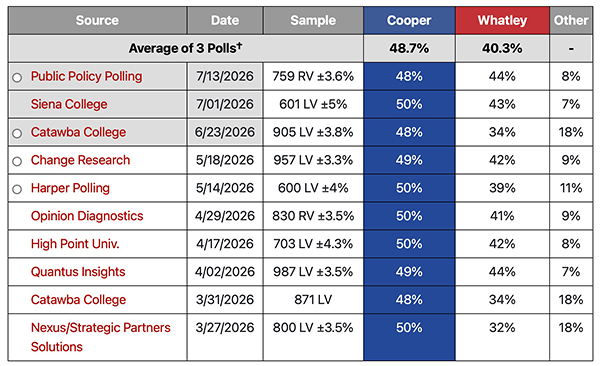
When Whatley first got in, nobody had ever heard of him and he was -18. Now he is better known and is only -8 or so. The top Republican super PAC, the Senate Leadership Fund, took a look and had to make a decision. It could have abandoned Whatley altogether and used the money in Texas, Ohio, or Alaska. But it decided to try to save Whatley and is now going to spend $17 million to try to save his neck. It will be tough because coming back from so deep in the hole is really, really hard because there aren't a lot of undecided voters left.
Also, what are the ads going to say? That Roy Cooper is a commie? He has been in state politics for a quarter of a century. People know him. No one will believe he is a commie. Will they tout Whatley's achievements? What achievements? Will they talk about how great Donald Trump is and he needs the Senate to stop fighting him? There is not a lot of material there.
The real reason for the ad blitz is that the NRSC and SLF have so much money they don't know what to do with it, so they are just throwing money at the wall and to see if any of it sticks. This is clearly not a good investment, but it does show that Republicans have money to burn, so burn it they will.
But do you know what is really weird? The SLF and MAGA Inc. haven't put a penny into the Texas Senate race. That one is very competitive, Ken Paxton is a poor fundraiser, James Talarico is a phenomenal fundraiser and Texas has 18 media markets, many of them expensive. When are they coming to the rescue? Part of the problem is that Whatley is merely boring, but Paxton is absolutely toxic. Each of the groups is hoping the other will pick up the ball and run with it. (V)
Michigan Senate Race Heats Up
One of the most contested primaries this cycle is the one between progressive Abdul El-Sayed and moderate Rep. Haley Stevens (D-MI) for the open Michigan Senate seat being vacated by Sen. Gary Peters (D-MI). El-Sayed has the backing of Sens. Bernie Sanders (I-VT) and Elizabeth Warren (D-MA), Rep. Alexandria Ocasio-Cortez (D-NY) and a dozen progressive House Democrats. He also has the support of half a dozen unions, over a dozen activist organizations and several newspapers. On the other hand, Stevens has the endorsement of outgoing Sen. Peters, former Michigan senator Debbie Stabenow, Gov. Gretchen Whitmer (D-MI) and many other state and national politicians. She also has the support of a dozen unions, EMILYs List, the Congressional Black Caucus and several newspapers. The Democrats are deeply divided on this one.
One important group that does not like El-Sayed is Black voters, who make up one-fifth of the Democratic electorate in Michigan. They tend to support moderates. In 2016, Hillary Clinton beat Bernie Sanders by 40 points among Black voters in Michigan. Some of the resentment against El-Sayed is due to his refusal in 2024 to endorse Joe Biden, which may have helped Donald Trump win a crucial swing state and the presidency. Also a factor is that Stevens, in her four terms in Congress, has been very active in the Black community. She also was on Barack Obama's task force that helped save the auto industry.
On Monday, El-Sayed and Stevens had their final debate. Here are six takeways from it.
- AIPAC: El-Sayed repeatedly hit Stevens for the help she has gotten from AIPAC. The group
spent $30 million supporting her although it ran its own ads independent of her. As is typical of AIPAC ads, these didn't
mention Israel but were more about kitchen table and other domestic issues. Stevens responded to the attacks saying the
campaign is not about Israel, but about which candidate will do more to help Michiganders and Michigeese pay their
bills.
- Celebrity: Stevens attacked El-Sayed as a self-centered celebrity. He has written three
books and done 300 podcasts. She said she was not a celebrity. She does not spend all her time making millions and
promoting herself. She said she spends all her time working for the people of her district and Michigan.
- Socialism: The moderator asked El-Sayed if he was a socialist. He said he was not, but
that capitalism run amok, dominated by corporate monopolies and oligarchs, was a bigger threat than socialism. Some
voters are going to interpret that as he is at least socialism-curious.
- ICE: El-Sayed said he would absolutely vote to abolish ICE. He also said the Democrats
should do more to praise immigrants. His parents are immigrants from Egypt. Stevens talked about her efforts to redirect
funding away from ICE.
- Black Voters: Nationally, whites are moderates and racial minorities are more
progressive, but among Democrats, it is the reverse. White progressives are powering El-Sayed but Black voters,
especially in and around Detroit, support the moderate Stevens. Stevens is counting on Black voters and she repeatedly
sought to appeal to them. Some of the ads AIPAC ran featured Barack Obama endorsing Stevens the first time she ran for
Congress. Stevens also said she has spent a lot of time helping minority-owned businesses.
- Ogre: Some of El-Sayed's online supporters have mocked Stevens' accent and speech patterns, even though she was born and raised in Michigan and lived there until she went to American University in D.C. Recently El-Sayed was caught on tape talking about Sen. John Fetterman (D?-PA). El-Sayed said: "Ideally you put one ogre on a pike, and then everyone else gets the message, and all of a sudden starts [sic] to sound a lot different." Stevens thanked El-Sayed for not calling her an ogre (like Fetterman).
Several polls that have just come out highlight the Democrats' problem. Two Democratic polling firms have produced polls that show El-Sayed ahead. Tavern Research has him ahead of Stevens by 10 points, 46% to 36%. A Data for Progress poll has him even further ahead, 54% to 41%. Now, here's the rub. There have also been recent general election polls rating the Democrat against former congressman Mike Rogers, the presumptive Republican nominee. A Glengariff poll has Rogers trouncing El-Sayed 48% to 41% while Stevens edges Rogers out 47% to 45% among likely voters.
For Democrats paying attention, do they want to support El-Sayed, even if that means losing the general election? The nightmare scenario for the Democrats here is that they hold all their other Senate seats, flip Maine and North Carolina, and two of Alaska, Texas and Iowa, giving them 50 seats while Rogers beats El-Sayed in Michigan, thus resulting in a 50-50 Senate and giving J.D. Vance something important to do besides making peace in Iran. If El-Sayed were to lose a winnable race and that cost the Democrats control of the Senate, the Party would tear itself to bits, not a great start for 2028. Will the Glengariff poll swing any El-Sayed voters? If there are any more primary polls, we may find out. The primary is Tuesday. (V)
New Ruling in Montana Senate Race Helps the Republicans
A new Verasight poll of the Montana Senate race has Kurt Alme (R) at 41%, Seth Bodnar (I) at 27%, Alani Bankhead (D) at 22% and Kyle Austin (L) at 6%. The staff mathematician says he thinks that 27 + 22 > 41. We take his word for it. So if Bankhead were to drop out, then Bodnar (whose positions closely mirror those of a generic Democrat) could be competitive? Yes. The poll actually asked about an Alme - Bodnar race and it was 50-50.
So why isn't Bankhead taking one for the team and dropping out? Because Montana Secretary of State Christi Jacobsen (R) just made a formal ruling that if Bankhead drops out, the Montana Democratic Party must name a replacement. That would defeat the purpose of her dropping out, since many low-information Democrats would just vote for the new Democrat on account of the (D).
Some Montanans have written the Montana Democratic Party an open letter arguing that the Democratic Party doesn't have to nominate someone, but it is a weak case.
There are two other possibilities, however. One is to nominate Bodnar as their candidate. State law prohibits fusion candidates (anyone on the ballot for two or more parties), as is common in New York. But technically, Bodnar would not be from two parties, so that might pass. Jacobsen is already on record saying that the exact words in the law require the Democratic Party to nominate a new candidate. Could she then turn around and say that even though the law does not mention running as an independent candidate and as a party candidate, she has interpreted "independent" to mean belonging to a party? Would the courts buy that? Of course, the Democratic label is not a plus in Montana, so Bodnar would have to think about whether he even wants the nomination.
Another way might be to go all in on rodent reproduction. Find some willing Democrat and pick him or her. Then make the platform consist of these three issues:
- Banning all abortions nationwide
- Eliminating all restrictions on gun ownership
- Getting rid of the federal income tax and slashing domestic social programs
Actually spend some money (Montana is a cheap state) publicizing the issues. With a bit of luck, Montana Democrats will be repelled and vote for Bodnar. Some Montana Republicans may be attracted and vote for the "Democrat" instead of Alme. It would be a strange race, but it could work. A variant of this could be first to nominate Bodnar and if Jacobsen vetoes that, go to court with the hope the court doesn't make a decision before the August 19 deadline. If the court rejects Bodnar, then Plan C is to pick a candidate and run on the above platform. There is no way the SoS could ban that. Then when reporters say to the candidate: "You sound like a Republican," he or she could reply: "I believe in bipartisanship and Republican voters who also believe in bipartisanship should vote for me." When the reporters then ask: "But what about the Democratic voters?" the response could be: "I have them locked down. They are stuck with me. They have no choice." Turn the arrogance up to 110. It would be an interesting experiment to see what a candidate can do to make sure his or her base hates him and walks away.
Yet another thing the Democrats could do, independent of what they do about their own nominee, is advertise for the Libertarian, Kyle Austin, who is on the ballot. From his website, he seems like a perfectly sane conservative whose issues are helping farmers and ranchers, protecting the Second Amendment, and improving the health care system (he is a pharmacist). Every vote he gets will come directly from Alme's hide. (V)
Americans Disapprove of All Three Branches of Government Now
Americans barely know there are three branches of government, but to the extent they do know, they have little faith in any of them. Congress has been in the toilet for years. In the last 50 years, it has been over 50% only during Bill Clinton's second term and briefly after 9/11. It is now at 14%. Here is the historical graph since 1976:
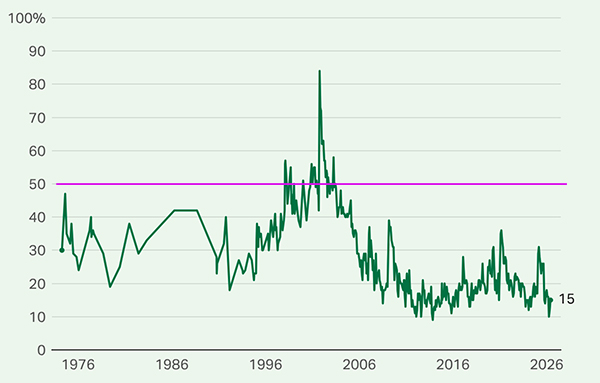
When asked about their own representative, 33% had a favorable opinion. That is better than Congress as a whole, but still not great.
Approval of the president goes up and down, depending who is president. Donald Trump is now at 34%. He can brag that he is twice as popular as Congress if he wants to. But beating Congress is a low bar.
What is new is the Supreme Court's approval. It used to always be above 50% and sometimes even above 60%. In a Gallup poll it is now at 33%, even worse than Trump, but at least better than Congress. The Supreme Court's slide is due to Republicans. Only 58% approve now, down from 79% last year. It looks like they want all the decisions to go their way. Getting 90% just doesn't cut it.
Basically, Americans have almost no trust in any branch of government. Very little gets done and everything takes forever. America has become ungovernable. As JVL at The Bulwark says at the end of all his podcasts: Good luck, America. (V)
Previous | Next
Main page for smartphones