Previous | Next | Senate races | Menu
New polls:
Dem pickups: (None)
GOP pickups: (None)
Trump Continues His Surrender as Iran Attacks Ships
Just before Trump's 2-week ceasefire ended, he unilaterally extended it forever. In other words, he said he would not attack Iran anymore. If he means it—and he might, because the U.S. is running out of munitions—it essentially makes his surrender complete. Iran now has the power to cripple the world economy whenever it wants to, and Trump has agreed to let this status quo stand, at least for now.
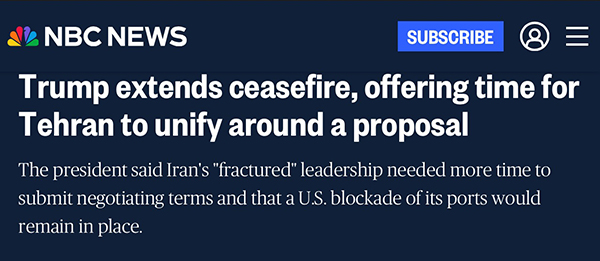
The basic facts are these. The U.S. and Israel attacked Iran, bombing 13,000 targets. Iran not only didn't beg for mercy, it responded by closing the Strait of Hormuz. Yesterday, it attacked three ships in the Strait. Trump is now essentially accepting this situation for the time being and maybe permanently. NBC News' story used this headline.
This boggles the mind. For a guy who claimed he read the ghost-written book The Art of the Deal, he seems not to have learned anything from it. When your opponent is divided, which it might be with the Revolutionary Guard and ayatollahs fighting for power, this is a good time to present your own proposal and insist that it is the starting point for negotiations. Instead, Trump is doing nothing even though time is on Iran's side. The last tankers that passed through the Strait have now docked and there is no oil buffer left. If this situation goes on for another few weeks, prices for oil, gas, fertilizer, and other products will shoot up. Iran doesn't care, but American drivers, farmers, and voters certainly do. As time goes on, Iran only gets stronger as pressure builds on Trump to cave even more—for example, to accept the Strait as an Iranian internal waterway and accept whatever tolls it wants to put on ships, potentially payable only in yuan.
Yesterday, Trump posted this bleat to his quasi-official private social media website:
Iran doesn't want the Strait of Hormuz closed, they want it open so they can make $500 Million Dollars a day (which is, therefore, what they are losing if it is closed!). They only say they want it closed because I have it totally BLOCKADED (CLOSED!), so they merely want to 'save face.' People approached me four days ago, saying, 'Sir, Iran wants to open up the Strait, immediately.' But if we do that, there can never be a Deal with Iran, unless we blow up the rest of their Country, their leaders included! President DONALD J. TRUMP
There is much to pick apart here. First, Iran very much wants the Strait closed for the time being, because it shows the world who the real boss is here: Iran. Second, opening it will not make Iran $500 million/day. It is more like $139 million. Third, while saving face is important to Iran, showing the world the power it has is even more important since it will cause a massive geopolitical realignment, reducing American power worldwide. If America can't force a fairly backward medium-size country run by religious zealots who want to take the world back to the 7th century to cave, what chance does it have against a big, modern, country run by intelligent and very rational people (China, we are looking at you). Fourth, Trump said "People approached me ..." Which people? The CEOs of some oil companies? It certainly wasn't the Iranians. Fifth, Trump is no longer thanking us for our attention. Is that because he knows no one is paying attention to him anymore?
The Strait is most definitely still closed, as this graphic from MarineTraffic.com shows:

Yesterday, three ships tried to run the dueling blockades. The Revolutionary Guard, which has its own navy of small "mosquito boats," fired on them. It captured two of them and brought them to Iran. That is probably a big enough lesson for any other ship captain who gets the bright idea to run the blockades. Iran is definitely in charge now, time is on its side, and Trump is stewing because his brilliant plan went totally awry, just as his generals told him it would. He is boxed into a corner and has no way out. And everyone except himself knows it. (V)
Trump Is Moving into Midterm Mode
Maybe it was the potential loss of three-to-five House seats as a result of the ballot measure in Virginia on Tuesday, or maybe not, but Donald Trump is now actively moving into midterm mode. He understands that unless he rights the ship, the Democrats are likely to capture the House and it's now close to 50-50 on the Senate. Kalshi has the probability of Democrats winning the House at 0.85. The Economist has it at 0.95. Trump knows he has to do something, anything, to shake things up. Oh, and he may know about the latest polls (see below).
Trump's first cut at something is to fire three unpopular women in the cabinet, cozy up to Joe Rogan and Robert Kennedy Jr., and give some speeches in battleground states. Whether Rogan is convinced remains to be seen, and the speeches may rally Democrats as much or more than the Republicans, since Democrats have the momentum now on account of the blowout special elections and the Virginia vote. Rogan aside, an equally big problem for Trump is Tucker Carlson, who now has regrets supporting Trump in 2024. He won't be easy to win back.
In Trump's speeches, he mostly rambles and then highlights the tax cuts in the BBB. But tax cuts may be counterproductive. The "no tax on overtime" and "no tax on tips" come with so many restrictions and limits that many people who expected a windfall are actually disappointed when the "windfall" was much smaller than they expected. And by Nov. 3, they will have long forgotten what they did get. Additionally, not all workers have overtime pay or tips.
He can try to woo Kennedy and the MAHA vote all he wants, but on a major MAHA issue the administration did something the MAHA base hates. It passed regulations to boost the use of glyphosate (used in the notorious herbicide Roundup), which for MAHA moms is roughly equivalent to removing any limits on how much arsenic companies can put in baby food. In the broader world, no one knows about this, but in the MAHA world, this regulation is absolutely toxic and no number of speeches is going to change that. It gives the Democrats an excellent talking point: "Trump wants to poison your baby so a giant German chemical company can have bigger profits."
Another problem area for Trump is Israel. Many America Firsters were not happy with what Israel is doing in Gaza and what Israel is doing in Iran makes it even worse. There is no easy way out for Trump on this as dropping Israel and aligning with Iran has even bigger problems for him.
And firing three women in the cabinet is surely going to be a big turnoff for some women, although there he could save himself if he wants to. All he has to do is replace each of them with other women. The trouble is he has already replaced Kristi Noem with Markwayne Mullin and there is no indication that he has a female AG or Secretary of Labor up his sleeve.
Another huge problem is the loss of Latinos on account of the ICE raids. Cutting back on the raids for a few months is not going to make Latinos forget how ICE has been terrorizing Latinos for a year. So despite his new focus on the midterms, we don't see any obvious actions he can realistically take that bring back disaffected groups. It is helpful for Republicans that he is apparently aware of the problems. But he is not aware of any solutions. (V)
Trump Is Approaching the Bush Line
Sarah Longwell of The Bulwark, a fierce Trump opponent, keeps saying that the Democrats' goal for this year should be getting Donald Trump below the "Bush line," the 32% approval rating George W. Bush had at the end. That would guarantee a Democratic blowout in November. Longwell is getting close to having her wish come true. In a new AP/NORC poll taken April 16-20, Trump's overall approval is 33%, down substantially from 38% in March. That is almost certainly due to the war in Iran and its effects on the economy. In fact, Trump's approval rating on the economy is now 30%, also down from 38% in March. An approval rating in the 20s on the economy would be absolutely toxic, with dozens of House seats flipping and probably the Senate as well (but see below on that).
Trump is also dismissing the price increases out of hand. He definitely does not feel your pain. Or anybody else's pain. In fact, he is minimizing the disruption, saying that the $90/barrel price of oil is much lower than the $200/barrel he was expecting. What he was expecting is cold comfort to people paying $4.02/gal. for gas today, although that varies enormously by region (e.g., it is $5.72 in California and $3.32 in Oklahoma).
Here is the partisan breakdown on some key issues:
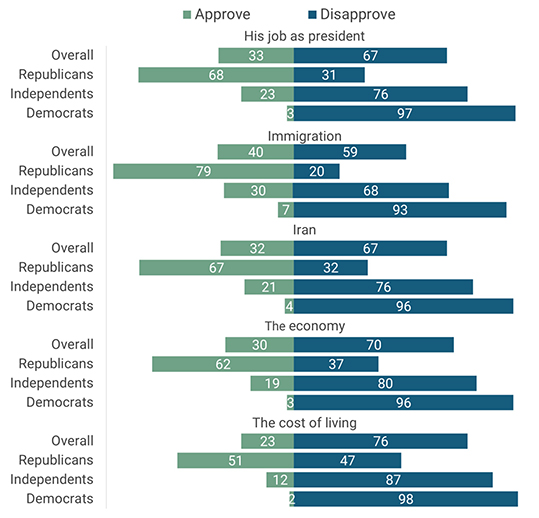
The important part of this is how independents feel. There is no way to win elections without heavy support from independents. The number of partisans available is not enough. Overall, Trump is at 23% approval with independents, with that varying from 12% to 30%, depending on the issue. If we focus only on kitchen table issues—so, not immigration or Iran—the range is 12-19%. James Carville was right: It is (still) the economy, stupid, and 19% is not a good place to be with the crucial bloc of independents.
Bad as Trump's approval is, the legislative branch is even less popular. The approval rate for Congress is now 10% and the disapproval rate is 86%. Apparently, 4% were not aware such a thing as Congress exists. That is not surprising since no one has heard from it in years. However, the generic House ballot has been hovering around D+6 for months. How can this be? Well, Republicans believe that the problem with Congress is that the Democrats are blocking all the good stuff Trump wants. Democrats believe that the Republicans are rubber-stamping all the terrible things Trump wants. Independents are somewhat more with the Democrats on this. The low rating is mostly due to Republicans souring on Congress since Trump was sworn in.
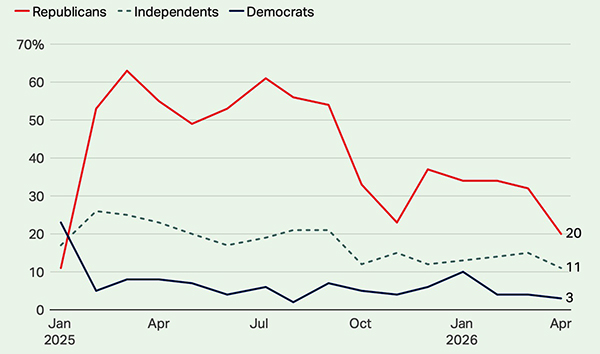
None of this is good news for the incumbent party. (V)
What Can Be Done to Protect the Midterms from Federal Interference?
Free elections are important—especially if a country is on the road to autocracy. Just ask Viktor Orbán. Will the U.S. have free elections in November? Many people are worried about that. The administration is doing nothing to reduce these fears. Instead, it is doing everything it thinks it can get away with to maximize them. Donald Trump clearly understands that the only way for the Republicans to win is to cheat, one way or another.
Politico reached out to a number of voting experts for advice about how states can protect their elections. From interference. By the government. The U.S. government, not the Russian government. Here is a summary of the advice:
- Harden Deadlines for Certification: One possible hack on the system is for losers to try
to delay members of Congress from being seated by Jan. 3, 2027. States need to tighten their laws to make sure election
results are certified well before that. Many states give the SoS a lot of time for canvassing. That can be shortened in
many cases by procedural changes. For example, absentee ballots and ballots voted early could be counted in real time
(and the results kept secret until the polls close on Election Day). Then on that day, only that day's votes would need
to be counted. In some states, if the results are close, an automatic recount is forced. States could give the SoS the
authority to start a recount if the SoS thinks it might be needed, even before the full count is done. If it is not
needed, no harm is done. Also important is for states to write laws ordering lawsuits to be handled quickly. Instead of
30 days to file an appeal, how about 3 days to file an appeal?
- Prepare for Ballot Seizures: States should be aware that the DoJ may try to seize ballots
and voting machines and should prepare their defenses now. That means having the briefs to fight a seizure ready long
before Election Day so they can be filed within minutes of an attempted seizure. A fully prepared legal team should be
ready to appear in court within an hour of the attempted seizure. Here is an
example plan.
Also, staff lawyers need to be aware of what constitutes a valid federal warrant and be prepared to simply refuse to
obey one that is not legally perfect. Improving tabulation speed is also important. If the near-final results (including
all early voting) are publicized at 10:00 p.m. on Election Day, the public will not have to deal with an initial showing
that the Republican won and days later that the Democrat won. The faster the (un)official result is in, the smaller the
window to interfere and stop the counting.
- Chain of Custody: It is essential that no federal agency gets control of any ballots or
machines until after all the votes have been counted (and recounted if need be) and the election has been fully
certified. This is called the "chain of custody." As soon as local officials give up the ballots to any third party,
including the federal government, the local authorities and the courts can no longer be sure that tampering or ballot
destruction didn't take place. Once the chain of custody has been broken, the public will completely lose faith in the
election. This must be prevented at all costs. Again, states and counties must physically resist handing over anything
without a valid warrant and states and counties need to have legal briefs ready to file to oppose seizure the minute the
federal government tries it.
- Interference at the Polls: Federal law
bans
the deployment of federal agents to polling places. States should pass identical laws. Then if a federal agent
shows up at a polling place, that agent is violating state law. State law-enforcement officials are authorized to arrest
people who are in the process of committing a state crime. When the federal agent screams: "You can't do that!" the state
trooper can yell back "Tell it to the judge tomorrow" and haul the federal agent away. States could recruit and train
volunteers to be at every polling place to look for interference and have a way to report it immediately.
- Election Tours: Declining trust in elections is a big problem. One way to deal with this
is giving candidates, officials, and even the public tours of election offices before the election to show how things
work and what the procedures are. Having candidates do the tour and recording it is especially important. After the
tour, the candidate can be asked: "Are there any aspects of election administration that you disagree with and think
need to be changed?" If the candidate says everything is fine before the election, making a claim after he or she loses that
the procedure was incorrect is vastly weaker.
- Adequate Election Funding: What Congress and states can do is make sure that election offices are properly funded and that there are enough well-trained workers to do the work quickly and accurately. There is potentially a fund available. On tax returns people can check a box to provide for public funding of campaigns. No one has used that fund since 2008. Congress could pass a law allowing it to be used to fund election administration.
Of course much more could be done, but it is unprecedented for states to have to worry about being attacked by the federal government. (V)
Democrats Are Gearing Up for a Supreme Court Battle Anyway
CBS News reported that neither Samuel Alito nor Clarence Thomas will retire in June. We had an item on this Monday, noting that one leak does not constitute proof, although we do suspect that Thomas will hang on until Aug. 2028 to break the record for the longest-serving justice in history. Democrats are also skeptical of the report. A group called Demand Justice is planning to spend $3 million now to frame the issue in the public mind and another $15 million if someone, probably Alito, actually tosses in his robe.
The ad campaign would focus on whether the nominee was loyal to the Constitution or to Donald Trump. There is not much chance it could swing votes in the Senate, but if the nominee is clearly unfit for the position, having the public understand that the nominee is unfit still has value, even if the Senate votes to confirm. Namely, any senator voting for a nominee who is seen to be a yes-(wo)man for Trump, could be attacked this November or possibly in November 2028 for that vote. For example, if the Bar Association rates the nominee as unfit, then an ad of the form: "The Bar Association stated that [X] was unfit to be on the Supreme Court and Sen. Jones voted for him anyway" could be effective in helping to defeat the senator.
Traditionally, Republicans have been better equipped for these fights because they have a coherent framework to rally donors, activists, and voters: originalism. Democrats don't have a clear framework to rally around. Democrats need to start thinking more about their PR campaign should a vacancy arise. Democrats on the Senate Judiciary Committee should also begin thinking about tough questions they might ask during the confirmation hearing. Of course, this can't be fine-tuned until the nominee is known and his or her background is researched. (V)
MAHA Will Get Its First Real Test in Louisiana
The MAHA movement hasn't been tested yet. It will get its first test in 3 weeks, on May 16, in Louisiana. That is when MAHA Action, which has endorsed Rep. Julia Letlow (R-LA), will get its chance to defeat its nemesis, Sen. Bill Cassidy (R-LA), who had the temerity to question whether vaccine-denier Robert Kennedy Jr. was the right guy to set national vaccine policy. Cassidy, a physician, knew the answer very well, but he ended up violating the part of the Hippocratic Oath that says "First do no harm." By voting for Kennedy to be confirmed, he has done great harm to the country. Despite Cassidy voting to confirm Kennedy, MAHA is targeting him because he had doubts and to them, that is unacceptable. Only cultist-like obedience is acceptable.
Donald Trump has also endorsed Letlow. Nevertheless, this is not a slam dunk for MAHA. For one thing, Letlow has previously supported vaccination, so she is not a perfect vessel for this battle. For another, MAHA hasn't actually pumped much money into Letlow's campaign nor aided her on the ground. It hasn't even made vaccination a top issue in the campaign. Nor is MAHA a presence in Louisiana. John Couvillon, a Louisiana pollster, said: "I've honestly not heard the word 'MAHA' mentioned other than in the context of the PAC donating to Letlow's campaign. It's really not an issue."
What the race really seems to be about is which of the three candidates, Cassidy, Letlow, and John Fleming, is the Trumpiest. And Trump has no interest in MAHA or vaccines at all. He endorsed Letlow to punish Cassidy for voting to convict him after his second impeachment. The most recent poll has Letlow at 31%, Fleming at 25%, and Cassidy at 21%. That means that every combination of them is possible in the June runoff. (V)
Senate Rundown
We keep the Senate candidates page as up to date as we can. Just click on the "Senate candidates" link above Maine on the map. Nevertheless, once in a while it is worth giving a rundown on the main page, so here goes. A simulation by The Economist gives the Democrats a 46% chance of taking the Senate. So let's look at the Senate seats most likely to flip, in the order we think a flip is most likely.
- North Carolina: When Donald Trump drove Sen. Thom Tillis (R-NC) out of the race, the
Republicans had no Plan B. They knew the Democrats were going to nominate the popular former two-term governor, Roy
Cooper, who has won five statewide elections in North Carolina. And the best they could do was an unknown apparatchik,
Michael Whatley, who ran the RNC but has never run for elected office before. There have been seven polls of the race so
far, and Cooper's worst performance this year has been +5. The most recent poll puts him ahead 50% to 42%. This race
could go over $100 million—or the NRSC could see the handwriting on the wall and just abandon Whatley so it can
spend on more critical races. It is also worth noting that although Republicans have won the electoral votes since
Barack Obama's win in 2008, the governor, lieutenant governor, AG, and SoS of North Carolina are all Democrats. The
previous governor (Cooper) is also a Democrat. It really is a purple state.
- Maine: Sen. Susan Collins (R-ME) has more lives than a cat, but even cats eventually hit
the end of the line. This could be it for Collins. Senate Minority Leader Chuck Schumer (D-NY) got his dream candidate
in Gov. Janet Mills (D-ME). The only problem is that although Maine voters like her, she will turn 79 four days before
the new Senate convenes. That is maybe a tad too old to start a Senate career. Luckily for the Democrats, a brash
oysterman named Graham Platner decided that bloviating on the Senate floor was an easier job than running after oysters,
even though oysters don't run that fast. In the most recent poll, Platner is crushing Mills in the Democratic primary,
61% to 28%. He is also crushing Collins in the general election, 48% to 39%. Susan is concerned. However, she surely
remembers how in 2020, Sara Gideon was crushing her in the polls and yet went down in flames. But if there is a blue
wave, Collins may have used up all her lives.
- Ohio: This is an odd race. Sherrod Brown was a three-term senator who lost when Trump was
on the ballot in 2024 and is trying for a comeback. He is very well known in Ohio. The incumbent is Sen. Jon Husted
(R-OH), who was appointed when J.D. Vance resigned to become vice president. He is much less well known than Brown. And
now there is that little matter of the local electricity company that spent $60 million to bribe its way to getting the
state to raise electricity rates so it could pull in an extra $1.3 billion. An excellent return on investment, if we do
say so. As we
discussed
Monday, Husted claimed to know nothing about this, but his calendar shows that he met repeatedly with all the people
involved, included the corrupt speaker of the House, who is now serving 20 years in federal prison. Polls have Husted up
by about 2-3 points, but the trial of the crooked electric company executives will be held starting Sept. 28, putting
this back in the news. That could cost Husted a few points.
- Alaska: Here we have Sen. Dan Sullivan (R-AK) running against former representative Mary
Peltola. Peltola raised $9 million in Q1 2026, four times Sullivan's haul, and Alaska is a cheap state to advertise in.
Peltola's $9 million is the largest Q1 haul for a Senate race in Alaska history, which admittedly does not go back to
the Pilgrims. There have been three
public polls
this year and Peltola has led by 2, 2, and 5 points respectively. Alaska is a notoriously difficult state to poll and
has an unusual top-four jungle primary followed by a ranked-choice general election, so caution is advised here. Still,
Peltola has won statewide before and Alaska is a quirky place. If the Republican brand is toxic in November, it could
rub off on Sullivan, who is otherwise a pretty normal Republican.
- Montana: This is an open seat, but the backstory is pretty sleazy. The filing deadline in
Montana this year was 5:00 p.m. on March 5, 2026. At 4:52 p.m. on March 5, U.S. Attorney Kurt Alme filed to run for the
Senate as a Republican. At 4:55 p.m. Sen. Steve Daines (R-MT) withdrew from the race. At 5:02 p.m. Daines announced his
withdrawal and endorsed Alme. The voters hate this sh**. Besides, nobody has ever heard of Alme. The problem is that the
Democratic brand is not great in Montana. Not terrible, like in, say, Wyoming, but not great, either. Fortunately for
the Democrats, Seth Bodnar, a former Green Beret and former president of the University of Montana, had earlier decided
to run (against Daines). He consulted with former senator Jon Tester and Tester advised him to file as an independent,
which he did. Montana Democrats will formally nominate someone, but there is a good chance that person will technically
drop out after the filing deadline and the Democrats will all support the "independent" Bodnar (who will undoubtedly
caucus with the Democrats, just like Sens. Angus King, I-ME and Bernie Sanders, I-VT). Because Bodnar is technically an
independent and because voters aren't going to like the sneaky trick the Republicans pulled, Bodnar has a real chance,
even in a red state like Montana. To make it even worse for the Republicans, conservative voters who understand that
Bodnar is a secret Democrat, but who hate the trick the Republicans pulled to swap Daines for Alme, have an alternative
in the Libertarian Party, where two candidates are battling for the nomination. Every vote the LP gets is one vote from
Alme's hide. There haven't been any Bodnar-Alme polls yet but this could be a squeaker.
- Texas: The big question here is who will win the May 26 Republican primary. If Sen. John
Cornyn (R-TX) wins it, he will probably win the general election against James Talarico. Cornyn has already won election
to the Senate four times, is reasonably popular, and Texas is Texas. However, if fire-breathing Texas AG Ken Paxton wins
the primary, then Katie bar the door. Trump has not endorsed in this race because all the Republican senators probably
spend an hour a day praying for Cornyn to win the primary, but the base wants the corrupt Paxton, who was
impeached
by the Texas House (but not convicted). A
poll
of the Republican runoff from last Friday has Paxton at 48% and Cornyn at 40%. When the Republican senators see that,
they are going to say "sh**" in unison and grudgingly resolve to up it to 2 hours a day praying for Cornyn. A
poll
from March has Talarico beating Paxton 47% to 45%. The poll also has Talarico beating Cornyn 44% to 43%, but we just
don't believe that. Democrats can't win in Texas (or anywhere in the South) statewide unless the Republican is truly
horrible (see Moore, Roy). Paxton fits the bill. Cornyn doesn't. If Paxton wins the primary, the NRSC will have to
spend a fortune in very expensive Texas to try to prop up a horrible candidate who is going to have great difficulty
winning independents and Democrats. For a summary of Paxton's many misdeeds over the past 20 years, check out this
article.
If Democrats want to engage in a bit of rodent reproduction, tossing a few nickels into Paxton's piggy bank can't hurt.
- Iowa: At a town hall last year, a constituent asked Sen. Joni Ernst (R-IA) about health
care and she replied: "We all are going to die." Wrong answer. Big time wrong answer. She quickly became known as "Joni
Hearse" and was forced from the race. The Republicans quickly settled on Rep. Ashley Hinson (R-IA) as their candidate.
The Democrats have a fight between two more-or-less interchangeable progressive state legislators, Josh Turek and Zach
Wahls. A recent
poll
has Wahls leading Hinson 46% to 44% and Turek leading her 46% to 45%, so basically a tie, and it doesn't matter which Democrat wins the primary. Iowa has become a red state
and, unlike Paxton, there is nothing wrong with Hinson, so she is probably the favorite, but in a big blue wave, either of the
state legislators could eke out a win.
- Nebraska: This is a longshot, but independent Dan Osborn has a small chance at knocking
off Sen. Pete Ricketts (R-NE). A
poll
in late March has Ricketts at 46% and Osborn at 45%. Osborn is more of a true independent than Bodnar in Montana, which
may help him in deep red Nebraska. He is not a Democrat in sheep's clothing. But if he should magically beat an
incumbent multimillionaire with unlimited campaign funds, it is less certain what he will do in the Senate. He might not
caucus with either party. Could Osborn, Bodnar, Sanders, and King form their own Independent Caucus? Seems unlikely, but
stranger things have happened.
In a closely divided Senate, a four-person Independent Caucus would have massive power.
So there you have it for now. We may have a better idea as primary season rolls on. (V)
Why Is Abbott in No Hurry to Call a Special Election in TX-23?
When Eric Swalwell resigned from Congress, Gov. Gavin Newsom (D-CA) instantly scheduled the special election to replace him—because he knew a Democrat would win it. Tony Gonzales resigned from Congress the same day, leaving a vacancy in TX-23. But Gov. Greg Abbott (R-TX) has not yet scheduled a special election to fill the vacancy. Why? Could Abbott be afraid that a Democrat could win it? He has to schedule it eventually, but he could schedule it for Nov. 3, the same day as the regular election for the term beginning Jan. 3, 2027.
For Abbott it is a tough political decision. On the one hand, Speaker Mike Johnson (R-LA) needs every vote he can get, although the resignation of Sheila Cherfilus-McCormick Tuesday gives him a tiny bit more margin, as does the death of David Scott (see below). That argues for Abbott to schedule the special election as soon as possible. On the other hand, TX-23 is only R+7 and the Democrats have been overperforming by more than 7 points in all the special elections so far. Abbott may be genuinely scared that a Democrat could win the district, especially since it uses the old (2020) map. If that were to happen, Republicans all over the country would be wetting their pants. He could easily be thinking it is better to keep the seat open until November than risk an actual loss.
The Democratic nominee for the next Congress, Katy Padilla Stout, wants the special election right now and would run in it if it were called. She said: "We are demanding that Governor Abbott immediately call a special election." She said that by stalling, Abbott is denying the people of the sprawling TX-23 district the representation to which they are entitled. Jon Taylor, a professor of political science at the University of Texas San Antonio, said that Abbott is making the decision to call/not call a special election before Nov. 3 based on partisan considerations. We completely agree. If he thought a Republican could win it now, he would call it in a flash. His hesitation strongly suggests he is not so sure about that. (V)
House Democrat David Scott Died Yesterday
Rep. David Scott (D-GA), who represented GA-13 in the Atlanta suburbs, died yesterday. He was 80 and had health problems. He was criticized for his refusal to retire, even though he had to be wheeled into the elections office by an aide to file for reelection. He was the first Black House member to lead the House Agriculture Committee and paid special attention to the farming communities in Georgia and the South generally.
The district is D+21, so if there is a special election, some other Democrat will win it. The big question now is when Gov. Brian Kemp (R-GA) will call the special election and when it will be held. Since Kemp knows a Democrat will win the seat, he will be mightily tempted to delay it as long as he can. Georgia law requires him to call the special election within 10 days of the vacancy but does not appear to have a maximum date when the election is held. This could allow Kemp to schedule the election for Nov. 3, depriving the Democrats of a seat for almost the rest of the year.
Subsequent to Scott's death, the House is 217R, 212D, 1 "I" and five vacancies (Cherfilus-McCormick, Gonzales, LaMalfa, Scott, and Swalwell). (V)
Trump Fires CEO of Trump Media after 90% of Former Value Is Wiped Out
As you may remember, the company that owns Truth Social went public in a peculiar way, by merging with a strange existing company that was just a bag of money. The company is listed on the NYSE as DJT. Its only actual asset is Truth Social. Here is how the stock has done over the past 5 years:
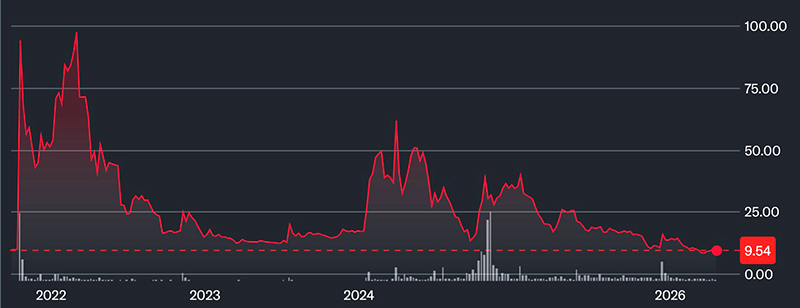
The high point was on Feb 28, 2022 at $97.54. It closed yesterday at $9.54. According to the staff mathematician, this means the stock has lost 90.2% of its value since early 2022. Any investor who put, say, $10,000 in DJT stock at the high now has stock worth $980. Since Nov. 2024, the capitalized value of the stock has lost $6 billion. We don't know how much stock Donald Trump still has. In any event, he got his for free, so he hasn't taken a loss, maybe just not so much profit if he hasn't sold any of it.
Trump celebrated the milestone of the stock losing over 90% of its value by
firing
the CEO he appointed to run the company, former congressman Devin Nunes. The firing may be related to a net operating
loss of $712 million in 2025. It is not easy for a company to lose $712 million in a year, but Nunes pulled it off. The
company is also changing what it does. Instead of merely owning and running Truth Social, which is basically worthless,
it has bought a lot of bitcoin and is becoming a crypto company. It might even spin off Truth Social altogether and
forget being a media company and just be a crypto company. The rubes investors who bought the stock thinking they
would get rich off Trump's coattails may or may not be happy with this change. If they are not, they are free to dump
their shares and take their (deserved) loss. (V)
Previous | Next
Main page for smartphones