


 Welcome & FAQs
  Table of Senate polls
 Senate graphs
 Senate averages
 Tipping-point-state
 Congress: retirements
 Governors' races
 Icons for bloggers
 Data galore


• There Goes My Hero?
• The Problem(s) with Trump
• Elon Musk Is Back in the GOP Fold...
• ...But the Latinos Are Headed for the Exits
• The Fight Over One House Seat in Missouri Continues
• Today's Senate Polls
No Surprises in New Hampshire
Yesterday, folks in the Granite State cast their primary ballots. Here are the results, which shook out the way pretty much everyone expected:
U.S. Senate: This was the marquee contest of the night, such as it is. On the Democratic side, Rep. Chris Pappas easily defeated the more progressive Karishma Manzur, 64.3% to 33.4%. They're both in their forties, so this wasn't one of those "old timer vs. young whippersnapper" matchups. And while it was a progressive vs. a more centrist candidate, you can't really draw any conclusions along those lines. Manzur did not campaign much, did not raise much money, and has no political experience, while Pappas did campaign, did raise money, and is well known thanks to his four terms in the House.
There was no doubt at all that Pappas would face off against a former U.S. Senator in the general, and very little doubt that the former U.S. Senator would be John E. Sununu (R). It will indeed be Sununu, who was unseated by retiring Sen. Jeanne Shaheen (D) in 2008, and would like his old job back. Sununu trounced former U.S. Senator Scott Brown (R) 68.3% to 26.6%, which is about what the polls predicted. It would seem New Hampshirites like former New Hampshire senators better than they like former Massachusetts senators.
Sununu will undoubtedly benefit from being part of a New Hampshire dynasty (his father and brother both served as governor of the state), and from having past Senate experience. That said, he's fighting a bit of an uphill battle, given the national political climate. Plus, the Democrats simply must have New Hampshire to have any hope of retaking the Senate, so Pappas is going to be inundated with donations from across the country. Polls say that Pappas begins the general election push up about 2 points. For those readers who find it instructive, there were about 180,000 votes cast by Democrats yesterday, as compared to about 120,000 votes cast by Republicans.
Governor: There was even less drama here than in the Senate contest. Gov. Kelly Ayotte (R), who wants to keep her job, took 91.1% of the primary vote. Former Executive Council of New Hampshire member Cinde Warmington (D) was unopposed.
Despite the possible blue wave, Ayotte is likely to keep her job. Incumbency helps a lot, and when the party in power is unpopular, voters tend to punish that party's candidates for federal office, not the ones for state office. Plus, Warmington has spent time as a lobbyist, including on behalf of Big Pharma, and voters really hate lobbyists, particularly those who worked for Big Pharma. Polls say Ayotte starts off with a lead of about 10 points.
NH-01: Both New Hampshire House seats are D+2 and are currently held by a Democrat. This one, however, is open because Pappas decided to run for the Senate. So, it was certainly the most competitive race of the night, on both sides of the aisle. The Democrat is going to be Stefany Shaheen, daughter of the retiring Senator, who took 37.3% of the vote. That barely edged out former Marine Maura C. Sullivan, who claimed 35%. If you want to look for a race yesterday that was bad news for progressives, this is probably it. Shaheen and Sullivan are both pretty moderate, and took nearly three-quarters of the vote between them. Carleigh Beriont and Christian Urrutia are both much more lefty, and combined for about 23%. The fact is that New Hampshire is a purple state, and both Democrats and Republicans there tend to be moderates.
The Republican in this race will be Anthony DiLorenzo, who got 52% of the vote, and easily outpaced MAGA-loving second-place finisher Hollie Noveletsky with her 26.4%. DiLorenzo has pretty wide name recognition in New Hampshire—not because he's served in political office (he hasn't), but because he owns a bunch of car dealerships and collision-repair centers that are advertised heavily on TV. It's like if the Michelin Man or the Pep Boys were running for Congress. We don't know how well that will translate to general election success, but we'll guess that Shaheen will be lifted to victory by the general political climate and by her famous name.
NH-02: This seat, by contrast, is occupied by an incumbent who very much wants to hold onto their job. Rep. Maggie Goodlander (D) easily fought off outspoken lefty Paige Beauchemin (D), taking over 80% of the vote. Again, don't draw too many conclusions here, as Goodlander is well known and raised a bunch of money, and Beauchemin isn't and didn't.
In the general, Goodlander will square off against Lily Tang Williams (R), who took 64.9% of the vote in a 4-way race. Williams is a perennial candidate who is 0-4 in her previous elections. She is also, at heart, a Libertarian who moved from Colorado to New Hampshire because Libertarians have a better chance of winning elections in low-population states. Williams likes to pose for pictures where she is holding very big and scary guns, and she is also a fan of "liberty." There is a statue in New York City she should check out, because we think she'll really like it. She was the losing candidate when Goodlander was first elected to the House in 2024, and we see no reason to think Willams won't run her record to 0-5 in November.
In case you ever wondered if we could squeeze nearly 1,000 words out of a primary election where virtually nothing unusual happened, now you know. Tomorrow, it's Rhode Island. (Z)
There Goes My Hero?
Donald Trump is most certainly a hero in his own mind. And he apparently wants to be a hero in your mind, as well. To that end, he's done a few things recently to pitch that narrative.
First up is the 9/11 attacks. Trump has always claimed that he was somehow on the scene, lending a helping hand, shortly after the Twin Towers fell. There is no evidence for this claim, of course. Nobody recalls seeing him there, despite the fact that he was one of the most famous men in New York at the time. He does not appear in any photos or video footage captured on that day, despite there being enough of each to fill a warehouse. Plus, he's just not the type.
Yesterday, Trump doubled down on that obvious fantasy. He has already taken a pass on participating in the 9/11 commemoration scheduled for New York later this week, because they would not let him give a speech. So, instead he gave a speech in Washington yesterday, at an event that was largely organized so Trump could give a speech. And here is the part that raised eyebrows all over the Internet:
The United States Steel Building was creaking, really creaking, and we thought it was going to fall down. The truth is, it creaked a lot. It creaked. It still creaks, but it never came down. And I'll never forget two firemen. We thought it was coming down on top of us, and two firemen, big, strong guys—and I'm not the smallest guy in the world—they grabbed me under the arm, said, 'Got to get out of here!' And they literally lifted me up. This is not easy to do. I'm big. They lifted me up and they started running with me. I said, 'Fellas, I can run myself,' but they were amazing. But they thought it was coming down. It didn't come down.
So, Trump was not only participating in the rescue efforts, but he was so brazenly risking his own life in service of those efforts that he had to be forcibly removed by two New York City firemen. Does anybody believe that actually happened? Does anybody think Trump would come within a country mile of putting his life in danger to help save the lives of others? And does anybody believe that, if he had to, he could run half a city block?
Meanwhile, Trump has also developed a habit of posting AI pictures of himself in military uniform. More specifically, he keeps casting himself in the role of a high-ranking World War II general. Here are a couple of specimens of the genre:
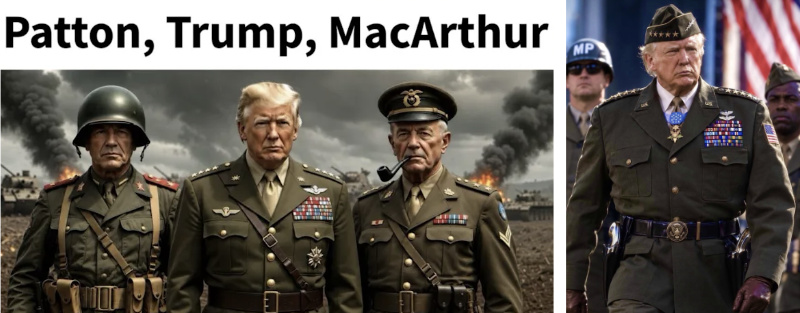
Let us pause here for a moment to note how very bad AI is at this. First of all, "Patton" and "MacArthur" do not look like the actual George S. Patton and Douglas MacArthur. Beyond his general incorrect appearance, MacArthur is smoking the wrong kind of pipe (he famously smoked a corncob pipe), the rank on his shoulder boards is an ambiguous mess, and he's wearing upside-down corporal's chevrons on his shoulder for some reason.
Patton, for his part, does not have the ivory-handled revolvers that he always wore and that were his trademark, his helmet has no rank on it (he always had insignia on his helmet), and who on earth knows what's going on with HIS shoulder boards. We cannot even tell what rank that is, but we can say that Patton was a tank commander, and so if he was going to wear colored shoulder boards, the correct color is yellow.
Meanwhile, in the picture on the right, note that the AI has granted Trump the riding gloves and revolvers that should be on Patton. It has also granted Trump five-star rank, as well as the Medal of Honor. That said, the five-star rank insignia is laughably incorrect. It's not supposed to be five stars in a row, it's five stars in a star-shaped pattern. They only appear in a row if you're "The General" from the insurance company:
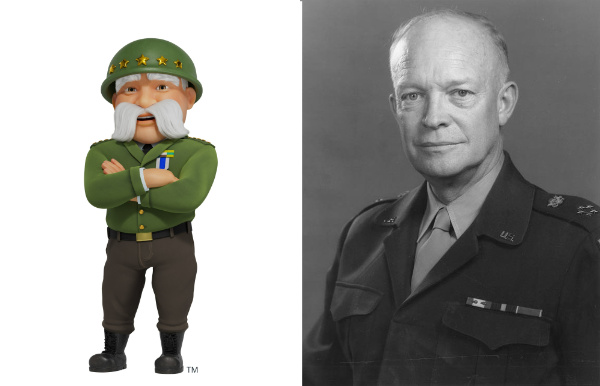
On the left is "The General." On the right is an actual five-star general. Note difference in rank insignia.
It is a really bad look to claim ranks and decorations that are not yours to claim. It's even worse when those ranks and decorations are the very highest the United States Armed Forces has to offer. It's worse still when you never even served in the armed forces. And it's even worse than that if you not only did not serve, but you were a draft dodger.
So, this is not going to endear Trump to all the war hawks and military fans/veterans out there. We do not know why he's suddenly so desperate to push the narrative that he's a great hero, and we also do not appreciate having to write a second item in as many days about this sort of foolishness. Still, any or all of the theses we put forward yesterday could also explain all the phony hero stuff. To wit: (1) He's losing his marbles, (2) He's doing everything he can to make the midterms about him, and/or (3) He's trying to create a distraction. In any event, tonight he'll be the featured speaker at the Republican "convention." Maybe by the time he speaks, he will be the guy who cured cancer, the guy who saved Little Round Top at Gettysburg, and the guy who died on the cross so that wrong-doers around the world could be forgiven of their sins. Literally anything is possible at this point. (Z)
The Problem(s) with Trump
We have mentioned The Bulwark's Sarah Longwell many times. She is moderately conservative, but also definitely not MAGA. She thinks Trump is a moron and hates him with the heat of 1,000 suns, which leaves her as an outspoken member of the Trump resistance. She is publisher and CEO of The Bulwark but also has time to run focus groups and do four weekly podcasts. The result is that she has her finger on the pulse of the voting public more than most other people in the media do.
In her recent focus-group work, she's been asking participants how they feel about Trump. Among those who have lost their enthusiasm for him, she's tried to figure out why. Yesterday, she published a piece headlined "The Three Issues Souring Trump Voters on Trump." Here is her list:
The first [issue] is the economy. In his first term, Trump voters were willing to put up with a lot of Trump-driven insanity because, until COVID, the economy did well. The inflation of the Biden years--and the Biden administration's inability to effectively talk to voters about it--was a major reason Trump was re-elected. But voters aren't feeling as flush now as they were during the halcyon days of 2017-19...
The second, related issue is the war in Iran. Losing wars has always been unpopular, especially when they make people feel even worse off economically than they already were. A lot of swing voters were in the "America First" and "No More Wars" camp during and after the 2024 election...
[Third, and] the real surprise to me was how much Trump's personal corruption is an issue for voters in a way it never was during Trump 1.0. Some of this is related to the Jeffrey Epstein stuff. But I think that's only part of the story. If everyone is doing well, and Trump's doing a little extra well, then voters could excuse that. But when they feel squeezed by high gas prices caused by Trump's war, stubborn inflation, and possible interest rate hikes that might exacerbate the housing crisis, Trump's flagrant corruption and obsession with his ballroom and arch are harder to overlook.
This certainly aligns with our gut feel about things, and so we don't have too much to add. That said, it is interesting to think that the corruption can be hand-waved away when the economy is doing OK, but that it becomes extremely bothersome once the economy heads downhill.
And that brings us to a second piece we'd like to mention. Ron Filipkowski, at Meidas+, compiled a rundown of the 75 most corrupt things Trump has done just this year. Just about everything on the list would have been enough to trigger impeachment, and probably conviction, 40 years ago. If we tried to summarize the whole thing, it would be kind of boring. So, what we thought we would do is run down the dozen most corrupt things from the list, from least to most corrupt, in our view:
- Amazon paying $40 million for rights to Melania Trump "documentary"
- The ballroom, with more than half of the "donors" having already received fat federal contracts after making their
bribesdonations - Abu Dhabi "investment" of $500 million in World Liberty Financial, the Trump family crypto company
- 70+ pardons for allies convicted of fraud and other financial crimes
- Selling premium (early) access to Trump's Truth Social postings
- Tentative approval from SEC for Trump-family-run bank
- Qatar Force One (acquired 2025, but upgraded with $400 million and counting of the taxpayers' money in 2026)
- $620 million "loan" from the Pentagon to Vulcan Elements, a firm partly owned by the Trump family
- $10 billion luxury real estate deal with Saudi Arabia, followed by attack on Iran
- Thousands of stock trades, often made right before Truth Social announcements that will affect those stocks' values
- $1.2 billion in crypto profits (largely earned in 2025, but disclosed in 2026)
- The $1.7 billion slush fund, plus IRS immunity from roughly the Big Bang to the End of Days
Remember, this is just stuff from 2026. Also remember there are 63 items on the list that we did not mention. In any event, there is so much corrupt stuff coming out of the White House, it's easy to forget the specifics, because it all blends together into a toxic stew of grift. This list is a refresher, and a reminder of why some voters might suddenly be willing to hold Trump's corrupt behavior against him and his party.
As we discussed Monday, Democrats are starting to connect the dots here and campaign on how corruption hurts them personally for House races, as in congressman [X] took $[Y] from some giant corporation and then voted to do something that hurt you directly (e.g., raise your healthcase costs). It wouldn't be hard to extend the "his corruption hurts you personally" to Trump as well. (Z)
Elon Musk Is Back in the GOP Fold...
Ever since he became a conservative (or whatever you would call his political philosophy these days), Elon Musk has established a pretty clear pattern: He invests heavily, loses bigly, whines loudly, and announces he's done with politics. Then, once the next cycle rolls around, he's right back at it.
The highest profile example of this probably came last year, when Musk tried to single-handedly secure the Wisconsin Supreme Court for the Republicans, spending well north of $20 million to try to elect conservative judge Brad Schimel, contributing substantially toward making it the most expensive judicial race in American history. When the votes were counted, the Democrats' candidate, Susan Crawford, was not only the winner, she was the winner in a rout. The final tally was 55% for her, 45% for Schimel, which is a huge margin for a purple state where statewide elections are usually decided by a few points. Musk's cash was not only ineffectual, but may have actually hurt the cause, because Musk is so toxic. At that time, Musk said he was done spending on politics. At that time, we wrote that we'd believe it when we saw it.
It was not hard to guess that Musk would not actually step back. First, he always gets petulant, like a small child, when things don't go his way. But, like his good buddy Trump, it takes just days (sometimes hours) before he's completely forgotten everything he said while throwing his tantrum. On top of that, Musk has a giant ego, and a compulsive need to impose himself on anything and everything. And the money means nothing to him. For him, blowing $20 million is like the average person blowing $100. Not nothing, but not enough to make any sort of permanent dent in the bottom line.
Musk did semi-learn, from the 2025 disaster, that it's sometimes best to keep his name out of things. So, there are probably races right now where he and his PAC are mucking around, and it's not publicly known. However, there are at least two Senate races where the Musk connection is crystal clear. The first of those is the contest in Texas, where Musk's America PAC has spent $1.6 million to try to save the seat for the GOP and to get Ken Paxton (R) elected. The second is Maine, where America PAC has kicked in $170,000 to try to help Sen. Susan Collins (R) defeat lumberjack Troy Jackson (D).
We honestly don't know what the heck Musk is thinking. $1.6 million is a pittance to him, and $170,000 is roughly 1/10 of a pittance. He's not going to affect either race, in any meaningful way, with such small outlays. Maybe he's waiting until October to back up the Brinks truck, or maybe he's also sending money through other, below-the-radar, PACs. But if the former is true, October is probably too late. And if the latter is true, then why would he allow ANY of his spending to become public knowledge?
And therein lies the problem. Musk is so toxic that his involvement is certain to cost a candidate at least some votes. That may not be a huge problem in Texas, since the people who like Ken Paxton apparently have hides of steel, and can tolerate almost any sort of bad or obnoxious behavior. But it's certainly a problem in Maine, where Collins wants that sweet, sweet Musk money, but doesn't want the fallout that comes with that. She was asked over the weekend about Musk's spending, and tried to thread a very fine needle, decreeing that she agrees with Musk about cutting government spending, but that she didn't agree with the way he tried to do it (i.e., DOGE).
Our point is: Spend enough money to matter, or else stay away completely so you don't risk contaminating your preferred candidates. But for Musk to indulge in this half-hearted electioneering seems to be the worst of both worlds: too little money to really help, but more than enough Musk to really hurt.
Oh, and not only is Musk holding back, money-wise, he's actively taking steps to make himself more obnoxious and toxic. How? Why, with a little site called votesafe.org. Given that friend-of-Musk Donald Trump is trying hard to kick people off of voter rolls, Americans have good reason to be nervous that they might have an issue with their registration. The correct site to check, and make sure, is vote.gov.
Certainly, votesafe.org (and we are very deliberately not linking to it; the above link goes to a story about the site), sounds legitimate. And it's being aggressively promoted on social media right now, with ads like these:
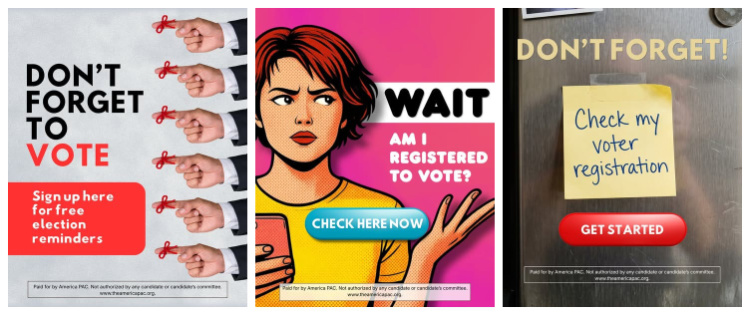
The first clue that something is fishy here comes when you try to use votesafe.org. While vote.gov does not ask for personal information, votesafe.org demands the following:
- First, middle, and last name
- Date of birth
- Full home address
- E-mail address
- Cell phone number
Further, while it's invisible to the user, the site installs cookies that collect:
- IP address and location (This information is used to derive each user's city, zip code, approximate longitude and latitude, time zone, and Internet provider.)
- Browser, operating system, screen size and language of your device
- What website referred you to votesafe.org
- Every link you click
- Every page you look at
- Your voter registration status
- Your district
Once votesafe has this information, it uses it to hit you with targeted political advertising on Instagram, Facebook, eX-Twitter, YouTube and other sites. It also forwards the information to marketing firms that use your information to try to sell you products.
As readers have probably guessed by now, votesafe.org is owned and operated by Musk's America PAC. It is also possible, though not yet proven, that some of the information it's compiling was made possible by the data thefts perpetrated by DOGE. For example, most states won't give out people's voter registration status to private vendors. But some version of that information is in the various databases that DOGE pirated.
This is all kinds of sleazy, of course. And it's also much more likely to be effective than spending a paltry amount of money on Susan Collins' campaign. But Americans hate, hate, hate to have their privacy abused and exploited like that. And if this project, which is hardly secret, gets wide attention, then Musk will become the most radioactive thing this side of Chernobyl. Frankly, it seems like something that should be getting more attention from the political media. (Z)
...But the Latinos Are Headed for the Exits
If you asked us who we would rather have on our side if we were running for political office: (1) Elon Musk and his money, or (2) a disproportionate share of Latino voters, we would most certainly choose the latter. Money only moves the needle if there's a lot of it, and even then, it doesn't move the needle all that much. On the other hand, Latinos are a true swing demographic. If you have them, particularly in Southwestern states, you're in pretty good shape. If you don't, you are really going to have to hustle.
This year, the GOP has Musk (see above). But they don't appear to have Latinos. At least, they don't appear to have the unusually high percentage of Latinos who voted for the red team in 2024. Are Latino voters only interested in macho, which would seem to be in short supply on the GOP's various 2026 tickets? Are they put off by the fact that Trump did... exactly what he said he'd do, both in terms of the border and in terms of tariffs? Are they being hit hard by the economic turmoil, and voting accordingly, like so many other demographics? Probably some of all of these things.
The latest evidence comes from a poll commissioned by TelevisaUnivision, conducted by Hart Research, and first released to Axios. Hart surveyed 17 competitive House districts, districts where Kamala Harris won the Latino vote by an average of 11 points. Now, when asked if they prefer a Democratic candidate or a Republican candidate (no names were mentioned), Latinos give the nod to the Democrat by 23 points, 58% to 35%. You can describe that as a shift of 12 points in favor of the Democrats, or you can say that the Democrats in these districts are poised to double Harris' lead (and then some) among Latinos.
There is, of course, the problem that Latinos are not a monolithic demographic. Most obviously, Cuban Americans sometimes vote very differently from Mexican Americans. However, the pollster thought of that. Three of the 17 districts that were surveyed are substantially Mexican districts in Texas. In those three districts, Harris and Donald Trump split the vote evenly, 44%-44%. Now, the Democrats are up 20 points, 56%-36%, in those districts. Two of the 17 districts that were surveyed are substantially Cuban districts in Florida. In those two, Trump beat Harris by 1 point in 2024, but now the Democrats lead the Republicans by 13 points, 52% to 39%. Put another way, Mexican Americans appear to be jumping ship more than Cuban Americans are, but both groups have shifted noticeably toward the Democrats.
The pollster also asked what issue the Latino voters care most about. The answer, not surprisingly, was the economy. That said, respondents were also asked whether they approve of Trump himself, and whether they approve of ICE. Those numbers were almost identical; for Trump it was 63% disapprove, 36% approve, while for ICE it was 64% disapprove, 35% approve. That suggests that immigration enforcement looms large in the minds of Latino voters, even if it's not the issue they say they care most about.
Needless to say, if the pollster has the right of it, then the Texas gerrymander, which was based on 2024 voting patterns, could easily become a dummymander. That could happen with the Florida gerrymander, too. If so, then the House will not only be lost to the Republicans, but we could see a number of flips comparable to the blue wave year of 2018 (41 seats that year). (Z)
The Fight Over One House Seat in Missouri Continues
In late 2025, the Missouri state legislature, under orders from Donald Trump, redrew its Congressional districts to break up a predominantly Black district around Kansas City and to spread its voters around to the neighboring, more conservative districts. This should have netted the Republicans one additional House seat. Missouri voters had another idea. Over 300,000 residents signed a petition to put a referendum on the ballot challenging the new map. By law, once the petition qualified for the ballot, the new map could not take effect until the voters had their say. But the state attorney general refused to sign off on the referendum and waited until after the primary, which used the new map, to object to the petition on some other manufactured basis. The petition's drafters sued and the state Supreme Court unanimously found in their favor, which meant that the new map had no force or effect and could not be used in the upcoming general election.
Cue the midnight run to the Supreme Court. Like clockwork, the Missouri attorney general filed an "emergency" application to the high court to nullify, or at least pause, the state Supreme Court's decision. But, in a surprise, U.S. Supreme Court Associate Justice Brett Kavanaugh denied the request. Because this was an application on the Court's shadow docket, Kavanaugh, who handles emergency appeals from the 8th Circuit, which includes Missouri, did not have to refer it to the whole Court. Instead, he acted on his own and simply denied the application. Sometimes, the Court operates as it should—go figure.
There is no written order so we are left to surmise the reasons behind the rejection, but we can come up with a couple. If this were a normal Supreme Court that respects precedent and adheres to consistent procedures to avoid favoritism for certain parties, this would be a no-brainer. The case only involves state law and a unanimous state Supreme Court decision over election issues, which are the unique province of the states. And emergency applications should only be granted under the most rare and extraordinary circumstances, which this case does not present.
Given that this Supreme Court is more than willing to get involved even on the eve of elections to help Republicans, it's hard to be completely satisfied with that explanation. But let us add that the decision was rendered by a Missouri Supreme Court comprising mostly Republican appointees, and was triggered by an AG who created this mess by waiting so long to object to the petition. No federal claims were raised originally in the litigation and those that were belatedly raised were weak. The upshot is that SCOTUS would have had to stretch, even more than in some of its real head-scratcher cases, to make a pro-Republican ruling. And all that for one House seat. So, we're not that stunned that Kavanaugh didn't want to wade into this morass.
But wait, there's more. No sooner had Kavanaugh rejected the application than a federal district court reinstated the new map in a different case brought by a GOP candidate who had prevailed in the primary under the new district lines. Stephen R. Clark, chief judge of the Eastern District of Missouri and a Trump appointee, ruled based on his concern that going back to the original map would create widespread confusion and "wreak havoc on the fairness and orderliness" of the election in violation of the equal protection clause. Presumably, there will be an appeal to the Eighth Circuit and potentially another trip to see Kavanaugh. We should learn the outcome of all this pretty quickly.
In case one is tempted to try to divine from Kavanaugh's immediate rejection of Missouri's application a possible outcome in the USPS mail-in voting case, resist the urge. Unlike the Missouri case, the USPS case involves a federal court order that blocked a federal agency rule. So, the reason to deny Missouri's application—that it only involves state law issues—is not present. Plus, Solicitor General John Sauer has a remarkable track record in getting the Republican Justices to grant his stay requests on the shadow docket. He knows the buzzwords that will give the right-wing majority what it believes is a legitimate-sounding justification to get involved, a justification that just so happens to work in favor of Trump and the Republican Party.
One potentially intriguing tidbit is that Kavanaugh acted on his own in denying the application outright without referring it to the whole Court. Conceivably (and Supreme Court experts among our readers can correct me on this), Associate Justice Jackson, who handles emergency applications from the First Circuit, which is where the USPS case is being litigated, could also have simply rejected the application. The fact that she referred the case to the Court could be an indication that she took the Court's temperature and liked what she learned. But that's pure speculation, and perhaps some wishful thinking. Stay tuned. (L)
Today's Senate Polls
Both candidates have their liabilities, and it's basically a purple state. Hard to see how this one doesn't remain on razor's edge right up until the votes are counted. (Z)
| State | Democrat | D % | Republican | R % | Start | End | Pollster |
| Michigan | Abdul El-Sayed | 44% | Mike Rogers | 46% | Aug 31 | Sep 03 | Glengariff Group |
* Denotes incumbent
Previous report Next report
If you wish to contact us, please use one of these addresses. For the first two, please include your initials and city.
- questions@electoral-vote.com For questions about politics, civics, history, etc. to be answered on a Saturday
- comments@electoral-vote.com For "letters to the editor" for possible publication on a Sunday
- corrections@electoral-vote.com To tell us about typos or factual errors we should fix
- items@electoral-vote.com For general suggestions, ideas, etc.
- Guidelines for questions (Saturdays) and letters (Sundays)
To download a poster about the site to hang up, please click here.
Email a link to a friend.
---The Votemaster and Zenger
Sep08 $100 Billion and Counting...
Sep08 Newsom 2028 Is in Full Swing
Sep08 Fetterman Story Presumably Surprises No One
Sep08 A Campaign Gone Wrong
Sep07 Two More Primaries This Week
Sep07 Iran Is Taking Control of the Midterms
Sep07 Trump's USPS Stunt Is Too Late
Sep07 Trump Says He Will Spend Up to $500 Million on the Midterms
Sep07 Democrats Have a Large Lead in Party Identification
Sep07 Talarico Is Countering Trump's Midterm Convention
Sep07 The DCCC Has Given Super PACs Detailed Plans--in Public
Sep07 Commerce Secretary Howard Lutnick Made over $250 Million Last Year
Sep07 Trumpism as an Export Product
Sep07 Vance Is Starting to Work on his 2028 Platform
Sep06 Sunday Mailbag
Sep05 Saturday Q&A
Sep05 Reader Question of the Week: London Calling, Part IV
Sep04 In Congress: Johnson Just Loves This Kangaroo (Supreme) Court
Sep04 It's the Stupid Economy: Don't Look Now, but There's a Diesel Crunch Underway
Sep04 Midterms: Charlie Cook Is Bullish on Dems' Chances
Sep04 Gerrymandering News: Judges Say, "Let America Decide"
Sep04 I Read the News Today, Oh Boy: Daniel Craig as Mister Fantastic?
Sep04 This Week in Schadenfreude: Fox Confirms the Obvious, that Bartiromo Is Out
Sep04 This Week in Freudenfreude: Meet Tuco
Sep04 Today's Senate Polls
Sep03 The Bond Market Is Not Happy
Sep03 Trump Has a Strategy: Outrun the Law
Sep03 More on Mail-in Ballots
Sep03 Trump Isn't the Only Player Trying to Rig the Midterms
Sep03 The Lame Duck Is Being Fattened for Christmas
Sep03 The Lindsay Graham Russia Sanctions Bill Is Stuck in the House
Sep03 El-Sayed Has a Hasan Piker Problem
Sep03 Today's Senate Polls
Sep02 Voters in Massachusetts Like Their Politicians Aged, Like a Fine Wine
Sep02 Boy, Do Voters Hate Data Centers
Sep02 Republicans Will Probably Get Their Anti-DSA Messaging Bill
Sep02 Team Trump Is Trying Its Best to Interfere with the Midterms
Sep02 The Reviews Are in on the Venezuela Deal...
Sep02 Today's Senate Polls
Sep01 The SHAME of Donald Trump
Sep01 Legal Bytes: The Majority of the Supreme Court Supports Trump's Balls
Sep01 Of Course It Was Him
Sep01 Today's Senate Polls
Aug31 Massachusetts Is the Next Youth vs. Age Test
Aug31 Trump Reinstates Colonialism
Aug31 Trump's Other Plan to Reduce Cost: Eliminate USDA Meat Inspection
Aug31 Trump Threatens Journalist--Again
Aug31 Trump WANTS to Make the Midterms about Himself
Aug31 Democrats May Find Success by Running Republicans as Candidates

