


 Welcome & FAQs
  Table of Senate polls
 Senate graphs
 Tipping-point-state
 Congress: retirements
 Governor's races
 Icons for bloggers
 Data galore


• Holding the Line, Part I: Judges Push Back on Trump's Legal Agenda
• Holding the Line, Part II: Judges Push Back on Voting Shenanigans
• California Gerrymander: Republicans Are Blowing It
• The Peter Principle on Steroids
• Our Long National Nightmare Is Over
Democrats go 1-0-1 in Special Elections
The elections calendar is pretty bare this year, on the whole. However, there were two special elections for state legislative seats yesterday, and the news was somewhere between "good" and "really good" for the Democrats.
We will start in Iowa, where a special election in SD-01 was occasioned by the death of state Sen. Rocky De Witt (R) back in June. It's a pretty red district; in November of last year, Donald Trump won the vote there 55%-44%, while De Witt won by a very similar 55%-45% tally. So, let's say the Republicans won the district by 10.5 points. Yesterday, in the special election, Catelin Drey (D) defeated Christopher Prosch (R) 55%-44%. Obviously, that's a 21.5-point swing from last November.
Drey's victory was powered by a robust fundraising operation (she outraised Prosch $160,000 to $20,000) and a strong ground game. And once she is sworn in, there will be an immediate implication for Iowa politics, as the Republicans' two-thirds state Senate majority will be broken. By the terms of the Iowa Constitution, the appointments made by Gov. Kim Reynolds (R) have to earn the approval of two-thirds of the state Senate. So, Reynolds can no longer secure confirmations on a party-line vote.
More broadly, Drey's victory is another data point suggesting the Republicans could be in trouble next November. The usual caveat here applies, of course—special elections, especially for an area as small as a state legislative district, are wonky. So, you don't want to read TOO much into them. That said, the Democrats have been way overperforming 2024 in nearly every special election this year. That includes the previous special election for an Iowa state Senate seat, back in January, when Mike Zimmer (D) won 52%-48% over Katie Whittington (R) in SD-35. In November of last year, Trump won the same district by 21 points. So, Zimmer's victory was a 25-point swing; rather similar to the 21.5-point swing from yesterday.
The other special election yesterday, meanwhile, took place in Georgia SD-21. It was to replace state Sen. Brandon Beach (R), who resigned when he was appointed Treasurer of the United States. This election is the "tie" from this item's headline; we couldn't figure out exactly how to characterize it. Yesterday's result is that Debra Shigley (D) got 39.5% of the vote, Jason Dickerson (R) got 17.4%, Steve West (R) got 17.1%, Brian Will (R) got 10.3% and Brice Futch (R) got 8.2%. That's with "95%+ reporting," which is basically code for "we still have to count some mail-in and military ballots," so Dickerson and West could still flip places. In any event, by virtue of electoral rules that, when they were established, were actually meant to guarantee a Democratic victory, Shigley will face off on September 23 against whichever Republican ends up in second place.
It is a fool's errand to try to guess what will happen in the runoff election based on yesterday's results. There was zero question Shigley would advance, so she presumably held back on spending money, and some Democratic voters probably stayed home. That means she'll probably grow her support some. But, of course, if the Republican vote coalesces around the last man standing on that side of the contest, then the GOP will win. There's certainly no guarantee that will happen, though. Some Republican voters could stay home if "their guy" is out, or if they don't like the red teamer who advances to the runoff. For what it is worth, the two guys duking it out for second are both pretty hard-right and pretty Trumpy, though West seems to be Trumpier. He also lives, part-time, in a cabin that looks like a Bob Ross painting:

While he himself looks like Moses:
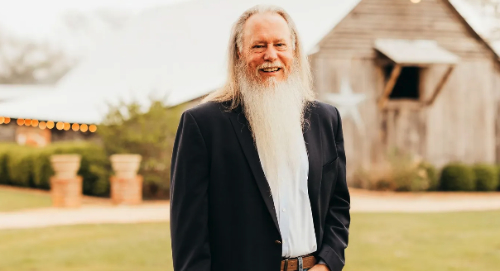
Those things are probably selling points in rural Georgia. Anyhow, Democrats are surely happy that their candidate got a large plurality of the vote, Republicans are surely happy that their party got a large majority of the vote, and beyond that, everyone gets to wait about a month to see what happens.
Georgia has a competitive Senate election next year, of course, and Iowa might have one, too, given Sen. Joni Ernst's (R-IA) severe case of foot-in-mouth disease. So, tea leaves from those states are of particular interest. If we assume that the Democrats' overperformance in special elections is not an illusion, and represents an actual shift in the electorate, then the next question is: What is the cause? The default answer is surely "A response to Donald Trump's policies, and particularly to the economic effects of his policies." That's probably some of it, though if that was the main driver, the Democrats' performance should be getting better and better, and it's actually pretty level. The other obvious explanation is that when Trump is not on the ballot, the Trumpy "swing" voters we wrote about earlier this week don't bother to show up to the polls. That seems to comport more with the available evidence. Of course, if it's Option 1, or Option 2, or both Option 1 AND Option 2, it would be very problematic for the GOP in 2026. And 2028, for that matter. (Z)
Holding the Line, Part I: Judges Push Back on Trump's Legal Agenda
Donald Trump is trying very hard to corrupt both the law and the order portions of the legal system, so that he has carte blanche to do whatever he wants. Thus far, he's had some success with the "law" part, since he gets to appoint those folks AND he can fire them if they don't do his bidding. The "order" part is going far less smoothly for him, as several news items from yesterday illustrate.
The biggest news came from the courtroom of Judge Thomas Cullen (a Trump appointee, incidentally), who oversaw the patently absurd lawsuit that the White House filed against all 15 federal judges in Maryland, in an effort to limit those judges' power to intervene in immigration-related disputes. Cullen's 39-page ruling is unsparing. He writes:
Over the past several months, principal officers of the Executive (and their spokespersons) have described federal district judges across the country as 'left-wing,' 'liberal,' 'activists,' 'radical,' 'politically minded,' 'rogue,' 'unhinged,' 'outrageous, overzealous, [and] unconstitutional,' '[c]rooked,' and worse. Although some tension between the coordinate branches of government is a hallmark of our constitutional system, this concerted effort by the Executive to smear and impugn individual judges who rule against it is both unprecedented and unfortunate.
That's actually a footnote. The main body of the ruling absolutely eviscerates the administration's entire argument. Needless to say, Cullen summarily dismissed the case.
A second bit of news comes from Washington, DC, which is currently the legal fiefdom of Fox entertainer and U.S. Attorney Jeannine Pirro. Pirro is the type to grossly overcharge offenses (in other words, to pursue a more harsh sentence than the facts would seem to support) because her primary interest is in pleasing Trump, and in making some headlines on Fox. And after D.C. resident Sydney Lori Reid got into an argument with ICE officers, and then resisted arrest (one agent got an owie on their hand), Pirro went for felony assault against a federal officer. Since there was no weapon involved, that would mean a sentence of up to 8 years. The facts of the case align much more closely with a charge of simple assault, which carries a maximum sentence of just 1 year.
The old saying, which we've repeated many times, is that a prosecutor can get a grand jury to indict a ham sandwich if they really want to. Well, it would seem that the grand juries of Washington are keeping kosher these days. Pirro's office went before one grand jury with the felony assault charge, and got the thumbs down. So, Pirro tried again, and yet again, and got two more rejections (proper term "no true bill"). That almost never happens, particularly three times on the same case. A prosecutor need only give evidence for the probable cause of a crime, with no arguments/pushback from the defense, and need only get the votes of a majority of the grand jurors. It's a low bar to clear, and Pirro and her team failed... three times.
How about one more? Since the White House militarized D.C., officers have been looking under rocks for people to arrest and charge. One such person is Torez Riley, who is Black, and who was clearly asking for trouble because he was walking the streets of D.C., in broad daylight, while... wearing a backpack. Given America's long and sordid history of crimes committed by people guilty of backpacking while Black (Blackpacking?), the feds decided they were justified in searching Riley. They found a couple of guns in his backpack, and since he has a weapons offense in his past, Pirro's office decided to throw the book at him.
If you know anything about the relevant law here, you will not be surprised to learn that U.S. Magistrate Judge (and former federal prosecutor) Zia Faruqui was not impressed by the arrest, to say the least. He said:
It is without a doubt the most illegal search I've ever seen in my life. I'm absolutely flabbergasted at what has happened. A high school student would know this was an illegal search. We don't just charge people criminally and then say, "Oops, my bad." I'm at a loss how the U.S. Attorney's Office thought this was an appropriate charge in any court, let alone the federal court.
Naturally, the Judge quashed the search. That means, with no evidence left, Pirro's office is going to dismiss the charges.
We had numerous items yesterday about the Trump administration's march toward fascism. This item, and the next, are useful reminders that at least some of the guardrails are holding reasonably well. (Z)
Holding the Line, Part II: Judges Push Back on Voting Shenanigans
As various states are in a gerrymandering arms race to try to see who can guarantee their party the most seats, courts have been busy striking down maps as illegal.
First up is Alabama, where Section 2 of the Voting Rights Act is still alive and well. U.S. District Judge Anna Manasco, a Donald Trump appointee, struck down the state Senate map and ordered a new map be drawn in time for the 2026 elections. She held that the state Senate district around the capital of Montgomery violated Section 2 by diluting the votes of Black voters. She ordered a new district to be drawn so that Black voters "comprise a voting-age majority or something quite close to it." Manasco further held that the Court will redraw the districts itself if the legislature doesn't act in time for the 2026 elections. She did reject the claim that a second district, based around Huntsville, violates the VRA. Last year, Alabama had to redraw its Congressional district map to create a new majority-Black district. In the state legislature, Republicans hold lopsided majorities, so the balance of power will not be affected by Manasco's ruling.
In Utah, state District Court Judge Dianna Gibson, an appointee of Republican former governor Gary Herbert, struck down Utah's Congressional map as a violation of a voter-backed initiative that established an independent commission to prevent partisan gerrymandering. "The nature of the violation lies in the Legislature's refusal to respect the people's exercise of their constitutional lawmaking power and to honor the people's right to reform their government," Gibson wrote.
The Court ordered new maps to be drawn immediately so they can be used in the 2026 elections. Gibson gave the legislature until September 24 to submit them and also allowed voting rights groups who are parties to the case to submit alternate proposals. Republicans will, of course, appeal, which could run out the clock, but this case has already been before the state Supreme Court once, when it held that the legislature can't repeal laws passed by voter initiative. The Court sent the case back to the lower court to determine if the maps needed to be redrawn, which the lower court has now ordered. So, any appeals could be fast-tracked, given that the district court did exactly what it was ordered to do.
There is a pretty dispiriting backstory here. In 2018, Utah voters passed an initiative to create an independent commission to draw state and congressional maps, which the legislature was required to consider. Instead, they repealed the law in 2020, and changed the commission's status to "advisory board," one that they then decided to ignore. If new, non-gerrymandered maps are drawn, this could impact Utah's delegation, as the state-drawn map carved up Salt Lake County, the blue dot in an otherwise red sea, into four reliably Republican districts.
This may seem to parallel the situation in California, but there are a couple of differences. First, Gov. Gavin Newsom (D-CA) has made clear that the legislature is not repealing or ignoring the independent redistricting commission that California voters created; instead, they're asking voters to modify temporarily the commission's role. Some might dismiss that as empty rhetoric, maybe justly so, but the second difference is pretty significant. California voters are being asked to approve/reject changes to a law that California voters previously approved. In Utah, it was the legislature that made the change, not the voters who approved the commission.
Finally, in Louisiana, which must be experiencing whiplash by now, a unanimous panel on the Fifth Circuit Court of Appeals upheld a lower court decision that found that Louisiana's state legislative maps violate Section 2 of the VRA by discriminating against Black voters. The lower court had found that the boundaries diluted Black votes so they had no fair opportunity to elect their own representatives. Mirroring their argument in the Supreme Court, the state argued that Section 2 is unconstitutional, but the Fifth Circuit disagreed. It held that Congress enacted Section 2 "based on overwhelming evidence that 'sterner and more elaborate measures' were needed to address 'an insidious and pervasive evil" of laws designed to disenfranchise Black voters. Given that the U.S. Supreme Court has just scheduled oral arguments to decide this very question for Louisiana's Congressional maps, it will be very interesting to see how this plays out and what maps will be used in 2026. (L)
California Gerrymander: Republicans Are Blowing It
As California Republicans endeavor to resist the temporary gerrymander of California's district maps being pushed by Gavin Newsom, they do have a couple of things going for them, namely a lot of money, and a fair bit of star power in the person of former governor Arnold Schwarzenegger. That said, while the GOP PR campaign is off to a rousing start, in the sense that everybody who's even so much as looked at a polling place is now getting "literature," the tactical campaign is not going so well.
The basic dynamic is that there are two different people who think they are the most important and influential Republican in California: Schwarzenegger and former speaker Kevin McCarthy. And they each have a different idea on the best way to approach this campaign. McCarthy, in brief, wants to drive up Republican turnout. That means ginning up Republican voters by focusing on how evil Democrats are, and probably by getting Donald Trump directly involved in the campaign. Schwarzenegger, on the other hand, wants to appeal to independents and moderate Democrats, based on a "good governance" message. That means no villainizing Democrats, and also keeping Trump as far away from California as is possible. Both men are aligned with super PACs (Schwarzenegger is working with billionaire Charles Munger Jr.), and both hope to raise $100 million.
The big problem here is that Republicans are in the minority in California, and have the less popular side of the issue. There have been two polls taken since the ballot measure became official, and the pro-Newsom position led by 22 points in one, and 16 points in another. Even worse for the GOP, polling-wise, is that in the second of those polls, from Politico-UC Berkeley Citrin Center, 70% of Democrats (which means nearly ALL of the pro-gerrymander respondents) say they are opposed to gerrymandering. In other words, they already accept the general "good governance" argument, but they also accept Newsom's argument that this is a special circumstance that requires a special response. And it is not going to help the Republicans to sell their argument if they actually have two different arguments, arguments that are somewhat in conflict (you cannot, for example, simultaneously villainize Democrats and yet also try to get them on your side).
It also does not help, by the way, to get caught basically lying to people by implying that the League of Women Voters is part of your team. This is what Munger and Schwarzenegger did; it makes them look dishonest, and also suggests their position is so weak they can't get a legitimate non-Republican activist to support it.
Meanwhile, not only are Democrats on the same page in terms of their argument, but Newsom's allies, particularly among organized labor, are already hard at work organizing and planning their ground game and field operation. This is the same basic group of people that Newsom deployed back in 2021, when he defeated a recall initiative by 24 points, 62% to 38%.
If Republicans want to win statewide elections in California, whether for political office, or for ballot initiatives, then they basically have to play their hand perfectly to even have a shot. At the moment, that is definitely not what is happening. (Z)
The Peter Principle on Steroids
When the U.S. began to urbanize in a serious way in the 19th century, building codes were not a thing. In fact, the notion that the government should be supervising private businesses in this way would have been perceived as something between "laughable" and "immoral." So, a lot of companies built ramshackle multi-level tenement buildings, out of cheap lumber and other substandard materials. Eventually, one portion of the building would deteriorate pretty badly, and would be propped up as best as possible. Then another, then another. In the end, quite often, the whole building would collapse, sometimes with people in it. That's for the buildings that did not first get burned down in the all-too-common urban conflagrations of the era, of course. No fire codes back then, either.
We write that as prelude to a couple of items that, taken together, paint a vivid picture of the "building" that is the Trump administration. First up is an op-ed from (very lefty) former labor secretary Robert Reich, which was published in The Guardian, and was brought to our attention by reader M.G. in Boulder, CO. It is headlined "Why Trump built a staff of incompetent sycophants."
That headline pretty much gives away the game, but just in case, Reich's answer to the (semi-)question is that the people who make up the Trump administration are exceedingly unqualified for their jobs, and they know it. What they learned, long ago in most cases, is that if they could not offer competence, they could offer loyalty, sycophancy, and a willingness to break the rules (and the law). Those, of course, are exactly the things that Trump (like all authoritarians) wants in an underling. Not only does he get people who kiss his rear end, and do his dirty work for him (which means THEY assume the risk), but the longer they serve, the more they are in his debt, whether that means they need him in order to have a job, or they need him because they hunger for the attention and prestige that comes from being on staff, or they need him because they want (or expect to need) a pardon.
Now, let's pair this with a second item, from Politico, headlined "Seven months in, Trump's revolving door reaching full swing." Again, the headline pretty much gives away the game. Trump v2.0 is not even 15% of the way to the finish line, and prominent staffers are already leaving the administration for greener pastures elsewhere. Deputy press secretary Harrison Fields is gone, Deputy Assistant to the President Trent Morse is gone, senior White House strategist May Davis Mailman is gone, and so too are several other high-profile staffers.
It is certainly possible that, for some of these individuals, life in the White House (or, maybe, the accompanying salary) was not their cup of tea. However, for anyone who has actual, marketable skills, it makes all the sense in the world to leave ASAP, even if they liked their White House jobs. First, they don't run the risk of getting involved with something indictable. Second, they maintain a relationship with Trump and his team, and don't end up as pariahs because he turned against them (as has happened with so many of his former insiders, from Omarosa Manigault Newman to John Bolton to Stephanie Grisham). Third, "I can get President Trump on the phone" is a real selling point for about 3.5 more years. Once a Democratic administration takes over, it's not only not a selling point, it's an anti-selling point. Better to exploit the window of opportunity for as long as possible.
It's not too hard to see what the effect of these two, parallel, processes will be. An administration that is already chock-full of subpar people will skew further and further in the direction of boot-licking, incapable, unethical potential felons. We actually planned this item on Monday. As chance would have it, there were two very relevant news stories yesterday: Social media guru and decade-long Trump toady Dan Scavino, is taking over the Presidential Personnel Office, while Heather Honey, a "statistician" who has no particular justification for that job title, and who cooked up some of the "analyses" that showed the 2020 election was "stolen," has been appointed to work on election integrity for the Department of Homeland Security.
Returning to the metaphor we began this item with, some of the "rooms" in this ramshackle structure have already suffered from structural failure. The Pete Hegseth Signal chats. The document printed to a public printer during the Alaska summit. The accidental targeting of Kilmar Abrego Garcia. The letter to Harvard that was not meant for public release. The tariff on penguins. The IRS Commissioner who lasted 2 whole days (aka, 18% of a Scaramucci). The litany goes on and on. Will the whole thing collapse in on itself, eventually? We don't know, but we can point out that: (1) In Trump v1.0, following the events of 1/6, it nearly did; and (2) the considerably less ramshackle structure built by Richard Nixon eventually collapsed, and at that point, it turned into every man for himself. (Z)
Our Long National Nightmare Is Over
Americans may not have faced a week this laden with tension and uncertainty since the Cuban Missile Crisis. But, after all the fear, and anxiety, and existential dread, the nation can finally stand down. That's right, Cracker Barrel has announced that it's going back to its old logo. Please take a moment to bow your head and thank the deity or deities of your choice.
After our item on this subject yesterday, in which we expressed confusion over how people could be so upset about a logo change, and in particular how the change could be described as "woke," we heard from a number of readers who chimed in with opinions. We thought we'd share a few of those:
P.H. in New York City, NY, writes: In your article The Strangest Culture Wars Battle... Ever? you remarked how, "The most difficult thing to understand, perhaps, is how the new logo is 'woke.' Huh?" It may be so obvious it is hard to see. It is nothing about the new logo, it is that the old logo featured a white man and the new one does not. That's it. They have a delusion that white male heritage is being erased. How American, Christian, white males, mostly born in the 20th century, somehow think they are being marginalized when in fact they are the least oppressed demographic in the entire known history of the human species is beyond me. Yet here we are. That and they are always looking for something, anything, to manufacture outrage about, so why not?
E.C. in Seattle, WA, writes: Regarding your piece about Cracker Barrel, some additional context you didn't mention. In the early '90s, the company was widely seen as anti-gay, with terminations and explicit policies targeting LGBTQ employees, which led to national boycotts and activist campaigns. Change came slowly, under sustained pressure, and by the early 2000s they had begun adopting more inclusive policies. I remember this clearly because I came out in the 1990s.
The MAGA crowd seems to be having a delayed reaction to a trivial change that they believe represents a purposeful cultural and corporate shift, when in fact those policy changes happened long ago. I am not even sure most people today would remember the Cracker Barrel boycott outside of the LGBTQ community from that era. Perhaps some gay MAGA of a certain age, Peter Thiel as an example, saw the new logo and reminded everyone that Cracker Barrel once used to be the bastion of anti-LGBT respectability.
J.J. in Johnstown, PA, writes: I think you're trying to put too much thought into why the right wingers are upset about the Cracker Barrel logo change. It's because they're racists. Plain and simple. They. Are. Racists. They are upset that they removed what appears to be a 90-year-old man, likely hiding a shotgun, mumbling about "uppity ni**ers" or something. Hell, it's right there in the name: Cracker. Don't give these racists more credit than they deserve.
J.P. in Boston, MA, writes: The right is just sad that the logo no longer includes a barrel or a cracker.
B.W. in Los Angeles, CA, writes: As someone who has lived in three Deep South states plus New York and Los Angeles (and has traveled to every state save Alaska), I'll suggest an explanation for the bizarre whitelash over Cracker Barrel's trade dress.
No single business is more emblematic of "forgotten" middle-America than Cracker Barrel (though Walmart might like a word).
Their business model has always favored very small rural towns (near highway exits). If a town with fewer than 1,000 residents has any chain restaurant at all, it's almost certainly a Cracker Barrel right by the highway. There are probably still places in America that don't have broadband Internet access, but are within a short drive of a Cracker Barrel.
For half a century, Cracker Barrel has had remarkably consistent trade dress that centered and revered rural life. If we city dwellers can muster some empathy, it's not too hard to imagine that the chain may have felt like a dependable, safe, presence to someone who perceives the world as fast-changing and scary.
So the decision to remake their brand in a manner more consistent with urban fast-casual chain restaurants—not just the logo, but the architecture (anonymous cuboids made of glass and metal)—could be easily seen as a betrayal by those communities; a failure to "read the room."
For the non-sequitur blaming of DEI/wokeness, we must remember that rural and exurban grievance has been cultivated, strategically, by the Republican Party for at least the entirety of this century. The GOP has always, as a power-consolidation tactic, supplied a ready-made bogeyman to explain any perceived ill, any perceived slight.
It seems totally believable—even predictable, to me—that people who were resistant to the Cracker Barrel change would: (1) be Republican, (2) have a persecution complex, (3) reflexively blame GOP enemy-du-jour.
Some very useful insights, we think. We do wish that we had recalled, while writing the item yesterday, that Cracker Barrel is central enough to red-state identity that a political scientist developed a system for predicting the presidential vote in states, based on the number of Cracker Barrels as compared to the number of Whole Foods locations (there is also a similar system using Starbucks stores vs. Chick-fil-A locations). This seems way off to us. Counting the number of restaurants that appeal to Republicans vs. Democrats simply tells you the relative numbers of each tribe in the area. In that sense, it is an alternative to Charlie Cook's PVI. Using the restaurant count to predict elections is like observing that Idaho has a PVI of R+18 and on that basis to "predict" that Trump would beat Harris there.
Anyhow, there are at least a couple of lessons here. The first, based on the fact that Donald Trump is taking credit for forcing the change, is that he will take credit for ANYTHING, whether or not he deserves it, whether or not the thing in question even happened (Can you win a Nobel Peace Prize for winning a logo argument?). The second is that, once again, Republicans find boycotts of private businesses to be outrageous and offensive... but only when they're staged by Democrats. (Z)
If you wish to contact us, please use one of these addresses. For the first two, please include your initials and city.
- questions@electoral-vote.com For questions about politics, civics, history, etc. to be answered on a Saturday
- comments@electoral-vote.com For "letters to the editor" for possible publication on a Sunday
- corrections@electoral-vote.com To tell us about typos or factual errors we should fix
- items@electoral-vote.com For general suggestions, ideas, etc.
To download a poster about the site to hang up, please click here.
Email a link to a friend.
---The Votemaster and Zenger
Aug26 Fascism Watch, Part II: Trump "Bans" Flag Burning
Aug26 Fascism Watch, Part III: The Brownshirtifying of the National Guard Continues
Aug26 Fascism Watch, Part IV: Trump Breaks Wind
Aug26 The Strangest Culture Wars Battle... Ever?
Aug25 Trump's Next Target: Big Cities
Aug25 Corporations Are Having to Pay the Piper--or Else
Aug25 Another Target Is the Fed
Aug25 The Calendar is on the Calendar Today
Aug25 Judge Nixes Alligator Alcatraz
Aug25 Could a Native American Decide Control of the Senate?
Aug25 Meet the New Swing Voter
Aug25 Fallout from the Habba Mess Is Here
Aug25 The Freedom Caucus Is Leaving Town
Aug25 Foreign Governments Are Using AI to Spread Disinformation
Aug24 Sunday Mailbag
Aug23 Corruption, Thy Name Is Trump
Aug23 Saturday Q&A
Aug23 Reader Question of the Week: Baby You're a Rich Man
Aug22 Legal News, Part I: Once Again, Donald Trump Is above the Law
Aug22 Legal News, Part II: Habba Suffers Major Setback
Aug22 Today in Gerrymandering: The Redistricting Derby Is Officially Underway
Aug22 Democratic Presidential Candidate of the Week, #29: Sen. Tammy Baldwin (D-WI)
Aug22 A Nation of Immigrants: Butchers and Bakers and Candlestick Makers
Aug22 I Read the News Today, Oh Boy: Don't Forget to Buckle Your Truss
Aug22 This Week in Schadenfreude: The British Know a Thing or Two about Petty Snubs
Aug22 This Week in Freudenfreude: Solar May Make up Half of U.S.' New Capacity in 2025
Aug21 Judge Refuses to Release Epstein Grand Jury Transcripts
Aug21 Newsom's Trolling Trump Is Getting Him Vast Attention
Aug21 Democrats Are Hemorrhaging Voters Nationwide
Aug21 How to Influence Trump
Aug21 Sooner or Later It's about the Grift
Aug21 Tulsi Gabbard Is Spending Her Time Punishing Democrats
Aug21 MAHA Meets MAGA
Aug21 U.S. Trans Woman's Request for Political Asylum Heard by Dutch Court
Aug20 For His Next Trick, Donald Trump Will Gargle Peanut Butter
Aug20 The Redistricting Wars Continue
Aug20 House Preparing to "Release" Epstein Files
Aug20 A Department of Justice Turned Upside-Down
Aug20 Candidate News: U.S. House
Aug20 A Nation of Immigrants: Pay It Forward
Aug19 Trump Meets with Zelenskyy and Friends
Aug19 Republicans Think Voters Flunked Civics 101
Aug19 Of Course Trump Has a Corporate Enemies List
Aug19 Today's Cable News News
Aug19 A Nation of Immigrants: A Big, Red "J"
Aug18 Trump Didn't Sell Out Ukraine--Yet
Aug18 There Is Still No ERS
Aug18 Three States Send National Guard Troops to Police D.C.
Aug18 Get Ready for The Arnold vs. Gavin Show

