


 Welcome & FAQs
  Table of Senate polls
 Senate graphs
 Tipping-point-state
 Congress: retirements
 Governor's races
 Icons for bloggers
 Data galore


• Supreme Court May Have Suddenly Discovered the Constitution
• Wes Moore Wants to Redistrict Maryland
• Democrats Could Win a House Seat in Utah...
• ...But Lose a House Seat in Maine
• This Woman May Put Her Thumb on the Scale
• Federal Agencies No Longer Help States and Local Governments with Cybersecurity
• Americans Blame Trump for Rising Prices
Some Media Takeaways from the Elections
The dust hasn't quite settled yet from Tuesday, but there have been a number of "takeaway" pieces from media outlets. Let's take a look at some of them:
- Democrats won handily in New Jersey
- Democrats swept in Virginia—despite a text scandal
- California pushes back on Trump
- Younger voters powered Mamdani
- Broad signs of trouble for Trump, Republicans
- Democrats finally showed some fight
- It was a bad night for Donald Trump
- Mamdani gives Democrats a new leader
- Even Democrats will shrug at a scandal
- No Trump on the ballot? Advantage, Democrats
- Trump remains off-year gold for Democrats
- Black and brown voters swing back
- Newsom's big redistricting risk pays off
- Democrats storm back in the suburbs
- Jay Jones wins in a new post-cancellation era of politics
- Mamdani is the GOP's new face of the Democratic Party
- Democrats find a midterm message
AP:
- A new Democratic playbook emerges
- It's (still) the economy, stupid
- A referendum on Trump
- A new star for Democrats (and Republicans) in New York City
- More Democratic wins
- Democrats turn the tide
- It's the economy again
- Voters are not happy with the state of the country
- Record turnout helps propel Mamdani
- Historic win for Muslim candidates
- Wins send message to Trump
- Trump remains the big factor in elections
- Democrats find success on the economy
- 2026 starts now
- GOP struggles with Trump coalition continue
- Candidates matter
- Partisanship persists
NPR:
- It's still the cost of living, stupid
- Republicans still have a Trump problem—in two different ways
- The Trump slump with Latinos appears to be real
- The redistricting race is on and Democrats got a boost
- The Democratic Party will have to wrestle with its identity next year
The Post's takeaways are pretty feeble—just repeating the election results. The recurrent themes with the other outlets are: (1) Trump is electoral poison, even with minority citizens who voted for him; (2) the economy is king and (3) Democrats got their mojo back. Here is our list of takeaways:
- In politics a week is a long time
- The "Democrats are in disarray" meme will disappear
- Black and Latino people who voted for Trump are not actually Republicans
- The Democrats now have actual momentum going into 2026
- Attacking Trump for his failed promise to lower prices is the way to go for Democrats
- Democrats should look for moderate women in many races
- Candidate quality generally doesn't matter except in extreme cases; the (D) or (R) matters most
- Democratic redistricting in California, Virginia, Maryland and more may cancel most GOP gains
- Promising to end gerrymandering nationwide could be an electoral winner
- Republicans will redouble their efforts to rig the 2026 election since they can't get the most votes
- Newsom will get a lot of attention now, but that doesn't make him frontrunner in 2028
Two of the most instructive maps are these:
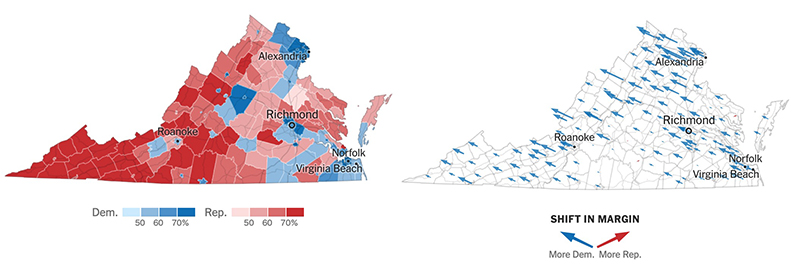
The map on the left above shows Tuesday's gubernatorial results in Virginia by county. The map on the right shows the partisan shift compared to the 2024 presidential election. What is noteworthy is that most counties are still red, but every county in the state—even the reddest ones—moved toward the Democrats. There is a message here for Democrats, although they may miss it. It is that campaigning in red areas matters. Losing a red county by 10,000 fewer votes is just as important in statewide elections as winning 10,000 more votes in a blue county. Showing up and making a pitch that Trump lied to people about affordability could be a winner. If Democrats don't even show up, the message is "We don't care about you." (V)
Supreme Court May Have Suddenly Discovered the Constitution
Yesterday, the U.S. Supreme Court held oral arguments in Learning Resources, Inc. v. Trump, in which the Trump administration appealed his lower court losses that held his tariffs are unlawful. As happens so often with this administration, Trump made up an emergency and then signed executive orders unilaterally imposing outrageous tariffs on imported goods from just about every country in the world, including an island inhabited only by penguins. Who can forget Trump triumphantly holding up a poster listing all the countries to be targeted, including Heard Island, a UNESCO World Heritage site that is home to penguins, elephant seals and sea birds—but no people? He then handed the mess off to his Solicitor General John Sauer to reverse engineer a legal justification for his power grab—a tall order, since the Constitution specifically names levying tariffs as a power belonging exclusively to Congress.
Sauer gamely tried to convince two courts that Trump was given this power by Congress in a statute called the International Emergency Economic Powers Act (IEEPA), pronounced by the lawyers as Eye-ee-pa. He was unsuccessful in the D.C. district court and before the Court of International Trade and appears to be on shaky ground with the Supreme Court.
This case pits Congress' Article I taxation power against the president's Article II powers over foreign affairs and whether Congress would or could delegate any of its taxing power without a clear indication it was doing so. The question before the Justices is a straightforward one: Does IEEPA authorize the president to impose tariffs? The statute itself says nothing about tariffs. Instead, the statute addresses the president's power during a declared national emergency to handle an "unusual and extraordinary threat" originating outside the U.S. The statute authorizes the president to, among other things, "...regulate... the importation or exportation of, or dealing in... or transactions involving, any property in which any foreign country... has any interest..." Meanwhile, Title 19 of the U.S. Code, which governs customs duties (i.e. tariffs) and which Trump did not invoke, does allow the president to impose limited tariffs in some circumstances.
Against that backdrop, Sauer tried mightily to convince the Justices that the word "regulate" in IEEPA allows the president to have unlimited power to impose tariffs on any country in any amount at any time. Even this Supreme Court was skeptical of that position. They noted that just last year they overturned the Chevron standard and no longer show deference to an agency's interpretation of a statute that explicitly outlines its authority. So, how can they find that Congress implicitly intended to hand over its taxing power over foreign entities to the executive branch?
Sauer then argued, well, this isn't actually a tax because its purpose is not to generate revenue but to bring these countries to the negotiating table. In that sense, it's a "regulatory tariff," so it falls more squarely in Trump's authority over foreign affairs. At that point, Chief Justice John Roberts mentioned the claims by Trump that the tariffs are reducing the deficit and also that tariffs were imposed on countries where the U.S. enjoys a trade surplus, like Switzerland. The Justices did not seem persuaded that calling it by a different name could serve to change the character of the tariff or that a "regulatory tariff" is even a thing.
The Justices also pointed out that if Trump's powers extend this far, a Democratic administration could declare climate change a national emergency and impose sweeping tariffs on all gas-powered cars imported into the U.S. Sauer had to concede that would indeed be possible. Gorsuch also expressed concern that reading the statute as conferring this power on the president would mean that it would be impossible for Congress to take it back since the president could veto such efforts.
Finally, the Justices asked how its "major questions doctrine" impacted the government's argument. In 2022, the Court introduced a new method to scrutinize agencies' regulatory actions by holding that regulations of significant political or economic issues must have clear Congressional authority. No one disputes that IEEPA does NOT contain clear Congressional authority giving the president the power to unilaterally impose tariffs however he sees fit.
The only clear votes for Trump's position came from the usual suspects, Associate Justices Clarence Thomas and Samuel Alito. Associate Justices Brett Kavanaugh and Amy Coney Barrett at times seemed to agree that the statute could be read that broadly but struggled with the fact that no other president has used it in this way and other statutes do not have the word "regulate" do so much heavy lifting.
Interestingly, no one argued that Trump's declaration of a national emergency is bogus. They all seemed to accept that his claims, however outlandish, were not part of the case and perhaps not even subject to judicial review. That issue was potentially left for another day.
We are not the only ones who believe the Court may finally rule definitively against Trump—and on his signature issue. Most outlets agree that the Justices were skeptical of Trump's position. Amy Howe of SCOTUSblog writes that "a majority of the justices appeared to agree with the small businesses and states challenging the tariffs that they exceeded the powers given to the president under a federal law providing him the authority to regulate commerce during national emergencies created by foreign threats."
This case was heard on an expedited basis before final judgment in the lower court. The Court stayed the TRO the lower court had put in place, and the plaintiffs claim that because the tariffs are currently in place, their small businesses are at risk if the Court does not decide this case quickly. Because this case was fast-tracked, a decision is likely to come much sooner than the end of the term.
If Trump loses—and again, the tea leaves are reading that way—it will be a huge blow to his foreign policy, such as it is. Most other nations, to be blunt, don't really take him seriously. But they do work with him, because he has the ability to influence vast amounts of international trade. If he loses the main (and really only) tool he has for that, he's going to have an even harder time securing new trade deals (something he tends to lose on, even WITH the tariff threats), and he's going to have an even harder time securing "wins," even the not-really-credible wins, like [COUNTRY X] promising, cross their hearts, hope to die, they will invest [TENS/HUNDREDS] of billions in the U.S. (L)
Wes Moore Wants to Redistrict Maryland
As a result of the elections Tuesday, two states are going to redraw their congressional maps: California and Virginia. This could net the Democrats about 8 seats, which might cancel out the Republicans' 2025 gerrymandering so far. If the Supreme Court kills the rest of the Voting Rights Act, at least half a dozen states in the South are going to dismember all of their majority-minority House districts, which could net another 5-10 seats for the Republicans, depending on how good they are at it. So the Democrats are scrounging for every seat they can.
Maryland is not exactly the Democrats' happy hunting grounds since there is only one Republican member of its House delegation that could be gerrymandered out of a job. Nevertheless, when every seat counts, well, every seat counts. Gov. Wes Moore (D-MD), who previously was lukewarm on redistricting, has changed his mind. He is now going to create a redistricting commission to redistrict Rep. Andy Harris (R-MD) out of his MD-01 seat. It may not be so easy. Maryland already has one of the worst gerrymanders in the country, with districts that are anything but compact. Look at the purple district, MD-03, for example. Here is the current map:
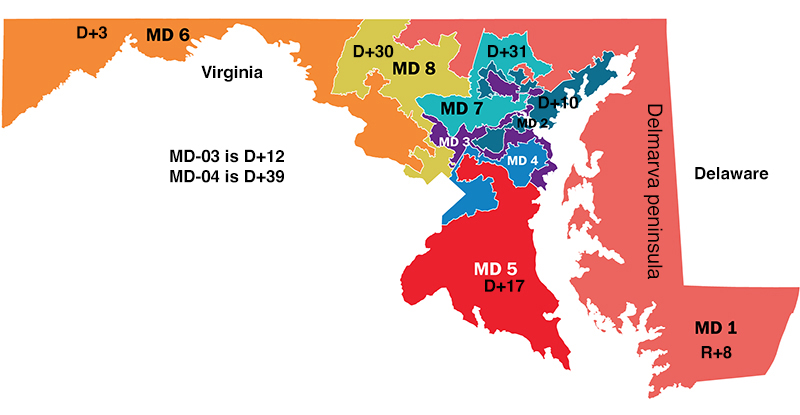
MD-07 and MD-08, which are contiguous with MD-01, have plenty of excess Democrats to dump into MD-01. The problem is that districts need to be roughly equal in population and contiguous and there is no place to put the Republicans in the Delmarva peninsula unless Maryland and Delaware renegotiate the border. Even the best gerrymanderers can't move unwanted voters out of state. It will take quite a bit of fine tuning to adjust the border of MD-01 with MD-02, MD-07 and MD-08 to expel enough Republicans. The problem is that the biggest concentrations of Republicans are in Queen Anne's County and Caroline County, which are in the middle of the Delmarva peninsula. The redistricting commission will have its work cut out for it. Of course, MD-01 doesn't have to be a slam dunk. Going from R+8 to, say, R+3, would make it winnable in a blue wave.
This isn't the first time Maryland Democrats have eyed Harris' seat. They went after it in 2020 after the census but a state judge said that the map violated the state Constitution's requirement of fair districts. But it is worth trying again. Maybe a different judge will have a different view in light of what other states are doing. (V)
Democrats Could Win a House Seat in Utah...
While we are on the subject of extreme gerrymandering, let's take a look at Utah. Heavily Democratic Salt Lake County has 1.2 million of Utah's 3.5 million residents, so you might think Democrats could win (at least) one of Utah's four House seats. If you thought that, how silly of you. The Republican-controlled state legislature prevented that disaster by dividing Salt Lake County among the four outlying districts to make sure no Democrat could be elected to the House. In August, a state judge threw the map out as a violation of the state's Constitution.
A new court-ordered map isn't quite as bad as the original. One district is R+6 and another R+11. In a blue wave, winning an R+6 district is at least conceivable. An R+11 district would require a really big blue tsunami, and Utah is over 500 miles from the nearest ocean. Still, the Democrats are drooling over the R+6 district. With the current map, three of the districts are R+10 and one is R+14. The new map needs to be approved by a judge by Nov. 10.
Democrats even have a candidate lined up. It is former representative Ben McAdams, who unseated then-Rep. Mia Love in 2018 during the blue wave that netted the Democrats 41 House seats that year. McAdams lost to Rep. Burgess Owens (R-UT) in 2020 by 3,765 votes. McAdams is likely to face a primary, though, from 2024 Senate candidate Caroline Gleich and a couple of state senators. Gleich is a professional skier and environmental activist. Winning the new R+6 district will be an uphill climb, but Gleich knows about uphill climbs. She scaled Mt. Everest in 2019. (V)
...But Lose a House Seat in Maine
Just when the House was starting to look good for the Democrats, they got bad news from one of their own. Rep. Jared Golden (D-ME) will not run for reelection. And he is not running for governor or the Senate. He is quitting politics. He said he never loved politics and just wants out.
This is not good for the blue team. ME-02, the biggest district east of the Mississippi by land area, is very white, very rural, and is R+4. Golden is a Blue Dog and was able to hold it, even though the Democrats are not that popular there out in the woods. It may be hard for the blue team to find a replacement, although in a blue wave, like the one on Tuesday, if they find a strong candidate, they have a chance. So far this cycle 14 Democrats have announced their retirements vs. 17 Republicans. The bad news for the Democrats is that most of the retiring Republicans are in safe districts. Ten of them are in districts running from R+10 to R+17. Unless the Republicans nominate real turkeys for those seats, they are safe. The list of retirements is available in the menu to the left of the map above. (V)
This Woman May Put Her Thumb on the Scale
Do you recognize this person?

If you said: "Of course, that is Rep. Suzan DelBene (D-WA)," give yourself a pat on the back (but be careful not to twist your arm). She is somewhat low-profile to the average voter, but very well known by all members of the House and wannabe members of the House. Before being elected to Congress in 2012, she helped found several startups, including drugstore.com, and was later a high-ranking executive at Microsoft. She is now chair of the DCCC (for the second time) and the point person in the Democrats' drive to capture the House.
She recently made it known that she might well meddle in Democratic primaries in swing districts in order to ensure that the strongest general-election candidate wins the primary. In swing districts, this will invariably be a moderate. In other words, given a choice between an Abigail Spanberger clone and a Zohran Mamdani clone, her money, well, the DCCC's money, will be on the Spanberger clone. This will not make progressives happy.
Traditionally, neither party's House and Senate committees have meddled in primaries much, but those days are ending. DelBene's goal is to win the House and that will guide all her decisions. She did note that she will not interfere in dark-blue districts, where any Democrat, moderate or progressive, will automatically win. In effect, she put progressives on notice that they are free to try to win primaries in D+10 and bluer districts that are not in danger, but kindly stay out of districts the Democrats could lose with too progressive a candidate.
She has interfered in primaries before, but there could be more this time because the stakes are so high. For example, last cycle the DCCC backed Janelle Bynum in the primary against the Congressional Progressive Caucus' favorite Jamie McLeod-Skinner in OR-05, a D+4 district. Bynum won the primary and the general election.
Another factor that DelBene didn't address is not moderate vs. progressive but young vs. old. It is clear the Democratic base wants generational change. In many cases, the young candidate is more progressive than the older one, but not always. In the Massachusetts Senate primary, for example, the much younger candidate, Rep. Seth Moulton (D-MA), is not as progressive as the 79-year-old Sen. Ed Markey (D-MA). If that happens in a House race, DelBene will go with the one she thinks has the best chance in the general election. (V)
Federal Agencies No Longer Help States and Local Governments with Cybersecurity
Donald Trump doesn't think cybersecurity is important. So what if Russia or China or Iran hacks an election? No big deal, right? The ayatollahs are all conservative so they must be Republicans, right? In April, Trump fired Gen. Timothy Haugh, the director of the NSA and head of the U.S. Cyber Command, on the advice of noted cybersecurity expert Laura Loomer, who didn't think the widely respected Haugh was Trumpish enough.
Now the saga is continuing. In the past, federal agencies have helped states and local governments with both cyber and physical security threats. They do this because the states and local governments generally have small security budgets combined with a total absence of expertise. But this year, the feds will not come charging over the hill to the rescue. The election monitoring room CISA (the Cybersecurity and Infrastructure Agency) will be closed. In past elections, it was a resource states and localities could call on for security help. No more.
In addition, the Election Infrastructure Information Sharing and Analysis Center has had its budget zeroed out, so it is gone. It collected and shared cyberthreat information in real time. States, counties and cities are now on their own. Most of them have no security infrastructure and are totally unprepared to ward off any attacks.
In addition, the CISA staff who monitored election equipment, including field workers who went out there and
inspected voting equipment, were all laid off. Instead, monitors were sent to California and New Jersey to
intimidate observe voters instead of making sure the equipment wasn't hacked. As it turns out, it didn't work and
the voters weren't intimidated in large numbers. Maybe next time.
It is worth pointing out that the thinking of Trump (and whatever acolytes are behind this) is exceedingly narrow-minded. And we don't just mean in terms of putting personal needs ahead of the nation's needs, though it's that as well. We mean that many (and maybe all) of the nations that might interfere with elections don't care about Republican vs. Democratic, per se. They care about current regime vs. new regime. And if they don't like the current regime, say because it is unpredictable on trade policy, or because it's careless about nuclear weapons, they could well try to achieve regime change, even if those countries are ostensibly "conservative." (V)
Americans Blame Trump for Rising Prices
As you have probably heard 100 times by now, voters are extremely sensitive to prices and inflation. Democracy doesn't interest them much, it often seems, nor does dictatorship, but prices are front and center. A new Ipsos poll shows that Americans definitely blame Donald Trump for the current rate of inflation. He will try to blame Joe Biden, Kamala Harris, Barack Obama, Zohran Mamdani, Nancy Pelosi, Bad Bunny, Bozo the Clown, Charles III, Charles II, Charles I (a toothless or, at least, headless, accusation), Charles Martel, Charles the Great, Charles the Bald (OK, maybe too close to home), Attila the Hun or somebody else, but that is not going to work. People have already decided this is the Trump economy—and they are not happy with it. Here are the responses to the question: Is Donald Trump to blame for the current rate of inflation?
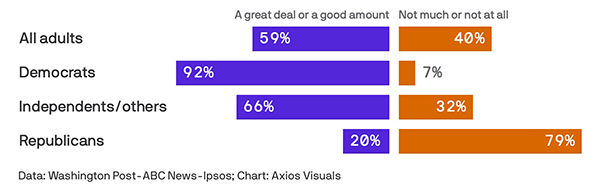
Among all adults, Trump is 19 points under water and that is more likely to get worse than better, especially if the tariffs stick. Or if their aftereffects stick, which is likely, even if Trump loses at the Supreme Court (see above). Seven in 10 Americans say they are spending more on groceries this year than last. In addition, SNAP benefits are in limbo. People who never needed food banks before are flocking to them.
High food prices disproportionately affect working-class families—that is, Trump's base. Also important is that energy prices are up 12% over the past year. That is also something they notice. Americans have found a scapegoat for the price increases: Trump's tariffs, with 58% believing this.
On Tuesday, candidates who hammered on prices, in particular Zohran Mamdani, Abigail Spanberger and Mikie Sherrill, did very well. The topic of prices is not going to go away. Famed economics expert Rep. Marjorie Taylor Greene (R-GA) said: "I can't see into the future, but I see Republicans losing the House if Americans are continuing to go paycheck-to-paycheck." For the record, in case you are curious, the actual name of the governor-elect of New Jersey is Rebecca Michelle Sherrill. If you are curious where "Mikie" came from, here is the governor-elect explaining it. (V)
If you wish to contact us, please use one of these addresses. For the first two, please include your initials and city.
- questions@electoral-vote.com For questions about politics, civics, history, etc. to be answered on a Saturday
- comments@electoral-vote.com For "letters to the editor" for possible publication on a Sunday
- corrections@electoral-vote.com To tell us about typos or factual errors we should fix
- items@electoral-vote.com For general suggestions, ideas, etc.
To download a poster about the site to hang up, please click here.
Email a link to a friend.
---The Votemaster and Zenger
Nov05 Shutdown Politics: The Readership Speaks
Nov04 Dick Cheney Has Died
Nov04 Let Us Proposition You
Nov04 The Republicans Don't Know Jack...
Nov04 ...And the Case against Letitia James Might Collapse
Nov04 Chuy Garcia to Retire (or, This Is How They Do It in Chicago)
Nov04 There's Something Happening Here: The No Kings Protests, Part X
Nov03 Tomorrow Is Election Day
Nov03 The Poop Hits the Ventilator
Nov03 Socialism Comes to America
Nov03 Republicans Are Pushing Back on the Call to Nuke the Filibuster
Nov03 Americans Are Extremely Pessimistic about the Present and the Future
Nov03 JP Morgan Chase Told the Government about Fishy Transactions Involving Epstein
Nov03 Ohio Draws a New Congressional Map
Nov03 All Politics Is Now National
Nov02 Sunday Mailbag
Nov01 Saturday Q&A
Nov01 Reader Question of the Week: Student Counsel, Part IV
Oct31 Today in MAGA: Better Dead than Red?
Oct31 It's Up to You, New York: Will a Blue State Elect a MAGA Governor?
Oct31 Today in Dystopia: Putting the "New" in NewSpeak
Oct31 There's Something Happening Here: The No Kings Protests, Part IX
Oct31 I Read the News Today, Oh Boy: What Is Your Condition Right Now?
Oct31 This Week in Schadenfreude: Southern (Dakota) Man, Better Keep Your Head
Oct31 This Week in Freudenfreude: That's the (Holy) Spirit
Oct30 Trump Seems to Realize He Cannot Have a Third Term
Oct30 Judge Rules that U.S. Attorney in L.A. Was Not Legally Appointed
Oct30 Hegseth Moves to Fire Defense Workers
Oct30 The Fed, Flying Blind, Lowers Interest Rates
Oct30 Red States Are Champing at the Bit to Cut Up Majority-Minority Districts
Oct30 An Arizona Election Will Test Whether Turning Point USA Has Staying Power
Oct30 Cases against the Fake 2020 Electors Are Fizzling Out
Oct30 Dutch Election Was Held Yesterday
Oct29 Shutdown Update
Oct29 Some Senators Show Some Spine
Oct29 Israel Observes Ceasefire by Doing Some More Firing
Oct29 On Thin ICE, Part I: Greg Bovino
Oct29 On Thin ICE, Part II: The Purge
Oct29 Washington Post Approves of Trump's Gold-Encrusted Eyesore
Oct29 The Case of the Missing Teamster
Oct29 All in the Family
Oct29 There's Something Happening Here: The No Kings Protests, Part VIII
Oct28 Game of Shutdown Chess Continues
Oct28 Putting the "Con" in Conservative, Part IV: Pardon Me!
Oct28 Trump Had MRI, Cognitive Test
Oct28 Who Watches the Watchers
Oct28 A Bridge Too Far?
Oct28 There's Something Happening Here: The No Kings Protests, Part VII
Oct27 The TACO Trip

