


 Welcome & FAQs
  Table of Senate polls
 Senate graphs
 Tipping-point-state
 Congress: retirements
 Governor's races
 Icons for bloggers
 Data galore


• The U.S. and E.U. Have a Trade Deal
• The Administration Has Fired 100 Immigration Judges
• Trump Has Found a Way around the Impoundment Act
• Trump Is Slipping with Independents
• Trump Has His Candidate for Thom Tillis' Senate Seat
• Trump Is Already Deeply Involved in the 2026 Congressional Races
• Jeanine Pirro's Nomination for U.S. Attorney for D.C. Advances
• Is the Washington Post in a Death Spiral?
The Rosetta Stone Is in Florida
The entire right-wing ecosystem (echosystem?) thinks it has found the Rosetta Stone that will answer all their questions about Jeffrey Epstein. And she is conveniently located in a prison in Florida. The only real problem is nobody knows how to pronounce her name (and if you bungle her name, she won't talk to you, naturally). Yes, the person who can unlock all the secrets is Ghislaine Maxwell.
It doesn't take a stable genius to realize that she will say whatever Donald Trump wants her to say in order to get a pardon. Last week she talked to Deputy AG Todd Blanche for 2 days and gave him 100 names of people Epstein knew. The names haven't been released yet, but surely will be soon. We expect that most will be Democrats or other "elites" the base hates. If she is smart, she will also throw in the names of a few minor Republicans (ideally Republicans who are dead) just to add some credibility.
Now Blanche and AG Pam Bondi have to decide what to do with the list. If they just publish it, many voices on the right will cheer and say the story is now finished and, see, Trump wasn't involved. Case closed. If they go further and try to indict people, it will get messy, fast. A grand jury will have to be assembled and given the evidence. If the only evidence is testimony from a known criminal and perjurer who is highly motivated to lie some more, the grand jury may not be convinced. Grand jury proceedings are secret, but if there are no indictments, the base may turn on Bondi and keep asking: "Why aren't these people in prison?" An answer like: "Because the grand jury didn't think the evidence was worth much" isn't going to make the base happy.
There is one piece of hard evidence the House Democrats very much want: the actual birthday book The Wall Street Journal said exists and which Trump denies. A prominent lawyer who has represented hundreds of Epstein's victims, Brad Edwards, said that the book exists and the lawyers for Epstein's estate have the book. House Democrats have no power to subpoena it. House Republicans definitely have the power to subpoena it and also the power to make it somehow unfindable after they have it. Needless to say, Trump does not want the book to be shown to the media. It is not known if other copies exist.
Trump visited Scotland to play some golf at his Turnberry golf course and also talk to European Commission President Ursula von der Leyen (more below). But even there reporters asked him about a potential pardon for Maxwell. Trump's likely game plan here is straightforward: Maxwell testifies that many top Democrats knew Epstein well and participated in his illegal activities but that while Trump and Epstein were friends, Trump never participated in the activities. In return, Trump promises to pardon Maxwell on Jan. 20, 2029, at 11 a.m. Of course, Maxwell has to trust that he will deliver. He has a very poor track record on keeping his promises. Maybe she will demand getting the pardon now, but dated Jan. 20, 2029. She might also demand a less remote date; she doesn't particularly want to waste 3 more of her remaining years rotting in a women's prison.
It could also go the other way, where Maxwell says: "If you don't give me a pardon now (possibly dated Jan. 20, 2029, or sooner), I will tell everyone what you actually did and drive you from the White House." Of course, doing that might result in her being suicided, but that wouldn't help Trump. It would just make it worse. It could be a game of chicken, and we may soon find out who wins the cockfight.
Many right-wing pundits and podcasters are looking forward to hearing Maxwell's story. They clearly all expect she told Deputy AG Todd Blanche what he wanted to hear in return for a pardon. Among others champing at the bit for Maxwell's story are Alan Dershowitz, Benny Johnson, and Charlie Kirk. However, far-right activist Jack Posobiec was actually on the mark when he said that Maxwell has no interest in getting at the truth. Her interest is in getting a pardon and she will do and say whatever is necessary to get one. Interestingly enough, when asked about a possible pardon for Maxwell, Trump refused to rule it out.
Another aspect that hasn't been discussed much is that Epstein wasn't the kind of guy to celebrate his 50th birthday by having a quiet dinner with Maxwell somewhere. There was undoubtedly a big bash with many invitees. Some of them may have seen the book and could testify about having seen Trump's card. If enough of them say they saw the card, that could negate Maxwell's saying there was no such card.
It is getting hard to keep track of Epsteingate so Politico has compiled a convenient timeline of the major events, as follows:
- Jan. 30: Kash Patel vows to expose Epstein's connections.
- Feb. 21: Pam Bondi says: "The client list is sitting on my desk."
- Feb. 27: Bondi hands out binders labeled: "The Epstein Files: Phase 1."
- May ??: Bondi tells Trump his name appears in the Epstein files.
- May 7: Bondi says there are tens of thousands of videos of people with children or child porn.
- July 7: The DoJ releases a memo saying there is no "client list" and Epstein committed suicide.
- July 8: Trump lashes out at all the calls for the Epstein files.
- July 12: Kash Patel defends the DoJ memo and says all the conspiracy theories are false.
- July 13: Trump says Bondi is doing a fantastic job.
- July 15: Trump says the Epstein case is boring and the media should drop it.
- July 15: Trump says Bondi never told him about his name appearing in the Epstein files.
- July 16: Trump calls the Epstein case a hoax invented by radical left Democrats.
- July 17: Karoline Leavitt says there will be no special prosecutor appointed.
- July 17: The WSJ reports on the bawdy birthday card Trump sent Epstein.
- July 17: Trump asks Bondi to unseal the grand jury transcripts (but a judge later refused).
- July 18: Trump sues the WSJ, Rupert Murdoch and others over its report.
- July 22: Trump urges the DoJ to "go after" Obama.
For more detail about each item, see the article linked to above.
As we noted last week, the existence of the thousands of videos is not really in dispute. The DoJ specifically mentioned them on page 9 of a court filing made in the SDNY on July 8, 2019. It would seem to us it would be interesting to have a neutral party with a strong stomach watch them and see who is in them. This would be far more valuable than listening to who Maxwell fingers. We suggest you don't hold your breath until this happens (unless NY AG Letitia James decides she wants to see them). (V)
The U.S. and E.U. Have a Trade Deal
Yesterday Donald Trump and European Commission President Ursula von der Leyen announced that they have a tentative trade deal. Instead of the 30% tariff Trump had proposed for E.U. exports to the U.S., the tariff will be only 15% on most products. The tariffs on steel will remain at 50%, however. Additionally, the E.U. will buy $750 billion worth of liquified gas and will invest $600 billion in the U.S. and buy military equipment.
At first glance, it appears that the blackmail worked. Trump simply announced a 30% tariff on products from the E.U. and after a lot of negotiation and promises that the E.U. would invest in the U.S., Trump agreed to cut the tariff to 15%. The E.U. got nothing in return. Of course, this is only a tentative agreement and there could be a lot of pushback within the E.U. when everyone sees the details.
But even if the E.U. got nothing, there is a downside on 15% tariffs on products from the E.U. and Japan. That is probably not enough to cause any American companies to build factories in the U.S. to compete with imports, but it is enough to spark some inflation. Maybe Trump's endgame is to get a 15% tariff on exports from every country in the world. In most cases that will be up from roughly 0% to 15%. In this context, keep in mind that the famous Smoot-Hawley tariffs that energized the Great Depression raised tariffs from about 13.5% to 20%. This is a bigger jump than that. (V)
The Administration Has Fired 100 Immigration Judges
Immigration judges judge, well, immigration cases. They are not Article III judges, do not require Senate confirmation, and do not have lifetime tenure. They are DoJ (i.e., Executive Branch) employees and can be fired at will by the AG. There are 700 of them. Well, there WERE 700 of them. Now there are 600, as 100 of them have been fired since January.
Many of them are now sounding off about the reasons they suspect led to their firing. The firing of a single immigration judge is unusual, but the firing of 100 within a short period is unprecedented. They were fired by e-mail and some of them are not happy about it. Jennifer Peyton, a former supervising judge, said: "I cared about my job and was really good at it. That letter that I received, the three sentences, explained no reason why I was fired." She was appointed in 2016 and later helped to train, mentor, and oversee other judges. She had top-notch performance reviews and was never accused of any behavior inappropriate for a judge. The only thing she did that might be considered inappropriate by the administration is that she gave a tour of her Chicago courthouse to Sen. Dick Durbin (D-IL) in June. Durbin blasted the administration for firing Peyton, saying it was an "abuse of power."
Peyton thinks she knows why she and the others were fired. She thinks they were all on a watchlist of people not cooperating with the Trump agenda maintained by a right-wing organization. She plans to take action before the Equal Employment Opportunity Commission, although with Donald Trump's appointments to it, she is not likely to get very far.
Another immigration judge, Carla Espinoza, was fired while she was delivering a verdict. She noted that the firings were disproportionately women and ethnic minorities. She believes she was fired because she released a man who was accused of threatening Trump but was later shown to have been framed. Espinoza also said that the judges who remained feel very threatened and uncertain about their future. (V)
Trump Has Found a Way around the Impoundment Act
Richard Nixon had a habit of refusing to spend money on projects he disliked, even if Congress had duly appropriated funds for them. Congress got wise and passed a law banning this practice, which is known as impoundment. Donald Trump also wanted to impound funds during Trump v1.0, but was stymied by the law. Now he has learned a trick that is almost as good as impoundment and also legal. It rests on two peculiarities in the appropriation process:
- Bills to fund the government can be filibustered so they have to be bipartisan.
- Rescission bills to claw back funds already appropriated need only 50 votes plus the veep.
This has led the administration to use a new strategy. Make a bipartisan deal with the Democrats to include items both parties want in the funding bill. Then afterwards, retroactively cancel the parts the Democrats got as part of the deal using the rescissions process. This allows Republicans to negotiate an agreement with the Democrats and then later legally renege on it. Republicans have already done this once, the first time a rescission has been done in decades. Republicans are plotting to do it again with the bill needed to fund the government after Oct. 1. Democrats don't know what to do.
Part of the problem is that Republicans know that if they play dirty pool, they will get away with it because
Democrats won't respond in kind next time they get the trifecta. It is not in their nature for the Democrats to write
their own giant BBB, make the Republicans actually filibuster it in August on the floor of the Senate, turn off the air
conditioning, and run the heat in the Senate full blast to get it to over 100 F and wait for senators to drop like flies
from heat stroke. Republicans play hardball and Democrats play softball pickleball.
Sen. Chris Murphy (D-CT) said: "They are going to stab us in the back again." Sen. Susan Collins (R-ME) is concerned. She has asked OMB Director Russell Vought to aim for more cuts through the regular bipartisan order rather than through the rescissions process, which would infuriate the Democrats. Vought could care less what Collins wants, despite her being chair of the Senate Appropriations Committee, which (in theory) controls the appropriations process (along with its House counterpart). Vought dripped with arrogance when he said: "There is no voter in the country that went to the polls and said, 'I'm voting for a bipartisan appropriations process.'"
Sen Lisa Murkowski (R-AK) said of Vought: "I don't know what to think other than that he's testing to see where we're going to line up. Are we going to line up following our own Article I authorities or are we going to line up and just follow the president?" Big words, but of course, MACO.
But some senators are all for the rescissions strategy. Sen. John Kennedy (R-LA) said: "The only time I have seen us reduce spending is through a rescission package. I'll take a dozen of them." Actually, if he wanted to reduce spending, he could have voted against the BBB, but he didn't.
The only weapon Democrats have is to demand that the rescissions law be changed to make it subject to the same rules as the appropriations bill—that is, to make it subject to a filibuster. If the Republicans refuse, then the Democrats could refuse to vote for the appropriations bill and shut the government down on Oct. 1. This has obvious risks since this whole rescissions business is extremely inside baseball and almost no one (our loyal readers excepted) understands what is going on here. Trying to explain it to the public would be... challenging, at best. On the other hand, since the public doesn't understand the process at all, Democrats could shut down the government in October and say: "Republicans control the White House, the Senate, and the House. It is their job to fund the government. We are powerless. It is not our fault they are fighting with each other." This is not exactly the full story, but it might be good enough for many voters. In any event, come November 2026, voters might remember only two things: (1) Republicans control everything and (2) They couldn't fund the government so it shut down. It might work. (V)
Trump Is Slipping with Independents
A new poll from Gallup shows that Donald Trump's approval rating among all American adults has dropped to 37%, the lowest point of Trump v2.0. Trump's approval among Democrats is about what you would expect (2%), as is his approval among Republicans (80%). But among independents, it could be concerning to Trump, as it is only 29%. The poll was taken just after the BBB passed.
Presidential approval is always a big factor in midterm elections. When the president is unpopular, his party gets whacked harder than when he is popular, and 37% is pretty bad. Of course, there is plenty of time to recover, but that requires doing something people approve of.
On many issues, Trump's approval has dropped since the February Gallup poll. This includes foreign affairs (-3 since February), the Middle East (-4), the economy (-5), trade (-6) and immigration (-8). Gallup didn't ask about Ukraine and the budget in February, but Trump is down 8 points on Ukraine since March and 14 points on the budget since March.
Trump is strongest among Republicans on foreign affairs (93% approval) and, somewhat ironically, weakest on Ukraine (70%). Maybe Republicans don't realize that is a foreign country, and so falls under the rubric of "foreign affairs." He is strongest with independents on Iran (36%) and weakest with them on the budget (19%). Among Democrats, Trump's approval is single digits on everything except Ukraine, where it is 12%.
It is instructive to compare presidents since World War II. Gallup has computed the average approval over multiple polls in the second quarter of their presidencies. Here are the results:
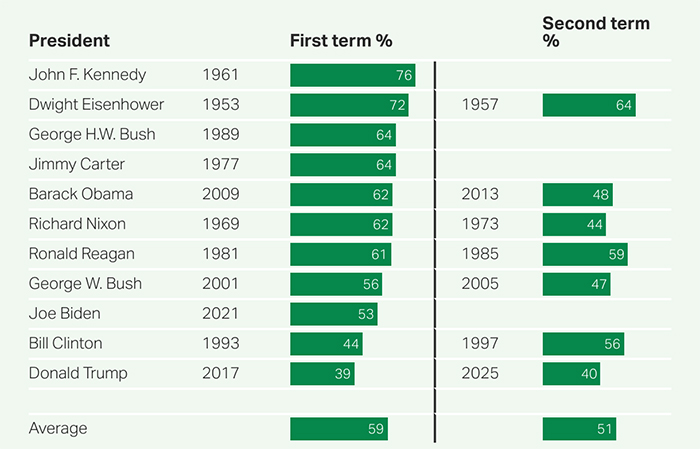
The worst-ever second-quarter performance is 39%, which Trump achieved in 2017. Next worst is 40%, which is Trump's average Q2 this year. The only president besides Trump to do better in his second term than his first term is Bill Clinton, who gained 12 points in his second term. Most other presidents took a real beating. (V)
Trump Has His Candidate for Thom Tillis' Senate Seat
Donald Trump effectively drove Sen. Thom Tillis (R-NC) out of the Senate. That probably wasn't a smart move, since incumbents generally survive midterms whereas open seats often go to the party not in the White House. We won't know for sure until next November. Nevertheless, Trump now has his candidate for the Senate in North Carolina. And surprise, it is not Lara Trump, who had been considering a race. Last week she announced that she was out. She said her decision was aided by discussion with her family, friends, and supporters. Interestingly enough, she didn't say that God told her not to run. After all, he intervenes in many races. Maybe he is a Yankee.
Why did Lara decide not to run? We don't know for sure, but some old polls showed that former governor Roy Cooper would beat Lara Trump soundly. If her own internal polls also showed that, that could be the real reason.
In any event, Donald Trump quickly got behind former RNC chairman Michael Whatley, even though Whatley is not in the race yet. He is expected to join soon. Whatley has never run for public office before, but he sure is interested in politics. As a high school sophomore, he helped out in the campaign of then-senator Jesse Helms. After getting a B.A. in history from UNC, a master's in religion from Wake Forest University, a master's in theology from Notre Dame, and a J.D. from Notre Dame, he joined the legal team working on the 2000 recount in Florida for George W. Bush. He later worked as chief of staff for then-senator Elizabeth Dole and later become a partner in a lobbying firm. In 2019, he became chairman of the North Carolina Republican Party and then chairman of the RNC. All those jobs are deeply political, but being around politicians is different from being the actual candidate.
Democrats are desperately hoping that former two-term governor Roy Cooper jumps in to challenge Whatley. Cooper has hinted that he will run, but hasn't come out and said it yet. Some rumors say that he will announce his entry as soon as today. If he does, the race will almost certainly be Whatley vs. Cooper, as no Republican has a chance challenging Trump's pick and no Democrat could beat the popular and experienced Cooper. Former Congressman Wiley Nickel (D) is already in, but as soon as Cooper jumps in, he's toast. If he is smart, he might be able to make a deal with Cooper that he will drop out and endorse Cooper in exchange for being Cooper's chief of staff if Cooper wins. We haven't seen any polling of Whatley-Cooper yet, but it won't be long. Hundreds of millions of dollars will soon flood into the state; North Carolina U.S. Senate elections are among the most expensive to be found anywhere, because the state is purple and has many large media markets. This might be a good time to buy stock in North Carolina radio and television stations. Business will be great for the next 16 months. (V)
Trump Is Already Deeply Involved in the 2026 Congressional Races
Donald Trump understands that if Democrats take the House in 2026, he will be impeached at least once, and possibly multiple times on different charges. He really wants to prevent this. Getting Texas to turn a few blue seats red is one way, but he has many irons in the fire.
Another way is selecting candidates. In open districts and districts where a Democratic incumbent is being challenged, Trump wants to avoid contentious and expensive primaries. His way of doing this is to pre-select and endorse candidates in the hopes of clearing the field. However, he also wants Trumpy candidates, who often have a "candidate quality" problem. Wanting to win and wanting a true-blue (true-red?) loyalist are sometimes in conflict.
As we get further along, Trump will also openly endorse candidates and campaign with them—if they want it. In swing districts, his endorsement and campaign appearances aren't always welcome, because although they excite the base they also enrage the opposition.
What Trump is also doing is encouraging candidates in swing districts to stay put and not run for higher office, rather than creating an empty seat. Case in point: IA-03, which is R+2 and includes Des Moines as well as many counties in the southwestern part of Iowa. The incumbent, Rep. Zach Nunn (R-IA), wants to run for governor, since that is an open-seat race. Trump ordered him to stay put in Congress, for fear of losing the seat. Nunn obeyed, but can't be too happy about it, since he had a good shot at becoming governor. Similarly, Trump ordered Rep. Mike Lawler (R-NY) to stay in his Hudson Valley seat and not run for governor of New York, even though Lawler is by far the strongest candidate the Republicans have in New York.
In Michigan, Trump told Rep. Bill Huizenga (R-MI) to stay put in his R+3 district and not run for the open Senate seat being vacated by Sen. Gary Peters (D-MI). Trump has endorsed Mike Rogers and doesn't want a primary, even though Rogers isn't all that Trumpy.
Sen. Joni Ernst (R-IA) knows she is going to die one day and hasn't decided if people who are going to die belong in the Senate. Trump wants her in there, even if she dies at her desk, like John Quincy Adams did. She is 55 and as long as she can hang on in there until Jan. 20, 2029, he doesn't care what happens to her after that. Trump is also concerned about Maine and definitely wants Sen. Susan Collins (R-ME) to run for reelection, even though she might well lose. Polls show that 70% of Mainers have had enough of her and she would probably prefer to go out a winner than have the people of Maine fire her, but Trump is pressuring her to run again.
Two close Trump aides, Tony Fabrizio, his pollster, and Chris LaCivita, his campaign manager, are his eyes and ears on the ground. They are scouting the land looking for places where Trump's presence or pressure could matter. Fabrizio is the pollster for more than a dozen statewide Republican candidates and LaCivita is involved in Mike Rogers' race as well as that of Sen. Lindsey Graham (R-SC). Both are in constant contact with Trump's chief of staff, Susie Wiles.
One race that is a conundrum is the Texas Senate race. Sen. John Cornyn (R-TX) is a loyal Republican and can be counted on to do what Senate Majority Leader John Thune (R-SD) tells him to do, but Cornyn is not very Trumpy. He is being challenged by the fire-breathing Texas AG Ken Paxton (R) who has a couple of "candidate quality" problems, like adultery, an ongoing divorce, and his impeachment by the Texas House. But he is Trumpy as hell. He is also probably the only Republican in Texas who could lose a statewide race. He may be to Texas what Roy Moore was to Alabama: a bridge too far. Trump has stayed out of the primary so far, waiting to see how it develops. (V)
Jeanine Pirro's Nomination for U.S. Attorney for D.C. Advances
Donald Trump strongly believes that being a Fox News host qualifies people for almost every job in government. So naturally, he is a strong supporter of Jeanine Pirro, his choice for U.S. attorney for D.C., one of the two most powerful U.S. attorneys in the country (along with the head of the SDNY). Pirro is somewhat qualified in the sense that she was Westchester County D.A. She is also extremely political, having run for lt. governor, senator, and attorney general. Of course, she either dropped out or lost all the races.
But her biggest qualification for one of the two most important U.S. attorney positions is her unflinching loyalty to Donald J. Trump. On Fox, she was a major source of lies about the 2020 presidential election and has advocated prosecuting the prosecutors of the Jan. 6 rioters. If Trump wants someone prosecuted, she will get on the case instantly. She will totally corrupt a key federal office.
Needless to say, almost all Republicans are for her nomination. The Senate Judiciary Committee has now advanced her nomination to a full vote of the Senate—despite her refusal to fill out the questionnaire the senators gave her to fill out. After all, if Trump supports someone, where did the senators get the idea that they have something to say about the nomination? She also refused to appear before the Committee to answer (largely pointless) questions. The vote was 12-10 along party lines.
This is Trump's second attempt at appointing a U.S. attorney for D.C. The first one, Ed Martin, was so bad that even Republicans were complaining about him and it was clear he would be rejected by the full Senate. (V)
Is the Washington Post in a Death Spiral?
It matters. There are four national newspapers with over 1 million subscribers: USA Today (2.0M), The Washington Post (2.5M), The Wall Street Journal (3.2M) and, on top, The New York Times (11.2M). Nearly all the subscribers are digital. The Times prints only 250K papers every day for its 11M subscribers. There are about 250 million adults in the U.S. so less than 8% of American adults have a subscription, digital or paper, to a national newspaper (probably much less since there are also many international subscribers). There are also regional and local newspapers, but they tend not to have much national news, and what they do have is from the wire services. They don't do much investigative reporting except possibly at the local level.
This means almost all national investigative reporting is up to four papers and a couple of wire services, mostly the AP and Reuters. TV stations do reporting, but it is mostly of the form "Politician [X] said [Y] today." Without investigative reporters, the news will simply consist of reporting what the administration and a handful of key senators are announcing. One of the four, the Post, which Jeff Bezos bought for $250 million in 2013, is showing signs of trouble. With only four major national newspapers, the possible demise of one of them is bad news.
Actually, the situation is even worse than it might appear. Investigative reporting is not USA Today's thing. It does a little, but its real goal is to make the readers feel good. The WSJ does heavy-duty investigative reporting, but its focus is business and it is owned by Rupert Murdoch, who gets to veto any reporting he doesn't like. Reuters is a serious organization, but is more focused on Europe than the U.S. That leaves the NYT, the Post, and the AP, plus occasional scoops from smaller outlets, and a few magazines. If the Post ceases to be top tier, that leaves just two main players.
The canary in the coal mine showing the potential death ahead is the—get this—obituary desk. The obit chief, Adam Bernstein, just jumped ship to the Times. All the others on the death beat quit save one, and that one is very junior.
Obit writers are unusual among newspaper staffers. They write up stories about powerful people and then carefully hide them for years until it is obit time. They don't generally have deadlines. They are also unusual in another way. The stories they write can (and often do) contain unsavory details the dearly departed would not like in a newspaper. But by the time the story hits the press or the server, the dearly departed is in no position to complain or sue. Getting rid of all the obit writers will mean future obituaries will be copied and pasted from Wikipedia and may be washed clean of any unpleasant truths about the deceased.
Historically, a Post obit was the ultimate status symbol. If you were important, your death will be covered. John Pope, the Pulitzer Prize-winning obit writer for the New Orleans Times-Picayune said: "When you see someone's obit in the newspaper, that is confirmation that the person mattered." The Post covered Washington like no other paper. Now we won't know who mattered. The people who were looking forward to dying so they could be written up in the Post may be so upset they refuse to die now. It is possible for a corpse to keep getting reelected to the Senate, at least, for a very long time (see Thurmond, Strom). On the other hand, there are said to be 900 pre-written obits waiting in cold storage for their namesakes to join them there.
Of possible interest to our older readers, the obit of Tom Lehrer went public yesterday. Here it is. No sequels to "Poisoning Pigeons in the Park." Sad. Now only 899 pre-written obits in cold storage.
The death of the obits page is part of a broader exit from the Post. Top opinion columnists Eugene Robinson, Jonathan Capehart, Ruth Marcus and Jennifer Rubin have all left. So did pioneering sports blogger Dan Steinberg. So have many lesser lights. Part of the problem is that Bezos is now interfering with the paper, something he didn't do at first. He installed a widely disliked publisher, William Lewis, to run the show. Then Bezos took a lot of flak for vetoing the planned endorsement of Kamala Harris. It also cost the paper 250,000 subscribers (and since 2020, the paper has lost 500,000 subscribers). Next up Bezos told all the opinion writers that they were henceforth to support personal liberties and free markets—that is, be libertarians. For a guy clearly as smart as Bezos, this was a really dumb move, since very few of the readers are libertarians and many more responded by ending their subscriptions.
Last week, JVL (Jonathan V. Last) over at The Bulwark had a newsletter about all the problems at the Post. Here is a summary:
- A steady stream of high-profile writers and editors has left.
- A lightly qualified editor, Adam O'Neal, was chosen to run the flagship Opinion section.
- William Lewis' only initiative, the Third Newsroom, was killed before it even started.
- Bezos not only killed the endorsement of Kamala Harris but then Lewis lied about it and was caught.
- In 2024, longtime executive editor Sally Buzbee left and the story about her departure was killed.
- In Jan. 2025, Bezos killed a cartoon from Pulitzer Prize-winning cartoonist Ann Telnaes, so she quit.
- In Feb. 2025, Opinion section editor David Shipley was canned because he wanted independence from on high.
- In March 2025, Lewis spiked a column by Marcus about what Bezos was doing to the Opinion page, so she quit.
JVL says a big part of the problem is Bezos' and Lewis' interference with the paper. All they are doing is getting the top talent to leave. Without top talent, you can't have a top newspaper. Bezos doesn't seem to care if he throws away his $250 million investment. After all, if Elon Musk is willing to throw away his $44 billion investment in eX-Twitter, what's a piddling $250 million?
JVL also says that the Post has a lot of legacy that hinders it. There are two opinion sections. No one knows why anymore. There are many more such quirks and they make it harder to evolve. When some piece of the paper is there for historical reasons, but doesn't really have any use anymore, it often continues because a small group involved with it wants to keep it going and no one else cares one way or the other. Getting rid of the many legacy bits requires strategic leadership and wisdom. The Post has none of that now.
Here are some examples. When the Post bought the Kaplan test-prep service in 1984 for $40 million, it diversified the company into a growing sector. When Bezos bought the Post, he didn't want Kaplan. This was when the Times bought the very popular Wordle to diversify.
One of Bezos' first projects was an attempt to turn the Post into a B2B vendor with a content management system called Arc. It failed. Another project is Ripple, where the paper will reprint content from a huge base of outside writers. It is a stupid idea. When AI will soon be producing free news summaries everywhere, what can keep a publication going is a real connection between the writers at the publication and the audience. Grabbing a few random articles from a big database of writers every day is the opposite of what is needed to achieve a connection between the publication and the audience. JVL's own publication, The Bulwark, is growing by leaps and bounds (over 1 million subscribers of which 100,000 are paying $100/year), in large part because there is a real attempt to build a community there with a handful of writers and podcasters, each with a clear personality. (V)
If you wish to contact us, please use one of these addresses. For the first two, please include your initials and city.
- questions@electoral-vote.com For questions about politics, civics, history, etc. to be answered on a Saturday
- comments@electoral-vote.com For "letters to the editor" for possible publication on a Sunday
- corrections@electoral-vote.com To tell us about typos or factual errors we should fix
- items@electoral-vote.com For general suggestions, ideas, etc.
To download a poster about the site to hang up, please click here.
Email a link to a friend.
---The Votemaster and Zenger
Jul26 Saturday Q&A
Jul26 Reader Question of the Week: Salud!
Jul25 The Epstein Files: Every Day, this Story Just Gets More Wild and Woolly
Jul25 States to White House: Extra Information on Voters Is Unneeded, Won't be Shared
Jul25 Candidate News: Who Will Succeed Tony Evers?
Jul25 Censorship Watch: Trump Is Made to Look Like a Buffoon
Jul25 Never Forget: Many Paths to Service
Jul25 I Read the News Today, Oh Boy: Ranger Rick (a.k.a. Rick Raccoon)
Jul25 This Week in Schadenfreude: The Appropriations Committee Did the First Lady No Favors
Jul25 This Week in Freudenfreude: Don't Judge a Man by His Tattoos
Jul24 POTUS Is Furious
Jul24 Democrats Are Struggling with a Possible Government Shutdown
Jul24 Bove's Nomination to the Third Circuit Clears a Key Hurdle
Jul24 Administration Removes Habba's Court-Appointed Successor
Jul24 Rand Paul Wants the Pardoned Anthony Fauci Charged with Something
Jul24 Big Law Caved but Little Law Didn't
Jul24 Virginia Is Beginning to Look Like a Disaster for Republicans
Jul23 Dead Men Tell No Tales, But a Live Woman Might Tell One or Two
Jul23 Today in Bending the Knee
Jul23 Iowa Wants to Go Back to the Front of the Line
Jul23 Democratic Presidential Candidate of the Week, #31: Gov. Katie Hobbs (D-AZ)
Jul23 Never Forget: A Moment Stuck in Time
Jul22 Of Course We Want to Release the Files, and... Hey! Look Over There!
Jul22 Republicans Want to Kill U.S. Tourist Industry
Jul22 Lots of Bad Polls for Trump
Jul22 Mark Green Makes It Official
Jul22 Never Forget: Flying Fox
Jul21 For a Dead Man, Jeffrey Epstein Keeps Making a Lot of News
Jul21 Trump Has Never Met a Scam He Didn't Like
Jul21 Trump Creates a Class of Easily Fireable Civil Servants
Jul21 Democrats Are Also Out There Talking about the BBB
Jul21 Sen. Warner Says Tulsi Gabbard Is Not Competent
Jul21 Jeffries Declines to Endorse Mamdani for Now
Jul21 Minnesota State Senator Convicted of Burglary
Jul20 Sunday Q&A
Jul20 Sunday Mailbag
Jul18 The Epstein Files: Story of The Week Just Keeps Chugging Along
Jul18 ICE Put on Ice: Judge Stops Government from Indiscriminately Grabbing People
Jul18 In Congress: Democrats Get Mad, But Not Even
Jul18 Programming Note: Stephen Colbert's Time on CBS Is Coming to an End
Jul18 Never Forget: Four Chaplains
Jul18 I Read the News Today, Oh Boy: Twinkle, Twinkle, Little Star
Jul18 This Week in Schadenfreude: Find a Loophole, Save a Fortune?
Jul18 This Week in Freudenfreude: The Day Mr. Rogers Made It Real Simple
Jul17 Democrats Are Warming to Using Epstein as a Wedge Issue
Jul17 Cue the Spin
Jul17 Republicans Are Trying to Claw Back Funding for Foreign Aid and Public Media
Jul17 Trump May or May Not Fire Jerome Powell
Jul17 Is Trump Readying His Next Supreme Court Pick?

