


 Welcome & FAQs
  Table of Senate polls
 Senate graphs
 Tipping-point-state
 Congress: retirements
 Governor's races
 Icons for bloggers
 Data galore


• The 2025 Election: Post Mortem, Part III--Blue Shift
• The 2025 Election: Post Mortem, Part IV--Democrats in a Quandary
• The 2025 Election: Post Mortem, Part V--Anti-Trans Can't Dance?
• Trump Is Giving Big Corporations a Huge Back-Door Tax Cut
• Republican Senators Are Very Nervous about Trump Going after Adam Schiff
• The Washington Post Is Losing It
• Stefanik Is Running for Governor of New York; House Democrats Are Cheering
You Got to Know When to Hold 'Em, Know When to Fold 'Em
When you're playing poker, and you're up a good bit, you have a decision to make. You can keep going, and hope that your good fortune and/or good play continue. Or you can call it a night, which means you won't be winning any more money, but you will also preserve the gains you've already made.
Late last night, the Senate had a "breakthrough" and managed to come up with a bill that can get 60 votes for cloture. That first procedural vote was already held, and succeeded 60-40. Here are the main provisions of the agreement:
- Government funding, at current levels, through January 30.
- Most federal workers (including 4,000 of them who were fired) will be able to return to their jobs and will be paid.
Trump cannot fire anyone prior to January 30.
- Funding for military construction, the Department of Veterans Affairs, the FDA, the Department of Agriculture
through September of next year. SNAP is administered by the latter department, and so people who need the program would
not be at risk of being cut off for the next 10 months.
- Protections for the Government Accountability Office (GAO), which keeps an eye on presidents and how they spend the
government's money.
- The Senate will hold a vote on ACA subsidies at some point in November or December.
Of course, the bill must work its way through the remaining Senate votes, then it must be passed by the House, then it must be signed by Donald Trump. The first of those three things is very likely to happen. The other two, you never know.
Now, let's talk about the politics of the deal. Sen. Rand Paul (R-KY) crossed the aisle, as he has done on all the other budget bills, to vote with the Democrats. So, we ended up with 52R + 7D + 1I for the bill and 38D + 1R + 1I against. Here is a list of the eight members of the Senate Democratic Caucus who voted for the deal, and why their votes are not surprising:
| Senator | Explanation |
| Dick Durbin (D-IL) | Retiring |
| Catherine Cortez Masto (D-NV) | Purple state; has voted for all the funding bills |
| John Fetterman (D-PA) | Purple state; has voted for all the funding bills |
| Maggie Hassan (D-NH) | Purple state |
| Tim Kaine (D-VA) | Purple state; represents many federal workers |
| Angus King (I-ME) | Purple state; has voted for all the funding bills |
| Jacky Rosen (D-NV) | Purple state |
| Jeanne Shaheen (D-NH) | Purple state; retiring |
This bears the hallmarks of a vote that was carefully managed to get it to 60 votes and not one vote more. Everyone here is either retiring (and is bulletproof) or has pretty good political reasons to steer a centrist course. Normally, with these "just enough" votes, the party leader is one of the 60. Obviously, that did not happen with Senate Minority Leader Chuck Schumer (D-NY), who did some very loud squawking and said he does not like this bill. Inasmuch as Schumer figures to face the reelection fight of his life in 2028 (possibly against AOC), it's plausible that he just could not afford to be one of the "yea" votes on this one.
In addition to Schumer, many other Senate Democrats complained about the bill. We have no doubt that some of them, like Sen. Bernie Sanders (I-VT), really are mad. Others... it's a little less clear. For example, Sen. John Hickenlooper (D-CO) voted no and said he didn't like the bill, but then turned around and declared that his colleagues who voted for the measure did not "cave," that they did "what they feel is helping the most number of people" and that "there is no good solution." It is very possible that much of the complaining yesterday is political theater for the benefit of voters, and that the Democrats decided as a group to take the deal, and then found the 8 caucus members (well, 5 members, since three were already voting "yea") who could most afford to vote a position that will be unpopular with many Democratic voters.
And that speaks to the risk that the Democrats are taking here. They were clearly "winning" the shutdown, in part because they remained unified and on message, and in part because Donald Trump has shot himself in the foot several times (more on that tomorrow). They could certainly have kept going, buoyed by Tuesday's election results. Now that they have "worked something out" without getting any firm concessions on health care, we may well see the return of "The Democrats caved again" and "The Democrats don't know how to play this game" and "DACO" (Democrats always chicken out).
However, sh** was about to get real. Many Americans were increasingly at risk of going hungry. Airline travel was turning into a mess, and with Thanksgiving right around the corner. Many federal employees were suffering due to the lack of pay. Any of those things could plausibly have changed the dynamics of the shutdown and of the polling. So, the blue team (or, at least, some members of the blue team) decided to quit while they were ahead. The Democrats have a huge burden the Republicans don't have: They care about people suffering; Republicans don't care who suffers, even when it is their own base.
As part of the negotiations, the Democrats did manage to advance some of their priorities. If you look at the list above, they really wanted to help out federal employees, and that happened. They also got money for the DoA and SNAP, and the vote on the health care subsidies. You might think the part about the GAO was a Democratic "win," but that part of the deal was actually put there because of demands from a few moderate Republican senators. That is very interesting—that some GOP members are asserting themselves, and (indirectly) defending their power of the purse. Anyhow, while the Democrats undoubtedly approve of that provision, it's not their doing.
And now, let's address a couple things the Democrats got that they cannot necessarily announce publicly. The vote on the subsidies is known, and it certainly seems like a loss, since a vote on the subsidies is not the same thing as restoring the subsidies. However, for those who would call it a loss, consider that maybe the blue team (the five new aisle-crossers, at least, and very possibly other Democratic members like Hickenlooper) are actually playing the long game. Well, not exactly long, but maybe the short-to-medium game. There are only three outcomes when it comes to the promised vote: (1) The subsidies are restored, or (2) The Republicans vote down the subsidies (again), either in the Senate or the House or (3) Senate Majority Leader John Thune (R-SD) refuses to hold the vote.
In the first case, the Democrats get what they want. In the second and third cases, they get crystal-clear proof that the Republicans are the ones who don't want poor people to have health insurance, which the blue team can then wield as a club in the 2026 elections. Oh, and if things don't work out to their satisfaction, the Democrats can resume their resistance on January 30, when the government will shut down again if there is no bill. In that scenario, the blue team will have even more political cover AND they won't have to worry about people who need SNAP going hungry, or veterans going without their pensions. In short, the Democrats got some pretty good stuff from a politics perspective without actually giving all that much up.
The second thing the Democrats got is pressure on Speaker Mike Johnson (R-LA) to reopen the House. If he does it, then Rep.-elect Adelita Grijalva (D-AZ) will have to be sworn in, and then Rep. Thomas Massie's (R-KY) Epstein files bill would have the necessary signatures to be brought to the floor of the House. If Johnson doesn't re-open, then he will open the Republicans up to withering criticism that they care more about protecting sexual predators than they do about hungry children. That is not a political winner.
Ultimately, many Democrats, including some who voted to hold the line (like Hickenlooper) concluded that the White House was never, ever going to give in on the subsidies. Shaheen, for example, concurred that "this was the only deal on the table." If that is true, then the blue team got about as much as they could have hoped to get, and they made the correct tactical decision—to cash out. If it is not true, and there was a real possibility of Trump caving, then the Democrats should have pushed all-in. That's really the crux of the matter; readers can decide for themselves if Hickenlooper, Shaheen, et al., assessed the situation correctly when they decided this was the best deal possible. (Z)
The 2025 Election: Post Mortem, Part III--Blue Shift
G. Elliott Morris, a data journalist who runs the blog Strength In Numbers, has taken a closer look at the election data from last week and come to some interesting conclusions. He examined the vote in every county in Georgia, New Jersey, Pennsylvania, and Virginia and compared it to the 2024 presidential election. He then plotted the 2025 vote margin for the Democrats against the 2024 vote margin for the Democrats. This is what it looks like for the counties within the D-50 to D+50 margin. Each circle is one county:
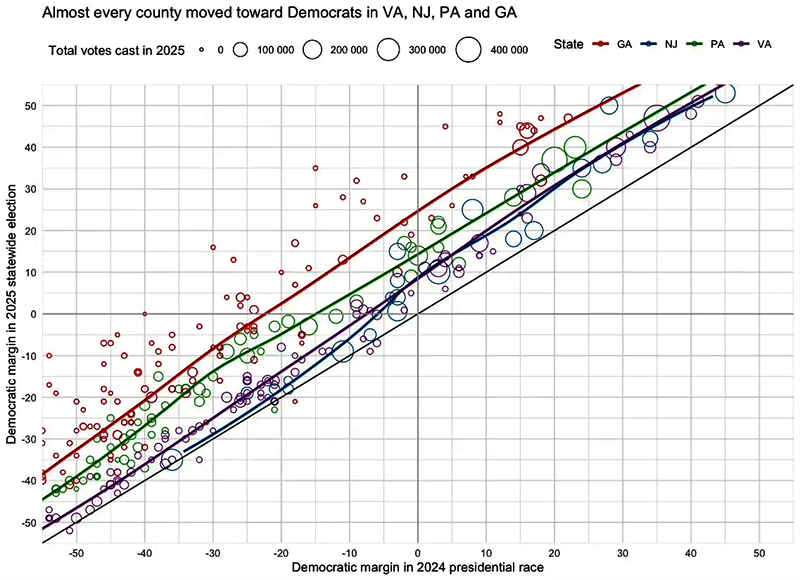
The solid black line is the line y = x, meaning there was no change from 2024 to 2025. Almost all the circles are above the black line, meaning the Democratic margin in 2025 was bigger than in 2024—that is, a shift toward the Democrats in almost all the counties in four states. That cannot be due to good or bad candidates in some particular race. It can only be due to a widespread popularity of the Democratic Party or a widespread dislike of the Republican Party (with the latter more likely).
The amount of shift varied by state. It was biggest in Georgia, next in Pennsylvania, then Virginia and finally New Jersey. What is noteworthy is that the shift was present in very red counties (far left of the graph), neutral counties (in the middle of the graph) and very blue counties (far right of the graph). This means that both Republican counties and Democratic counties moved to the left, across the board. This should be a warning to Republicans that unless they make some big changes, 2026 is probably not going to be a fun year for them. (V)
The 2025 Election: Post Mortem, Part IV--Democrats in a Quandary
While winning everywhere last week was nice for the Democrats, it has created a new problem, or at least exacerbated an old problem. Progressives point to New York City and say: "A young progressive crushed it and beat a much more experienced candidate. We need to run more young progressives." Moderates point to Virginia and say: "We went from D-2 in 2021 to D+15 in 2025 with a moderate white woman. That also worked in New Jersey. We need to try that in more places."
Both of them are right, of course—at least about the results. Now what? The battle between progressives and moderates will be on full display in many Democratic U.S. Senate primaries next year, such as in Maine, Massachusetts, Michigan, and Minnesota—and that is just the states starting with "M." In Maine, the battle is between a progressive oysterman, Graham Platner, and moderate Gov. Janet Mills (D-ME). Platner is the insurgent and the establishment is definitely with Mills. This race is not a pure test of progressive vs. moderate though, since Platner has a lot of baggage already, not the least of which is a Nazi tattoo on his chest. That could be a bridge too far for some progressive voters.
In Michigan, it is progressive firebrand state Sen. Mallory McMorrow (D) vs. moderate Rep. Haley Stevens (D-MI). Former Wayne County Health Director Abdul El-Sayed is more progressive than both women, but not as well known. The establishment is with Stevens, but wouldn't be terribly unhappy with McMorrow, since she might excite young voters more than Stevens.
The Massachusetts race is an oddity, since the senior-citizen incumbent, Sen. Ed Markey (D-MA), is the progressive and the upstart young challenger, Rep. Seth Moulton (D-MA), is the moderate. Here, the desire of many Democrats for young progressives is foiled. They can have either young or progressive, but not both.
In Minnesota, it is not as clear-cut. Lt. Gov. Peggy Flanagan (DFL-MN) is more progressive on policy issues than her Democratic opponent, Rep. Angie Craig (DFL-MN). In Congress, Craig tried to get things done and that meant compromising and working with Republicans. But Democrats are always very conscious of identity politics and here it is tougher. Both are women, so that cancels out. However Flanagan is a White Earth Nation Native American through her father, Marvin Manypenny. Her Ojibwe name is Gizhiiwewidamookwe. Her mother, Patricia Flanagan, is of Irish descent. Flanagan wouldn't be the first Native American in the Senate, as Ben Nighthorse Campbell (a member of the Northern Cheyenne Tribe) and Markwayne Mullin (a registered Cherokee Nation member) preceded her, but she would be the first Native American woman. On the other hand, Craig is a lesbian. She wouldn't be the first lesbian in the Senate though, as Sen. Tammy Baldwin (D-WI) broke that particular glass ceiling. Still, identity politics could play a role in the primary.
The outcome of these primaries could give a better feeling for which way Democratic voters want to go, especially if they all go in the same direction. If progressives sweep them all big time, then Rep. Alexandria Ocasio-Cortez (D-NY) might forego a Senate race she could probably win for a shot at the top job in her field. If moderates sweep them all, Gov. Andy Beshear (D-KY) might suddenly be propelled to the front of the race. If it is a 2-2 split, then Democrats will continue to fight with each other. (V)
The 2025 Election: Post Mortem, Part V--Anti-Trans Can't Dance?
During the 2024 presidential campaign, Donald Trump's campaign manager, Susie Wiles, spent $65 million on variations of one ad. It was about how, during her short-lived 2019 presidential campaign, Kamala Harris said she was fine with spending taxpayer money to allow prisoners to get sex-change operations. The tag line was: "Kamala is for they/them; President Trump is for you." Wiles is a smart operator and undoubtedly tested that ad nine ways to Sunday before spending that kind of money on it. Typically that would involve polling some city, running the ad there, then polling it again to see if anything changed.
The ad worked and possibly contributed to getting low-propensity voters (e.g., young Black and Latino men) to the polls, although that is hard to test. Naturally, Republicans thought they had found the holy grail and used it again in 2025. And... it flopped.
Both Winsome Earle-Sears in Virginia and Jack Ciattarelli in New Jersey made anti-trans ads a big part of their campaigns. Over half of Earle-Sears ads were about trans issues, like this one:
Of course, they both lost bigly. In the end, the two Republicans got virtually identical shares of the vote, 42.6% for Earle-Sears and 42.9% for Ciattarelli. That tells you two things: (1) candidate quality wasn't much of an issue, since Earle-Sears was clearly a weaker candidate than Ciattarelli and (2) both of them basically got the Republican votes in their states, and no others. The whole point of the anti-trans stuff is to peel off independents and even some Democrats who are really bothered by trans people in general, or by trans girls playing organized sports, or trans women in women's restrooms, or drag shows, or whatever. And please be clear, we understand that there is only a smattering of trans girls actually playing organized sports, that most trans women who use women's restrooms do not attract attention because they pass for assigned-female-at-birth women, and that the vast, vast majority of drag queens are not trans. Often, when it comes to trans, feelings don't care about your facts.
Both Republican gubernatorial candidates knew from surveys that something like 80% of the voters were on their side, so why did the issue fail them? We can think of three possible explanations. First, and most likely, is that that they didn't dig deeply enough. While the voters are anti-trans, to various degrees, this wasn't the top issue for them. It wasn't even in the top five. Things like the economy, health care, immigration, education, crime, taxes, and other items ranked way above trans issues, no matter who was being polled. That is not surprising; people pretty much always care more about these things than culture-wars stuff. That's doubly true when there is nervousness about things like the economy, health care, etc., which there clearly is right now.
The second possibility is something we've pointed out before: The bugaboo du jour only works for so long, and then a new one has to be found. There's a reason that Republicans today don't build their campaigns around gay marriage anymore—opposition to gay marriage is a minority position now, and the issue doesn't motivate very many voters who aren't already showing up to the polls and voting Republican. There's a reason that Donald Trump has moved on from his habit of making sure that every sentence has a noun, a verb, and a mention of MS-13. MS-13 wasn't moving the needle anymore. Maybe the anti-trans stuff is losing salience.
Third is that nearly any political framing has to be spot-on to work. Otherwise, the commercials and slogans and talking points basically become background noise. Wiles' "Harris is for they/them" shtick was clearly very compelling. But "Abigail Spanberger doesn't hate trans people enough" (see commercial above) doesn't have quite the same ring to it.
Still, Republicans are undaunted and planning to use anti-trans messaging again in 2026. The old ways die hard. Somehow, the Republicans are drunk on bigotry. Terry Schilling, president of the American Principles Project, said his group ran $2.5 million in ads in New Jersey and Virginia "to expose radical Democrats' support for gender insanity." He explained the lack of results by noting that they are solid blue territories. So, he is planning to try again against Roy Cooper in North Carolina and Sen. Jon Ossoff in Georgia.
However, the Global Strategy Group noted that when Democrats respond directly and early they can fend off the attacks by demonstrating their values and strength. Gov.-elect Abigail Spanberger ran this ad:
It talks about how she is a mom with three girls in public schools and how as a former law enforcement officer she went after child predators. It also talks about getting politics out of schools and her plans to make Virginia schools the best in the country. Rep. Sarah McBride (D-DE), who is trans and so knows this issue pretty well, said the Democrats' problem in 2024 was sticking their heads in the sand and ignoring the ads instead of confronting them head-on and responding directly. Undoubtedly, many Democrats will be scheduling meetings with McBride to learn how best to thread this particular needle. It might be ironic that McBride's election to the House could end up being a godsend to the Democrats. They now have a high-profile subject-matter expert to give them advice. (V)
Trump Is Giving Big Corporations a Huge Back-Door Tax Cut
The extension of the 2017 tax cuts was a gift to big corporations and the ultrawealthy, but no matter how much they get, it is never enough for them. So the Trump administration is working on more "tax cuts," but doing it under the radar so it doesn't get too much publicity, especially with all the stories about hungry SNAPless children floating around.
Rather than pass a law making the tax breaks explicit, the method chosen is to weaken a 2022 law that Joe Biden signed. A provision of that law, the Inflation Reduction Act, created a 15% Corporate Alternative Minimum Tax (CAMT) for the very largest corporations. Corporate taxation is very complicated because publicly traded companies want to show large profits to the shareholders but small profits to IRS. The former, book income, is governed by the Generally Accepted Accounting Principles (GAAP). The latter, taxable income, is governed by the Internal Revenue Code. Corporate tax lawyers are paid a lot of money to exploit the differences between the two so the company can show a large profit to the shareholders and little or no profit to the IRS. If you want to get into this stuff in more detail, but still in highly readable form, here is a good tutorial.
Very briefly, the CAMT starts with gross receipts and limits which deductions can be used to reduce tax liability (but allows them for business purposes). One area it addresses is how fast equipment can be depreciated. Another is international transactions. A favorite trick of manufacturing and tech-heavy companies is to set up a subsidiary in a low-tax country like Panama or the Cayman Islands and transfer patents to the subsidiary. Then the subsidiary charges the mother company in the U.S. an arm and a leg for use of the patents. The enormous royalty payments (for using their own patents) causes profits in the U.S. to go down and profits in the subsidiary to go up—but the tax rate there is low, which is why the subsidiary was placed there in the first place. The CAMT addresses this type of international shenanigans.
The CAMT doesn't get into the weeds on everything. Some of its power is due to Treasury regulations. What the administration is doing is changing these regulations to give breaks to giant private equity firms, crypto companies, foreign real estate investors, insurance companies, and certain other multinational corporations. What are the requirements for getting a break? There aren't any formal ones, but tossing a few tens of millions into the pot to help Trump keep his balls close to home is a plus. Got the picture? The CAMT was originally expected to bring in $222 billion over 10 years, but with the new and proposed regulations, most of that will be wiped out. It is effectively a $222 billion tax cut for very large corporations, even though Congress is out of the loop on this, despite its so-called power of the purse.
Not everyone likes this, not even conservatives. Kyle Pomerleau, a senior fellow and tax expert at the right-leaning American Enterprise Institute, said: "Treasury has clearly been enacting unlegislated tax cuts. Congress determines tax law. Treasury undermines this constitutional principle when it asserts more authority over the structure of the tax code than Congress provides it."
The administration is also busy dismantling regulations that shut down some extremely aggressive tax shelters used by oil companies and AT&T to save something like $100 billion. To make sure IRS doesn't put them back, the administration has suspended top officials who oversee taxation of large multinationals—for example, Holly Paz, an experienced professional who understands how these shelters work.
From Donald Trump's point of view, changing the regulations allows pinpointed tax breaks for specific Favored Companies without giving them to disfavored companies in the same business that are not using a particular tax shelter. This provides companies incentives to become Favored Companies. Fortunately for them, there are many ways to become a Favored Company, some of them involving tangibles (his balls) and some intangibles (his crypto). It's a good deal for some folks. (V)
Republican Senators Are Very Nervous about Trump Going after Adam Schiff
U.S. Attorney Lindsey Halligan of the Eastern District of Virginia has indicted former FBI Director James Comey and NY AG Letitia James. Republican senators know very well these are vindictive prosecutions and both cases are so weak that no U.S. attorney was willing to make a fool of himself or herself and file an indictment. Donald Trump had to first get rid of the previous U.S. attorney for Eastern Virginia, Erik Siebert, so he could put in someone willing to sign the indictments. Nevertheless, no Republican senators are talking about these indictments in public, even though they know very well that they are legal garbage and morally completely wrong.
Many of them are worried about what is next. They fear that Trump will order AG Pam Bondi to indict Sen. Adam Schiff (D-CA), whom Trump bitterly hates. Schiff's alleged "crime" is getting mortgages on his house in Burbank, CA, and his house in Potomac, MD, claiming both as a primary residence. Schiff is clearly a legal resident of California. He votes there, pays California state income tax, and has a California driver's license. His "crime" then would be claiming his house in Maryland as a "primary" residence, even though he lives there around 10 months a year.
The problem for the Republican senators is that their situations are almost all the same as Schiff's. Almost all of them own a home in their home state and most also have a home in D.C., Maryland, or Virginia as well, and very likely most of them claimed both as primary residences on their mortgage applications. If Trump can indict Schiff for having two primary residences, what is to stop a future Democratic president from asking his or her AG to indict them for the same offense as Schiff? This is making them very nervous.
In the end, Trump may not get his indictment (so easily). Schiff's house is in Maryland, so Halligan can't indict him. Trump will have to convince the U.S. Attorney for Maryland, Kelly Hayes, to do it, or replace her with a flunky who will. Hayes has a J.D. from a reputable law school, the University of North Carolina, and has been a prosecutor since 2013. She is not going to take on a case she knows she will lose. Trump could try to get rid of her, but it won't be so easy. Hayes is already serving as interim U.S. attorney after Trump's previous pick, Phil Selden, had to stand down. She was first appointed to replace Selden by AG Pam Bondi, back in February. Then she was re-appointed by the judges of the circuit in July. These things being the case, she can only be replaced by a Senate-confirmed nominee, or by a different attorney selected by the judges of the circuit. The Senate probably won't confirm someone whose clear mandate is to go after Schiff, and the judges definitely won't.
Trump violates norms left and right, but ordering the indictment of a sitting senator on essentially made-up charges takes his vengeance to an entirely new level. Senators can and have been indicted—former senator Bob Menendez comes to mind—but he was an actual crook, charged with a serious offense (taking bribes), and there was a mountain of very hard evidence (in the form of gold bars) against him.
If Trump goes ahead, it will be an impossible battle. In addition to an extremely weak case, Schiff has signed up legal giant WilmerHale to defend him and his lawyer is Preet Bharara, whom Trump fired from his job as a U.S. attorney in the SDNY in 2017. Schiff has also raised an undisclosed amount of money for his legal defense and has almost $9 million in his campaign account, which could be tapped if need be. Bharara is probably salivating at the prospect of handing Trump a very high-profile defeat in court and would probably have worked for free had that been necessary, which it isn't.
So far, no Republican has spoken up to defend Schiff, but in private many of them are very worried what this could do to the Senate now and possibly in the future, if the shoe is then on the other foot. All of this might come to a grinding halt if a Republican senator not up again until 2030 were to say out loud: "Indicting a U.S. senator on a made-up charge is such an abuse of power that the president should be impeached if he does it." But so far, much anguish in private but crickets in public. (V)
The Washington Post Is Losing It
Back when Katharine Graham was running the show at The Washington Post, she tried to emulate The New York Times and be a high-quality paper of record. The current owner, Jeff Bezos, wants to emulate The Washington Times. This editorial about New York City Mayor-elect Zohran Mamdani is beyond despicable. It drops all pretense of being written by journalists and is openly auditioning for the role of mouthpiece for the billionaire class. Here is the first paragraph:
A new era of class warfare has begun in New York, and no one is more excited than Generalissimo Zohran Mamdani. Witness the mayor-elect's change of character since his Tuesday election victory.
Generalissimo? WTF? Not even mayoralissimo. The second paragraph says he ran a nice-guy campaign who wanted to bring the city together. Then comes this third paragraph:
Across 23 angry minutes laced with identity politics and seething with resentment, Mamdani abandoned his cool disposition and made clear that his view of politics isn't about unity. It isn't about letting people build better lives for themselves. It is about identifying class enemies—from landlords who take advantage of tenants to "the bosses" who exploit workers—and then crushing them. His goal is not to increase wealth but to dole it out to favored groups. The word "growth" didn't appear in the speech, but President Donald Trump garnered eight mentions.
Mamdani's speech was about what you would expect from a candidate who had just won a huge victory. It was not the second coming of Karl Marx. Watch for yourself:
Readers posted almost 7,000 comments about the editorial, overwhelmingly critical of the editorial. Here is the AI summary of the comments.
The conversation explores a strong reaction to the Washington Post's editorial on Zohran Mamdani, with many participants criticizing the tone and language used in the piece. Several comments express disapproval of the editorial's use of terms like "generalissimo" and its portrayal of Mamdani's priorities, suggesting that it reflects a bias towards the interests of the wealthy and powerful. Some commenters argue that the editorial board's approach is more aligned with right-wing or pro-corporate perspectives, and they question the motivations behind the editorial. Others highlight Mamdani's focus on addressing economic inequality and supporting working people, contrasting it with the editorial's negative framing. Overall, the discussion reflects a significant dissatisfaction with the editorial's portrayal of Mamdani and raises concerns about the Washington Post's editorial direction under its current ownership.
We don't know Jeff Bezos' role in the editorial, but at the very least, he didn't kill it. Does he seriously think that Post readers are going to like this or be convinced by it? Has it occurred to him that, for many readers, this is going to be the straw that breaks the camel's back and they are going to cancel their subscriptions? Yes, he can put out all the propaganda he wants to since the Post is his personal toy, but if thousands of people drop their subscriptions, advertisers are not going to be willing to pay high prices for ads, which will be a double whammy: less income from subscribers and less income from advertisers. What's the end game here for Bezos? A heavily subsidized publication no one reads? For a guy as smart as Bezos, it is hard to fathom what he is up to. A gentle thumb on the scale, blocking criticism of Amazon and not endorsing candidates anymore, would have worked, but we suspect if editorials like this become the norm, he is on the path to destroying the paper altogether. (V)
Stefanik Is Running for Governor of New York; House Democrats Are Cheering
Rep. Elise Stefanik (R-NY) feels that her party has done her wrong. Now she is going to get even. But not quite in the way she is imagining it. Donald Trump nominated her to be U.N. ambassador, a job she wanted, so she gave up her position in the GOP House leadership. However, before she could be confirmed by the Senate, Trump pulled the plug on her because margins were so tight in the House that Mike Johnson did not want a vacancy for months until a special election was called. Stefanik couldn't get her leadership spot back because by then it had been taken by Rep. Lisa McClain (R-MI), who had no intention of giving it up. Suddenly Stefanik was a garden-variety backbencher, not in the leadership and not a Cabinet-level officer.
It has been speculated for months that she would run for governor of New York. Now she has formally announced a run. This has not been greeted with universal acclaim. In particular, some Republicans think she can't possibly win the general election because the current incarnation of Stefanik is extremely Trumpy. She doesn't really mean it. She is just an opportunist who senses which way the wind is blowing and goes with it, but detrumpifying herself now to run for governor would infuriate Trump. It is likely that Nassau County Executive Bruce Blakeman, who isn't as famous, but is politically a better fit for the New York GOP, will challenge Stefanik in a primary.
Democrats will enjoy the two of them tearing each other to bits for months—assuming they can tear themselves away from their own nasty gubernatorial primary between Gov. Kathy Hochul (D-NY) and Lt. Gov. Antonio Delgado (D-NY). In the GOP contest, the Democrats will certainly be rooting for Stefanik (and could quietly try to help her with a bit of old-fashioned ratf**king), but for a reason unrelated to the gubernatorial race. There are three New York House Republicans in swing districts: Mike Lawler (NY-17, D+1), Nick LaLota (NY-01, R+4) and Andrew Garbarino (NY-02, R+6). Democrats think that having Stefanik on top of the GOP ticket could be a gift to them, as she could weigh down the ticket, suppress the Republican vote, and help them flip the three Republican seats. It would be ironic if Johnson's call to Trump to kill her U.N. nomination because he needed her vote ended up in her causing three Republicans to lose their seats. And Johnson to lose his gavel, for that matter.
One way to prevent this scenario from taking place would be for the Republican Party to get behind the not-so-Trumpy Blakeman, but how would Trump respond to this? That might cause him to endorse Stefanik, creating a split in the Party. Trump doesn't think about things like party unity; he thinks about who supports him the most. It should be interesting. (V)
Previous report Next report
If you wish to contact us, please use one of these addresses. For the first two, please include your initials and city.
- questions@electoral-vote.com For questions about politics, civics, history, etc. to be answered on a Saturday
- comments@electoral-vote.com For "letters to the editor" for possible publication on a Sunday
- corrections@electoral-vote.com To tell us about typos or factual errors we should fix
- items@electoral-vote.com For general suggestions, ideas, etc.
To download a poster about the site to hang up, please click here.
Email a link to a friend.
---The Votemaster and Zenger
Nov08 Saturday Q&A
Nov08 Reader Question of the Week: Leisure Where?, Part I
Nov07 The 2025 Election: Post Mortem, Part II
Nov07 Into the Sunset: Nancy Pelosi, a Democratic Rock Star for Decades, Will Retire Next Year
Nov07 I Read the News Today, Oh Boy: Sign of the Times
Nov07 This Week in Schadenfreude: The Eyes are the Mirror of the Soul
Nov07 This Week in Freudenfreude: Carvd N Stone, Guardian of Good Vibes
Nov06 Some Media Takeaways from the Elections
Nov06 Supreme Court May Have Suddenly Discovered the Constitution
Nov06 Wes Moore Wants to Redistrict Maryland
Nov06 Democrats Could Win a House Seat in Utah...
Nov06 ...But Lose a House Seat in Maine
Nov06 This Woman May Put Her Thumb on the Scale
Nov06 Federal Agencies No Longer Help States and Local Governments with Cybersecurity
Nov06 Americans Blame Trump for Rising Prices
Nov05 The Red Team Is Feeling Blue
Nov05 Shutdown Politics: The Readership Speaks
Nov04 Dick Cheney Has Died
Nov04 Let Us Proposition You
Nov04 The Republicans Don't Know Jack...
Nov04 ...And the Case against Letitia James Might Collapse
Nov04 Chuy Garcia to Retire (or, This Is How They Do It in Chicago)
Nov04 There's Something Happening Here: The No Kings Protests, Part X
Nov03 Tomorrow Is Election Day
Nov03 The Poop Hits the Ventilator
Nov03 Socialism Comes to America
Nov03 Republicans Are Pushing Back on the Call to Nuke the Filibuster
Nov03 Americans Are Extremely Pessimistic about the Present and the Future
Nov03 JP Morgan Chase Told the Government about Fishy Transactions Involving Epstein
Nov03 Ohio Draws a New Congressional Map
Nov03 All Politics Is Now National
Nov02 Sunday Mailbag
Nov01 Saturday Q&A
Nov01 Reader Question of the Week: Student Counsel, Part IV
Oct31 Today in MAGA: Better Dead than Red?
Oct31 It's Up to You, New York: Will a Blue State Elect a MAGA Governor?
Oct31 Today in Dystopia: Putting the "New" in NewSpeak
Oct31 There's Something Happening Here: The No Kings Protests, Part IX
Oct31 I Read the News Today, Oh Boy: What Is Your Condition Right Now?
Oct31 This Week in Schadenfreude: Southern (Dakota) Man, Better Keep Your Head
Oct31 This Week in Freudenfreude: That's the (Holy) Spirit
Oct30 Trump Seems to Realize He Cannot Have a Third Term
Oct30 Judge Rules that U.S. Attorney in L.A. Was Not Legally Appointed
Oct30 Hegseth Moves to Fire Defense Workers
Oct30 The Fed, Flying Blind, Lowers Interest Rates
Oct30 Red States Are Champing at the Bit to Cut Up Majority-Minority Districts
Oct30 An Arizona Election Will Test Whether Turning Point USA Has Staying Power
Oct30 Cases against the Fake 2020 Electors Are Fizzling Out
Oct30 Dutch Election Was Held Yesterday

