


 Welcome & FAQs
  Table of Senate polls
 Senate graphs
 Tipping-point-state
 Congress: retirements
 Governor's races
 Icons for bloggers
 Data galore


• Voters in the Swing States Are Unhappy with Trump's Tariffs
• Trump Goes after Letitia James
• Trump Is Threatening to Take Harvard's Patents
• Trump's Retribution Tour Is in Full Swing
• Retirement Season Is on Hold
• Blue-State Republicans Are Upset with New Redistricting Push
• Should Democrats Threaten a Project 2026?
Trump to Meet Putin in Alaska
Donald Trump and Russian President Vladimir Putin will meet in Alaska on Friday. Trump may offer part of Ukraine to Russia in exchange for a temporary peace there so Putin can rebuild his decimated army. However, Ukrainian President Volodymyr Zelenskyy has already rejected that option and said that any deal about Ukraine must involve, well, Ukraine. Furthermore he noted that the Ukrainian Constitution does not give him the authority to give away or trade the country's land. Will Trump then pivot and offer to return Alaska to Russia in return for permission to build Trump Tower Moscow? Will Trump include Sen. Lisa Murkowski (R-AK) as part of the package, to get rid of her? We don't know what will happen except for one thing: Putin will own Trump.
Russian military bloggers were wildly enthusiastic about the meeting being in Alaska, which they regard as rightfully theirs and think should be returned. The choice of venue couldn't be worse, as it emphasizes that countries can sell or give their land to other countries. Geneva or Vienna would have been far better choices. Unfortunately, those are off the table, because there is an ICC warrant for Putin’s arrest. So, the meeting has to be in the U.S. or Russia.
When asked specifically by reporters about whether Ukraine would have to give up some territory for peace, Trump suggested that Ukraine might have to give up some land but might get some other land. Trump sees this as a real estate deal. Suppose he wants to buy some land for a building, but he needs a bit more on the east side, but doesn't need all the land on the north, so he'll trade some land here for some land there and we have a deal. In theory, if Trump got Putin to agree to give back Crimea, which he stole from Ukraine in 2014, in return for some land in the east, Zelenskyy might take the deal, but there is no way Putin would ever give back Crimea.
Just in case anyone has forgotten, Trump campaigned on a promise to end the war in Ukraine within 24 hours of taking office. Friday is day 208 of Trump v2.0 and we're not so sure about that deal being completed on Friday. More recently, you may remember that Trump sent a couple of nuclear submarines over to Putin's neck of the woods. Putin probably didn't see that as a gesture of love.
Another meeting of world leaders about somebody else's land comes to mind. It is the 1938 Munich Agreement in which British Prime Minister Neville Chamberlain and French Prime Minister Édouard Daladier gave Adolf Hitler the Sudetenland, a part of what was then Czechoslovakia, in return for a meaningless promise. Czechoslovakia had no representative at the meeting and no say in the deal. At the time, Winston Churchill said of Chamberlain: "You were given the choice between war and dishonor. You chose dishonor and you will have war." Hitler then swallowed all of Czechoslovakia and that set the stage for World War II. Could that happen again? Probably not, because Ukraine doesn't trust Russia and would never accept a deal without some security guarantees. Still, the chance of a deal that is favorable to Ukraine is very low, because neither Trump nor Putin cares one whit about Ukraine.
Maybe Trump can pull off a miracle, but much more likely he will get played. By now almost every world leader has figured out how to manipulate Trump: Make a meaningless promise that you have no intention of fulfilling so Trump can claim a win. European Commission President Ursula von der Leyen promised the E.U. would invest $600 billion in the U.S., but neglected to mention that all the money would come from private companies and only if they thought it worthwhile for themselves.
So, what could Putin promise? He could promise to stop selling oil to India (but then have China buy it and then resell it to India at a small markup). He could promise to stop attacking Kyiv with drones—and then in a few weeks begin attacking it with missiles. He could promise to work with the U.S. to exploit Ukraine's rare earths to reduce U.S. dependence on China in 10 years. He could promise to eliminate all tariffs on the $500 million worth of goods the U.S. sells to Russia (about the same as the U.S. exports to Bermuda or Latvia). Putin could promise to nominate Trump for the Nobel Peace Prize. There are lots of things Putin could promise since all Trump cares about is an announcement he can claim as a win. Then it is back to subjugating law firms, media companies, and universities. That he does care about.
Putin has a terrible record keeping his promises and just sees them as bargaining chips. He knows that Trump has no interest in the details. It's the handshake and the photo op that matter to Trump. Putin knows this very well. Ronald Reagan's approach to Russia was: "Trust but verify." Trump's approach is the same—except without the "verify" part. Putin could agree to a ceasefire and then break it in 2 weeks, something he has done before. What would Trump do then? Probably nothing.
John Bolton said of the meeting: "I have a feeling this is sliding very quickly in Russia's direction." Bolton thinks that Putin will make an offer to Trump that Trump may not even understand and then tell Zelenskyy that he has to accept it because "he has no cards." Again, Trump doesn't care what is in the deal. If Ukraine gets nothing out of the deal, that is fine with Trump. What Trump wants is to get credit for making a deal.
What might Putin want in a deal? He thinks tactically, as well as strategically. In the short run, he would like a deal that Trump thinks is great but is completely unacceptable to the other NATO members, thus driving a wedge between Trump and the rest of NATO. For Putin, a good deal would include some land swaps and promises that no NATO troops would be stationed in Ukraine, Ukraine would not join any military alliances, Ukraine would not be rearmed by the West, and Ukraine would not be allowed to develop its own weapon industries. In other words, his requirement would be that Ukraine would be kept weak so Russia could invade again in a year or two and finally conquer the entire country.
Strategically, Putin is probably thinking about the Yalta conference in 1945, when Joseph Stalin, Franklin Delano Roosevelt, and Winston Churchill carved up Europe. Putin could propose this deal: Russia gets to be the boss of Europe, the U.S. gets to be the boss of North and South America, and China gets to be the boss of Asia. Trump might have some rudimentary knowledge of the world map and be thinking: "North America and South America combined are much bigger than Europe, so I got more real estate than Putin. Boy, I am a good negotiator. What a deal!" For Putin, this would be a gigantic win. He has said the 1991 breakup of the Soviet Union was the greatest geopolitical catastrophe of the century. If Trump agreed that Putin could reassemble it by force, Putin could go down in Russian history as one of the greatest czars of all time. (V)
Voters in the Swing States Are Unhappy with Trump's Tariffs
The effects of Donald Trump's tariffs vary by state. In some cases, they protect local industries. In others they don't protect anything but will raise prices. There have been a number of nationwide polls about the tariffs. They are very unpopular, overall, but how does that play state-by-state? The national polls don't break out the data by state and, in any event, the samples would be too small to be meaningful if they did. G. Elliott Morris (Nate Silver's successor at FiveThirtyEight until its demise) used statistical techniques to model the likely state-by-state views on the tariffs. See the link if you want to get down in the weeds, but roughly, he computed the correlation between people's views on the tariffs with their race, age, sex, education, income, and party nationally and then used the known state data to infer their views on tariffs. Very simplistically, if poor people hate the tariffs (because money is tight), then a state full of poor people will be more negative than a wealthy state. Here are the results for 13 states that have important elections (governor or senator or both) this cycle:
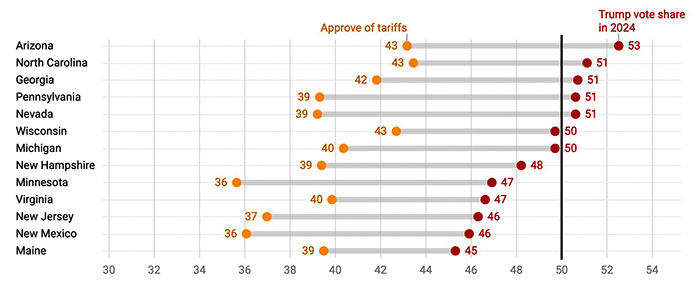
In each of the states above, the percentage of people who approve of the tariffs is lower than the percentage of the
vote Trump got in 2024. This means that a substantial number of Trump voters are unhappy with him on trade. The midterms
will not be entirely about trade, of course, but if there is a recession or there is inflation or both, it will be easy
for the Democrats to pin the tail on the donkey elephant and blame Trump's tariffs for their being squeezed.
In only 10 states is approval of the tariffs above 50%, and all of them are deep-red states. West Virginia is tops with 56% approval (vs. 70% of the vote in 2024). All of this suggests that talking about trade, starting right now, could be a good line of attack for the Democrats, especially in the states where it matters the most. (V)
Trump Goes after Letitia James
NY AG Letitia James has sued Donald Trump dozens of times, sometimes with great success. She won a civil case against him in Feb. 2024 in which he was ordered to pay $450 million in penalties for lying about his wealth to defraud New York banks. Including interest, the amount Trump owes is now over half a billion dollars. The case has been on appeal for a year and a half. Maybe all the appellate judges have died and everyone has forgotten the case.
Except Trump. He is very much still aware of it and is now trying to exact revenge by going after James. The DoJ has issued a subpoena to her as part of an investigation about whether making him pay up for defrauding the banks violated his civil rights. After all, the Fourteenth Amendment guarantees everyone, regardless of race, the right to defraud banks.
The case against James is being pursued by interim U.S. Attorney for the Northern District of New York John Sarcone. He worked for Trump's election team in the past. A panel of federal judges has refused to make Sarcone's appointment permanent.
There is one area where James is vulnerable. In 2023, she helped her niece buy a house in Virginia. She cosigned the mortgage application. There have been unverified media reports that she listed the house as her principal residence. If that turns out to be true, then in a sense, she has also defrauded a bank, which Trump will pursue to get her. This case is being prosecuted by Ed Martin, Trump's former nominee for U.S. Attorney for D.C. Martin was so obviously unqualified for that position that he was forced to withdraw because too many Republican senators saw him simply as a hit man for Trump. Then Trump appointed him a special prosecutor and sicced him on James. James has hired famed defense attorney Abbe Lowell to defend her. (V)
Trump Is Threatening to Take Harvard's Patents
Harvard hasn't caved to Donald Trump yet, so Trump is upping the pressure. Now he is threatening to take away Harvard's patents, allegedly because Harvard might not have complied with federal laws relating to patents. Needless to say, Harvard has access to some pretty good lawyers and it is unlikely that they made any errors when filing patent applications. Still, Trump is absolutely determined to beat Harvard (and other top universities) into submission and will try every tactic until he finds one that works. That there is no serious legal basis to what he is doing is of no interest to him. The patents are worth hundreds of millions of dollars.
Secretary of Commerce Howard Lutnick, who is carrying the ball for Trump on this one, said: "We believe that Harvard has failed to live up to its obligations to the American taxpayer and is in breach of the statutory, regulatory, and contractual requirements tied to Harvard's federally funded research programs and intellectual property arising therefrom." It is common, and perfectly legal, for universities to file for patents for inventions that are made as part of federally funded research done by their professors and students. Universities then license companies to use the patents. The companies pay licensing fees or royalties to the universities for use of the patents. This is the mechanism by which federally funded research turns into products and services that help Americans. This arrangement has worked well for more than 75 years and no one has ever complained about it before.
Lutnick has ordered Harvard to produce a list of all patents it has that stem from federal grants to see if they comply with the Bayh-Dole Act, which requires inventions coming out of federal research to be used to benefit Americans. For each patent, Lutnick wants to know if the patent is being used, the details of the licensing agreements, and where any manufacturing is taking place. A spokesperson from Harvard said: "Technologies and patents developed at Harvard are life-saving and industry-redefining. We are fully committed to complying with the Bayh-Dole Act and ensuring that the public is able to access and benefit from the many innovations that arise out of federally funded research at Harvard."
Of course, Trump has no interest in the Bayh-Dole Act. He just wants ways to punish Harvard if it refuses to submit to him. With Trump, the first thing he generally thinks of is money, so ways to punish universities financially are always on the top of his to-do list.
While attacks on Harvard, Columbia, and other top universities are getting the most attention, grants are being unilaterally terminated at many universities across the country. Thousands of grants from NIH, NSF, EPA, and other federal agencies have been prematurely terminated because they deal with clean energy, climate change, "woke social, behavioral, and economic sciences" and other areas Trump wants to stamp out. In many cases, the universities or the state governments are suing the federal government for terminating grants willy-nilly, but Florida is a special case. Gov. Ron DeSantis (R-FL) has encouraged the termination of grants to his own state universities, saying: "The Trump administration is working hard to get some of the rot out of higher education, the intellectual rot, the ideological rot."
Among other grants terminated is one to the University of South Florida that was designed to bring life-changing improvements to an underserved (minority) neighborhood of 10,000 people near Tampa. Another was helping to restore clean water service to 50 multifamily complexes whose well water and septic systems were polluted by Hurricane Milton. In the private sector, when party A contracts with party B to provide some service, the contract cannot just be unilaterally canceled if party A gets a new CEO who doesn't like the service as long as B is providing the contracted service. With government, it doesn't work like that. The government is actually allowed to terminate contracts at any time, but has to have a valid justification. There are going to be courts working overtime for the next several years to determine if that is the case here. (V)
Trump's Retribution Tour Is in Full Swing
One promise Donald Trump made during his campaign was to get retribution on anyone who has ever crossed him. It is a promise he is carrying out thoroughly and with great enthusiasm. He is going far beyond accusing his enemies of misdeeds. He is using the full power of the federal government to try to fire, investigate, and prosecute some of them already. Often, the only thing they did wrong is criticize him for breaking the law. In many cases, the prosecutions will fail, but the targets will end up with huge legal bills and lives that are greatly disrupted. These investigations are also meant to send a message to anyone thinking of criticizing him in the future. Here are some of the people he is going after:
- Barack Obama: Trump has not forgotten about the Russian interference in the 2016
election. He has even accused Obama of treason for allegedly manufacturing the notion that Russia interfered in the 2016
election on Trump's behalf. AG Pam Bondi has now opened a grand jury investigation into this, even though there is vast
evidence that Russia did interfere and no evidence that Obama or anyone in his administration committed any crimes. Like
so many of the others on this list, this is simply Trump punishing his enemies and making them run up serious legal
bills.
- James Comey: Trump fired Former FBI Director James Comey for investigating Russia's
interference in the 2016 election and its possible ties to Trump's campaign. Now the tables are turned and Trump has
ordered the FBI to investigate Comey.
- John Brennan: The Russia investigation partly involved former CIA Director John Brennan.
Trump has regularly attacked him. Now the FBI is investigating Brennan.
- Adam Schiff: Sen. Adam Schiff (D-CA) has had a special place in Trump's brain ever since
Schiff managed Trump's impeachment while he was in the House. Trump has called him a thief and said he should be
prosecuted. Schiff is sufficiently concerned that he hired Preet Bharara as his lawyer. The charge the DoJ is looking at
has something to do with mortgage fraud, something Schiff vehemently denies.
- Liz Cheney: As co-chair of the Jan. 6 House Committee, Cheney has received her share of
insults from Trump. He has called for a televised military tribunal for her, even though she is not in the military. So
far there are no credible reports of the FBI investigating her, but given Trump's hatred of her, that could yet come.
- The Vindmans: Lt. Col. Alexander Vindman (ret.) testified before the the House Intelligence
Committee about a phone call between Trump and Volodymyr Zelenskyy in which Trump tried to extort Zelenskyy into
investigating Hunter Biden. Trump didn't like this very much. Vindman's twin brother, Eugene Vindman, was deputy legal
adviser to the NSC and reported Trump's call to Zelenskyy to the NSC. Trump is not much of a fan of him
either. Eugene is now the Democratic representative for VA-07. Earlier this year, then-interim U.S. Attorney Ed Martin
was investigating both Vindmans about a business venture of theirs.
- Letitia James: Trump really hates her because if her case is upheld on appeal, he may
have to fork over half a billion dollars to New York State. The FBI is investigating her about a mortgage she cosigned
for her niece (see above).
- Jack Smith: For Trump, he is the worst of the worst, a dogged prosecutor who indicted him for stealing government documents when he left the White House and for his actions on Jan. 6. When Trump won the 2024 election, the cases were suspended. Trump sicced the Office of Special Counsel on Smith for alleged violations of the Hatch Act.
Most of these cases will not get very far, as they are all made up. Smith is probably hoping that his case actually gets to trial. Then he could bring up some of the material he found as part of his defense. Trump certainly does not want that. (V)
Retirement Season Is on Hold
The congressional August recess in the odd years is when members go home and talk to constituents, friends and family about whether they are up for another election circus. For older members, just being home makes then realize how much they love home and hate D.C. For others, being yelled at by constituents makes them wonder why they are in this crummy job. For still others, they realize that come September, they have to start begging for money again. For the previous 10 cycles, the average number of retirements has been 39, which is about 9% of the House. Here are the House retirement numbers for 2006 to 2026 (the 2026 numbers are preliminary, of course):
| | |||
| Year | Democrats | Republicans | Total |
| 2026 | 10 | 11 | 21 |
| 2024 | 24 | 21 | 45 |
| 2022 | 33 | 17 | 50 |
| 2020 | 12 | 36 | 48 |
| 2018 | 18 | 34 | 52 |
| 2016 | 8 | 20 | 28 |
| 2014 | 16 | 25 | 41 |
| 2012 | 23 | 20 | 43 |
| 2010 | 17 | 20 | 37 |
| 2008 | 6 | 27 | 33 |
| 2006 | 9 | 18 | 27 |
But this year there is a whole new consideration that has never happened before. Members are wondering: What will my district look like? In census years, the House districts are not changed. The first elections with the new districts are in the years like 20[X]2 (e.g., 2022). By the summer of 2021, the new district boundaries had been drawn and members knew what their districts looked like for the 2022 elections. There was no uncertainty about that in the summer preceding the election year. On account of all the furor about redistricting now, many members now have to consider what their new PVI will be.
This obviously strongly affects the members that are being targeted for defeat, but it affects many other members as well. When the legislature is busy stuffing voters of their own party into certain districts to defeat incumbents, those voters have to come from somewhere. For example, suppose there is a D+3 district with a Democratic representative that a Republican-controlled legislature wants to get rid of. The mapmakers can pull Republican precincts from neighboring (or sometimes not neighboring) districts and add them to the targeted district, while also moving Democrats out of the targeted district. But this has two kinds of consequences. The Republicans being added to the targeted district have to come from somewhere. This means that a safe neighboring R+10 district might have to become R+4 to supply Republicans to the target district. The member in the safe district may suddenly be in a competitive district and decide that fighting a competitive election isn't worth it and just retire. Similarly, the excess Democrats removed from the target district have to go somewhere. If there happens to be a convenient D+20 district nearby, they can go there without changing much, but that is not always the case. If some nearby incumbent suddenly discovers he or she has a bunch of new Democrats to woo, that could be the moment to throw in the towel.
The consequence of all the threats and feinting is that many members are holding their breath and waiting to see what happens. The result could be a spate of retirements in the fall instead of the summer.
But that has real consequences. Filing deadlines for primaries start to crop up in December. If a U.S. House member calls it quits in October, there is less time for state senators to plan a House campaign. And this cascades. If a state senator announces a run for the U.S. House in November, that leaves even less time for state House representatives to file for the vacant state Senate seat. Decisions may be made hastily and candidates who really aren't viable may jump in, possibly leading to messy primaries next spring. In short, we now have a level of uncertainty in the House that we have never had before at this point in the cycle. (V)
Blue-State Republicans Are Upset with New Redistricting Push
As we note above, many House members are nervous about the ongoing discussion about redistricting. Some are more nervous than others, namely Democrats in swing districts in red states and Republicans in swing districts in blue states. The former are powerless but the latter have some power. They can talk to Speaker Mike Johnson (R-LA) and point out that if these plans go forward, they and some of their colleagues will probably lose their seats, so the net result of all the redistricting may end up being zero while at the same time making independents, who don't like the idea of midterm redistricting at all, angry with Donald Trump and the Republican Party.
Axios has made a graphic showing which House incumbents in California, Texas, Ohio, and Missouri are on the front lines of the redistricting wars:
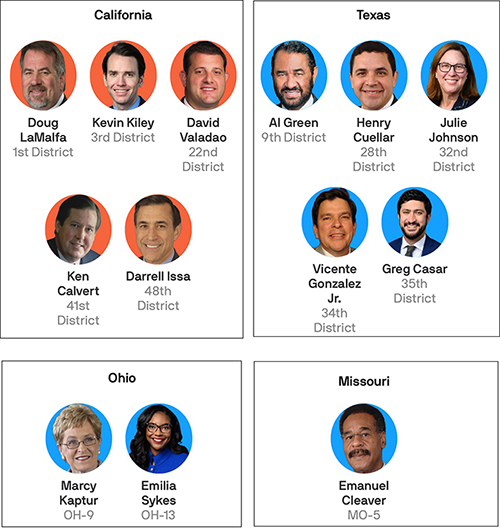
These aren't the only members in danger. If the Democrats really go to town, they could unseat Republicans in New Jersey as well, and maybe in Illinois, but that is tougher. New York is easy, but takes longer, since the process of changing the map requires two consecutive sessions of the state legislature to approve. This means New York can't change the map for 2026 but can change it for 2028.
The Florida map is already heavily gerrymandered, with 20 of the 28 House seats (71%) being occupied by Republicans, despite Donald Trump winning only 56% of the vote in Florida in 2024. Nevertheless, it is conceivable that Republicans could go for the gold and try to wipe out a few of the remaining Democrats. Here is a list of the eight Democrats in the Florida House delegation:
| District | PVI | Incumbent | Location |
| FL-23 | D+2 | Jared Moskowitz (D) | Southeast: Boca Raton, Coral Springs |
| FL-22 | D+4 | Lois Frankel (D) | Palm Beach County: Boynton Beach, Delray Beach |
| FL-09 | D+4 | Darren Soto (D) | Orlando suburbs: Kissimmee, St. Cloud |
| FL-14 | D+5 | Kathy Castor (D) | Tampa Bay: most of Tampa, parts of St. Petersburg |
| FL-25 | D+5 | Debbie Wasserman Schultz (D) | Southern Broward County: Hollywood, Weston |
| FL-10 | D+13 | Maxwell Frost (D) | Most of Orlando |
| FL-24 | D+18 | Frederica Wilson (D) | Southeast: North Miami, Little Haiti, Miami Beach |
| FL-20 | D+22 | Sheila Cherfilus-McCormick (D) | Southeast: parts of Ft. Lauderdale and West Palm Beach |
Gov. Ron DeSantis (R-FL) hasn't made a decision on this yet.
Some of the Republicans in the hot seat are taking action to save their souls necks. Rep. Kevin Kiley (R-CA)
will introduce legislation in the House this week to ban mid-decade redistricting nationwide. Most likely all the
Democrats will support it, as well as those Republicans about to lose their seats. There is probably a majority in the
House for it. The problem is that Donald Trump really wants the redistricting. This puts the Republicans pictured above in a bind:
Support Kiley's bill and be primaried, or oppose the bill and have your district be redrawn so you can't possibly win
it. (V)
Should Democrats Threaten a Project 2026?
Two Democratic strategists, Arkadi Gerney and Sarah Knight, have thought up a strategy. That's what strategists do, after all. It is a throwback to the Cold War strategy of mutually assured destruction, or MAD. It has two parts, the counterforce, which matches aggression tit-for-tat, and countervalue, which is designed to annihilate the other side if triggered. Here's how that would work now.
The counterforce part would have Democrats redistrict their states as much as they can, to match or exceed the number of House seats Republicans would flip. This is a kind-for-kind battle, your House seats for my House seats.
The countervalue part would go way beyond that if invoked. It would use the blue states' greater economic power to inflict real pain in the red states. The 15 states where the Democrats have the trifecta are economically much stronger than the 23 states where the Republicans have the trifecta. The strategy here is to (threaten to) use that power to force the red states to cut it out.
For example, blue states could make it more difficult for big corporations to operate in red states. Laws could be passed forbidding blue state pension funds from buying stocks, ETFs, or mutual funds containing companies headquartered in "Bad States," where the governor would maintain the list of "Bad States" and could update it as needed. This means no AT&T, American Airlines, ExxonMobil, Phillips 66, and more. Selling off that stock would depress the prices.
Further, when the state put out a tender to have companies bid on a contract, state agencies would be banned from buying anything from a company on the Bad State list unless there was no alternative. That means no more Dell computers (headquartered in Round Rock, TX) but good news for HP in Palo Alto. Also no more Teslas (Austin), which would be good news for General Motors and Ford (in Michigan). Going a step further, all state contracts, also for services, with Bad State companies would be banned.
The next level would be poaching key personnel. California, Illinois, New York, etc. could offer substantial relocation bonuses for doctors, nurses, teachers and other valued professionals to relocate to their states if they settled in areas that are currently underserved. If the only doctor and all the teachers in some rural county in Texas decamped for an equally rural county in California, it would hurt Texas while helping California. The governor could appoint a chief poaching officer who would ask hospitals, medical associations, school boards, etc. in underserved areas to send a Web page listing job vacancies (and information about living in that county) and put them together on a new website to make it easier for people who want to move to easily search for jobs that qualify. Some people might be inclined to think hurting the poor patients and students in Texas is not fair to them, but instead they should focus on the improved services for the poor people in California in the areas these people moved to.
California and New York could explore facially neutral taxes on financial transactions, data processing, and other things that in practice hurt Texas businesses more than local ones. Texas produces a lot of oil and gas. Taxes on gas-guzzling cars and subsidies for electric ones come to mind here.
There are plenty of creative professionals in the blue states. Those state governments could hire some of them to think up ways to use their economic, buying, and market power to actively hurt Bad States and inflict as much pain as possible at the lowest cost to their own state.
Is this unprecedented? To some extent, yes—for the states. But the Trump administration is using every bit of power it has to force law firms, media companies, universities, nonprofits, and more to bend to its will. The states, or better yet, a compact among the 15 blue-trifecta states, could be a countervailing force. A credible threat to use federalism to pit the massive economies of the blue states against the largely agricultural economies of the red states could be a game changer if done right. (V)
If you wish to contact us, please use one of these addresses. For the first two, please include your initials and city.
- questions@electoral-vote.com For questions about politics, civics, history, etc. to be answered on a Saturday
- comments@electoral-vote.com For "letters to the editor" for possible publication on a Sunday
- corrections@electoral-vote.com To tell us about typos or factual errors we should fix
- items@electoral-vote.com For general suggestions, ideas, etc.
To download a poster about the site to hang up, please click here.
Email a link to a friend.
---The Votemaster and Zenger
Aug09 Saturday Q&A
Aug09 Reader Question of the Week: We Shall Return
Aug08 Trumponomics: A Trade War, Based on Pretzel Logic
Aug08 L'Etat C'est Trump: Maybe Antifa Was on to Something
Aug08 I Read the News Today, Oh Boy: A Burger or a Wiener?
Aug08 This Week in Schadenfreude: Gabbard Getting Flak from All Sides
Aug08 This Week in Freudenfreude: Another Glass Ceiling Goes Kaput
Aug07 There Are Tapes
Aug07 Newsom Will Bet the Farm on Redistricting
Aug07 Trump's Tariffs Could Backfire in Numerous Ways
Aug07 Trump Is Now Underwater on All Major Issues
Aug07 Apple Is about to Make Polling Even More Difficult
Aug07 Democratic Presidential Field--As Viewed from the Right
Aug07 The Supreme Court May Kill Off the Rest of the Voting Rights Act
Aug07 Marsha Blackburn Is Running for Governor of Tennessee
Aug06 How Trump Is Alienating Republicans
Aug06 Epstein Isn't Going Away...
Aug06 ...But the DOGE E-mail Reports Are
Aug06 Israel Is Losing
Aug06 Making Criminals Great Again
Aug06 Never Forget: Budae Jjigae, Part II
Aug05 Trump On the Wrong Side of the Issue, Part I: The Texas Gerrymander
Aug05 Trump On the Wrong Side of the Issue, Part II: Energy
Aug05 What We Need Is a Distraction, Part I: Weaponizing the DoJ
Aug05 What We Need Is a Distraction, Part II: Strictly Ballroom
Aug05 Never Forget: Russian Roulette
Aug04 How Does QAnon Fit into the Epstein Case?
Aug04 Nine Questions about Epstein that Need Answering
Aug04 2028 Republican Candidates Are Split over Epstein Files
Aug04 Democrats Are Also Thinking about 2028
Aug04 Republicans Are Crushing Democrats on Money
Aug04 China Won't Roll over and Beg Like the E.U.
Aug04 The Senate Is Gone
Aug04 Is Texas about to Execute a Dummymander?
Aug04 Fed Governor Resigns
Aug04 Corporation for Public Broadcasting Is Forced to Shut Down
Aug03 Sunday Mailbag
Aug02 Trump Has A(nother) Meltdown
Aug02 Saturday Q&A
Aug02 Reader Question of the Week: The Better Angels
Aug01 Trade War: Today's the Day... Sort Of
Aug01 Redistricting, Part I: Texas Will Indeed Chase Every Last Seat
Aug01 Redistricting, Part II: But Red States Are Only Half the Story
Aug01 Never Forget: It Took 59 Years
Aug01 I Read the News Today, Oh Boy: Black Coffee
Aug01 This Week in Schadenfreude: White Whine
Aug01 This Week in Freudenfreude: Apparently, the Butler Didn't Do It
Jul31 Maxwell's Supreme Court Case Could Upend Everything
Jul31 Schumer Tries to Get the Epstein Files

