


 Welcome & FAQs
  Table of Senate polls
 Senate graphs
 Tipping-point-state
 Congress: retirements
 Governor's races
 Icons for bloggers
 Data galore

|
Bonus Quote of the Day More Than 170 U.S. Citizens Held by ICE Agents House GOP Won’t Extend Obamacare Credits |
Power Grab Quote of the Day Eric Adams Aides Intervened to Reinstate Mob Tow Trucks |

• Federal Judge Temporarily Blocks Layoffs
• Democratic and Republican Voters See the Parties Very Differently
• Gallup Poll: Tax the Rich
• Is Kristi Noem Trying to Violate the Hatch Act?
• Kennedy Is Powering a Growing Quackery-Loaded MAHA Movement
• Wisconsin Democrats Elect a Vigorous Young Chairman
Supreme Court Seems Poised to Gut What Is Left of the Voting Rights Act
Yesterday, the Supreme Court heard oral arguments in what could be a landmark case striking down the little bit of the Voting Rights Act that it hasn't already struck down. It is a bit complicated, but here is the backstory. After the 2020 census, Republicans in the Louisiana legislature drew a congressional map with one majority Black district out of six, despite one-third of the state being Black. In 2022, Black voters sued based on the Voting Rights Act and won. In early 2024, the legislature drew a new map with two majority-Black districts. This time white voters sued. A three-judge panel agreed with the plaintiffs that drawing a map based on race discriminated against white voters. In March 2025, the U.S. Supreme Court heard the oral arguments. In June, instead of rendering a verdict, the Court ordered the parties to come back in October and give more arguments. Those additional arguments happened yesterday.
The question before the Court in Louisiana v. Callais is this: Was the Louisiana legislature engaging in racial discrimination when it intentionally drew a map with two majority-Black districts? And if so, is that constitutional? If you want more of the legal details, the Brennan Center has them.
The district at the heart of the case, the second majority-Black district, is an obvious gerrymander and a gerrymander to create a majority-Black district at that. Here it is. Chief Justice John Roberts has called it a "snake":
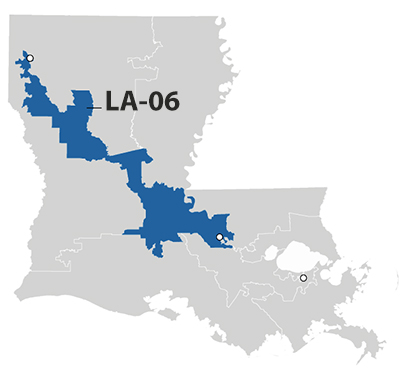
If the Court decides LA-06 is a racial gerrymander, it is likely to strike it down because the Court has previously ruled that while partisan gerrymanders are fine and dandy, racial gerrymanders are unconstitutional. If LA-06 is found to be a racial gerrymander, it will have to go.
It is always a bit tricky to infer votes from the justices' questions at the oral arguments, but Justices Clarence Thomas, Samuel Alito and Neil Gorsuch appeared to be against the idea of using race at all when drawing maps. Roberts has long said the way to stop racial discrimination is to stop discriminating based on race. That's four votes to kill the Voting Rights Act right there.
Justice Brett Kavanaugh, who may be the swing vote, suggested that remedies for past racial discrimination might be constitutional, but only for a limited period of time. The Voting Rights Act was signed by Lyndon Johnson in 1965. That was 60 years ago. Kavanaugh seemed to be asking whether 60 years was long enough. Justice Amy Coney Barrett was playing her cards close to the chest and didn't let on what she was thinking. The three Democratic appointees will no doubt vote to uphold the Voting Rights Act, so Kavanaugh and Barrett will be crucial.
The decision could have nationwide implications and greatly help the Republicans in 2026 and beyond. Many states in the South have drawn one, sometimes two, majority-Black districts in order to comply with the VRA. If they no longer have to comply with it, the Republican-controlled legislatures will be falling all over each other trying to be the first to eliminate all of the majority-Black districts. Since Southern Black voters are largely Democrats, eliminating these de facto Democratic districts will give the Republicans perhaps another dozen seats in the House. The New York Times' data guru, Nate Cohn, has worked out the potential map in the South if the VRA is struck down. Here it is, compared to the current map:
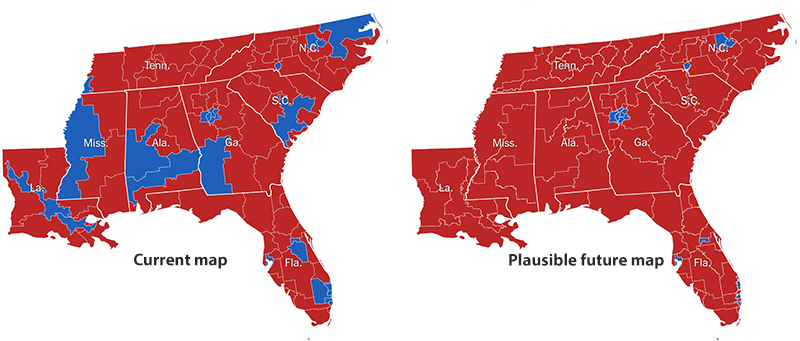
One thing to note here is that some Republican members of the House will be strongly against the map on the right above. The reason is this: The majority Black districts have a lot of Democrats in them. They have to go somewhere. In practice, they will probably have to go into neighboring districts, watering them down. If a (safe) R+8 district suddenly becomes a competitive R+4 district, the Republican congresscritter representing that district is likely to howl to the moon and make sure the state legislature hears it. The fear of turning safe-red districts into competitive pink districts could be a check on what the legislatures do.
Timing will play an important role here. If the Court renders its decision in June 2026, as it usually does, then the primaries will be underway already and even completed in many states. Having the legislatures create new districts in July, after the primaries have already been completed, would create enormous chaos. Donald Trump would probably suggest canceling the 2026 elections and just waiting until 2028, but he has no such authority. In any event, the blue states will hold elections on Nov. 3, 2026, as required by law.
If the Supreme Court wants to do its best to help the Republicans, it could issue its ruling in November or December 2025. In principle, that would give states time to draw new maps (or, more likely, simply vote on the new maps they have probably already drawn). It would be an unheard-of power grab but it could easily happen. Democrats would scream to the rooftops, but there is not much they could do other than try to motivate their voters to be sure to vote in 2026, no matter how hopeless it looks. (V)
Federal Judge Temporarily Blocks Layoffs
Yesterday, U.S. District Court Judge Susan Illston, a Bill Clinton appointee in Northern California, ruled that the layoffs—or reductions in force, as OMB Director Russell Vought prefers to describe them—are illegal. Specifically, she wrote: "The evidence suggests that the Office of Management and Budget, OMB, and the Office of Personnel Management, OPM, have taken advantage of the lapse in government spending, in government functioning, to assume that all bets are off, that the laws don't apply to them anymore and that they can impose the structures that they like on a government situation that they don't like."
The judge pressed the DoJ lawyers to explain why the layoffs were legal, given the civil service protections many federal workers have. The lawyers said they were not prepared to argue the merits of the case this early. The judge shot back: "But it's happening. This hatchet is falling on the heads of employees all across the nation, and you're not even prepared to address whether that's legal." Then she ruled that the government is banned from issuing any reduction in force notices for the time being. Needless to say, to be continued. (V)
Democratic and Republican Voters See the Parties Very Differently
Democratic and Republican voters have very different ideas about what the Democrats care about. In contrast, everybody agrees on what the Republicans care about. Let's start with what the voters themselves actually care about. The top three issues are highlighted with a darker background:
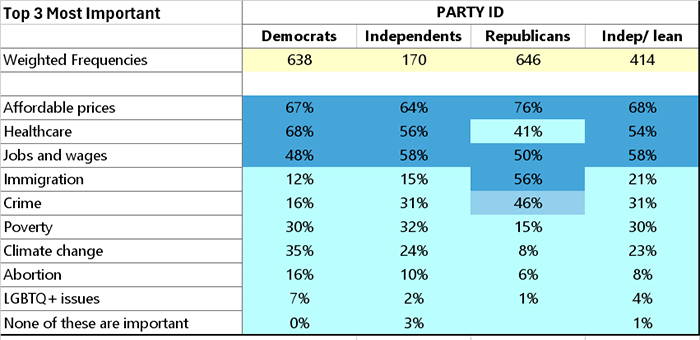
First, everybody thinks affordable prices are #1, especially Republicans. Democrats and independents think healthcare is also important; Republicans not so much. This suggests Republicans are not paying attention, because many Republicans live in rural areas and when their county hospital closes, the nearest one could be hours away. This is far less an issue for Democrats in cities or suburban areas where: (1) hospitals are less dependent on government subsidies and (2) the hospital density is much greater. Jobs and wages also rank high. So two of the three are about the economy.
Now here is the interesting part. What do Democrats and Republicans perceive as the parties' main focus? Here are the polling data for what the voters think Democratic leaders care about.
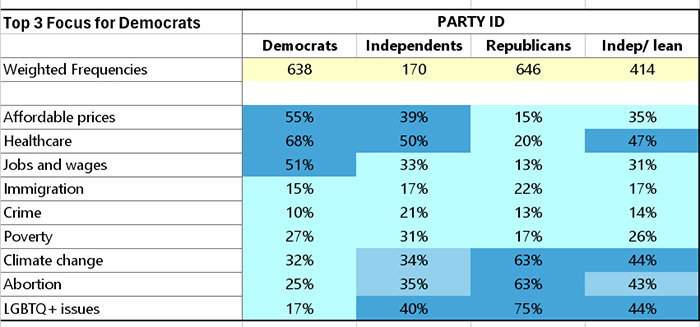
Democrats think their party is focused on prices, healthcare and jobs above all else. These are precisely the issues Democratic voters also think are important. In other words, Democrats are pleased with what they think their elected officials are trying to achieve.
In contrast, Republicans don't believe that at all. Only 13-15% of Republicans think Democrats care about the kitchen-table issues. By large majorities, Republican voters think the Democratic Party is all in on climate change, abortion and especially LGBTQ+ issues. For Republicans, these issues are totally irrelevant. They don't give a hoot about LGBTQ+ issues, think these are totally and completely unimportant, and blame the Democrats for thinking about nothing else. It's true Democratic leaders care somewhat about LGBTQ+ issues, but it isn't their #1 issue by a longshot. But Republican voters absolutely think it is and don't like it one whit because they don't think it is important at all. OK, 1% of Republicans think it is important. We suspect if the pollsters separated LGBQ+ from T, the latter would poll even worse. Independents are split on what Democratic leaders care about, with affordable prices and healthcare being on top, which is basically true. The message here couldn't be clearer. Fox News and Friends have convinced Republican voters that the Democrats are entirely focused on things Republican voters don't care about at best and hate at worst.
Now what does everybody think that Republican leaders care about? Here are the data:
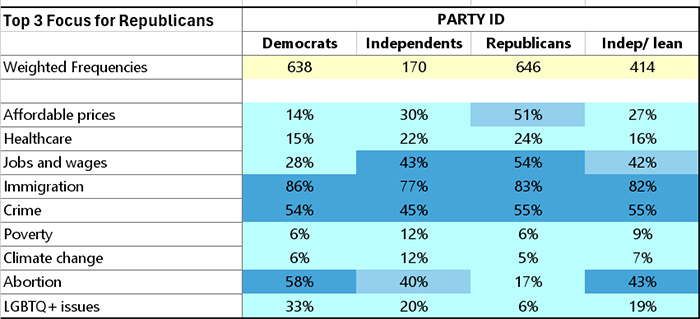
Democrats think the Republican leaders care mostly about immigration, abortion and crime. If one equates "Republican leaders" with "Donald J. Trump," the Democratic voters are batting .333 here. Not bad—for baseball—but not so good for politics. Based on his actions, he cares most about immigration. He is sending National Guardsmen into blue cities to pick up litter, but mostly in low-crime areas. That isn't about crime. It is about intimidating the voters. If he really cared about crime, his BBB would have allocated $40 billion to allow states and cities to hire more cops instead of using the money for ICE. And abortion? Trump has roughly zero interest in that one way or another. He knows if he were to get Kristi Noem or somebody else pregnant, he could send her to Maryland for an abortion. Abortion is not on his radar at all.
Republican voters, however, think their party is mostly concerned with immigration, which is correct. In second place is crime, which gets a lot of talk from Trump and Republican leaders, but little action. Next come the economic issues, which isn't even roughly true. And in contrast to Democrats, who (incorrectly) think Republican leaders (i.e., Trump) care about abortion, Republican voters (correctly) realize that abortion is not a Trump priority. Since it is also not a priority for most of them (evangelicals excepted), they are fine with this.
The main conclusion is that most voters have a tolerably correct idea of what the Republicans want. However, Republican voters are largely off-base on what the Democratic Party stands for. LGBTQ+ issues are not #1 by a country mile. Climate change probably is an important issue, but abortion isn't really in the top three. Democrats clearly have a messaging problem here. They need to downplay the LGBTQ+ stuff—not oppose it, but just not talk about it so much—and talk about prices and jobs from morning to night. For example, they can talk about all the jobs Joe Biden's bills created, especially in rural areas. They can and should also talk about how bringing broadband Internet to rural areas and creating solar farms in rural areas will create lots of blue-collar "manly" jobs there.
Another natural topic is to talk about passing a vastly stronger antitrust bill in order to break up big companies and force more competition. That is a realistic scenario for getting prices down. Make companies compete for your business. Not only should all future supermarket mergers be killed as soon as they are proposed, but existing large chains should be forcibly broken up. In New York, Zohran Mamdani ran on the idea of government supermarkets. That is probably pointless, but talking about breaking up Kroger and Albertsons to force more competition among the pieces might well get traction. In any event, it pits the Democrats against the perceived enemy, the big supermarket chains. This might even force the Republicans to defend them, which could be toxic. (V)
Gallup Poll: Tax the Rich
A new Gallup poll asked U.S. adults about the best way to reduce the federal deficit. There were seven choices, including both ways to raise more revenue and ways to cut spending. Here are the results:
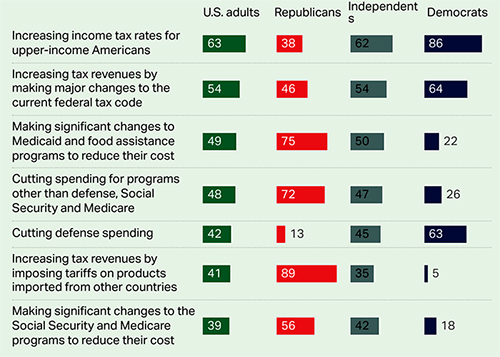
The top choice, with nearly two-thirds of respondents in favor, was increasing taxes on the rich. The least popular choice was cutting Social Security and Medicare. There is surely a campaign message here for Democrats. For example, the Social Security trust fund is going to run dry in about 10 years if nothing is done. One very simple fix is to raise the cap. Currently, income above $176,100 is not subject to FICA payroll tax. The FICA tax could be made progressive and the upper limit abolished, so it would apply to all paychecks (and some other income) with no upper limit. This would "save" Social Security by raising payroll taxes on the rich. According to the poll, that would be a real winner.
Another popular proposal is fixing the tax code. That is very vague, of course, but the Democrats could turn it into "Get rid of the thousands of tax loopholes rich people use to avoid paying taxes." That would likely also be a winner. For example, the "carried interest" provision is a "feature" of the tax code that allows fund managers in private equity to arrange to get paid in a way that has their income technically be considered capital gains, and thus taxed at a low rate. Needless to say, if the Democrats harped on this and other tax loopholes they want to close it would be enormously popular. Other polls have consistently shown that economic issues top voters' concerns, and this poll gives a clear suggestion for an approach Democrats could take that would resonate with large numbers of voters. (V)
Is Kristi Noem Trying to Violate the Hatch Act?
Secretary of Homeland Security Kristi Noem is always trying to play to an audience of one—her boss. In her latest play, she made a video for TSA to show at airport checkpoints. In effect, she blames the long lines on the Democrats for not caving and reopening the government. The video is likely a violation of the Hatch Act, which states that federal employees, except the president and vice president, may not campaign or engage in partisan activities on the taxpayer's dime. By specifically blaming the Democrats and not simply stating that the shutdown was caused by political differences between the parties, she has probably crossed the line into felony territory. Here is the ad:
Quite a few airports, including those in Atlanta, Baltimore/Washington, Buffalo, Charlotte, Chicago, Cleveland, Denver, Las Vegas, Los Angeles, Miami, Minneapolis-St. Paul, New York, Phoenix, Portland (OR) and Seattle, among others, with the list growing daily, have refused to play the video. Many of them have put out statements similar to this one from Portland's airport: "We did not consent to playing the video in its current form, as we believe the Hatch Act clearly prohibits use of public assets for political purposes and messaging."
Statement length does not correlate with airport size. Westchester County owns and operates a small airport 3 miles north of White Plains, NY, but is technically in Harrison, Purchase, and North Castle (which is why its IATA code is HPN). (V) flew out of it many times years ago when it was just a dirt strip and a Quonset hut. Westchester County Executive Ken Jenkins issued a press release stating:
Westchester County has reviewed the request from the Department of Homeland Security to replace the REAL ID video with a Public Service Announcement (PSA) that was released by United States Secretary of Homeland Security Kristi Noem, and our message is clear: it is inappropriate, unacceptable, and inconsistent with the values we expect from our nation's top public officials. The PSA politicizes the impacts of a federal government shutdown on TSA Operations, and the County finds the tone to be unnecessarily alarmist—particularly as it relates to operations at Westchester County Airport. This video will not be displayed at Westchester County Airport.
With most major airports refusing to show the ad, has Noem achieved her goal? Well, if the goal is getting herself a lot of publicity and getting Trump to see her as a fellow traveler, then probably it is a success. Remember, in TrumpWorld you can win by losing. (V)
Kennedy Is Powering a Growing Quackery-Loaded MAHA Movement
Secretary of HHS Robert F. Kennedy Jr. is sometimes described as an anti-vaccine fanatic. This description does not do him justice. He is actually a full-service quack. Six former surgeons general have called his alleged leadership a "profound, immediate, and unprecedented threat to the health and safety of Americans."
But Kennedy also has supporters. Every other Wednesday, his ragtag bunch of allies get together on a call organized by MAHA (Make America Healthy Again) Action to discuss national public health policy. Participants have included the governor of West Virginia, Patrick Morrisey; a shirtless Russell Brand in a bathtub; a former member of the Pussycat Dolls; and Kennedy's wife, Cheryl Hines. The calls open with a montage of a gas-mask-clad worker spraying crops; R&B singer, Jimmy Levy, who sells hoodies that say: "I think the earth is flat. So What?"; and Kennedy walking onstage in slow motion at a Donald Trump rally, among other clips.
A recurring star is CMS Administrator Mehmet Oz, who sometimes calls in from his D.C. office, and sometimes from wherever he is at that moment. Sometimes he supports the things Kennedy has said and sometimes he disagrees. For example, after Kennedy said that Tylenol causes autism, Oz said: "It's not causation. Gotta be restrained on this."
Kennedy fans take turns praising the secretary for his many achievements. One said: "Fluoride disconnects one from God." It is an odd collection of wackos discussing public policy, but they clearly have Kennedy's ear. (V)
Wisconsin Democrats Elect a Vigorous Young Chairman
Wisconsin is probably the ultimate swing state. So much so that the French minister for Europe, Jean-Noël Barrot, once said: "We cannot leave the security of Europe in the hands of voters in Wisconsin every 4 years." Or, to update an old saying: "As Wisconsin goes, so goes the nation." In the past five presidential elections, Wisconsin went with the winner each time. It was also the closest state in 2024.
Wisconsin Democrats seem to understand that and have just elected a vigorous young (33) chairman, Devin Remiker, to run the state party. One of his first comments after his election was "The job is about building a bulwark against a hostile administration that seems intent on subverting democracy. That really places in me an immense sense of responsibility to help make sure that we can be that bulwark ahead of 2028."
Remiker is succeeding Ben Wikler (44), who was very successful. Remiker is quite young for such an important position within the Democratic Party. He sees his job as year-round organizing, especially the communications infrastructure. The old ways—especially television ads—don't work with many young voters, so he has to figure out what does work, especially how to use social media effectively. In that sense, having a millennial as chair might be a good choice since he knows better than older people how to reach millennials and the older Gen Z'ers who are eligible to vote. They have low turnout rates and are harder to reach. Maybe he can find the silver bullet.
Another thing Remiker is focused on is getting the word out to all 72 counties in Wisconsin. Here is the 2024 presidential election map in Wisconsin by precinct:
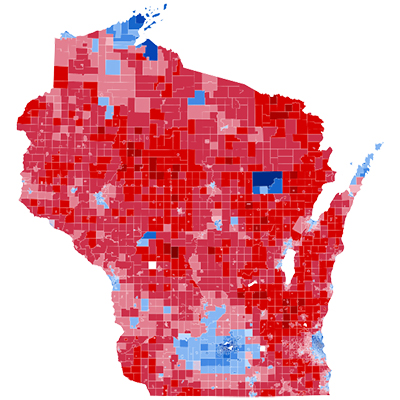
The blue blob in the bottom center is the Madison metropolitan area. The blue area east of Madison near the state line is Milwaukee. The rectangle northeast of Madison is the Menominee Indian Reservation. The blue bits in the northern part of the state are Douglas, Bayfield, and Ashland Counties, which are in the Duluth, MN, suburbs and also have substantial Native American populations. They have been very Democratic for a century. Other than these blue hotspots, the state is almost entirely red.
Remiker is going to make a great effort to spread the word in RedLand. After all, getting a red county with 30,000 voters from 20% Democratic to 30% Democratic is 3,000 more votes. In statewide elections, it doesn't matter where the votes come from, and the deep-red counties offer a lot of potential. Sometimes, simply showing up and listening to the voters there is enough to show them you care about them and that alone could win votes. This is definitely on Remiker's agenda. (V)
If you wish to contact us, please use one of these addresses. For the first two, please include your initials and city.
- questions@electoral-vote.com For questions about politics, civics, history, etc. to be answered on a Saturday
- comments@electoral-vote.com For "letters to the editor" for possible publication on a Sunday
- corrections@electoral-vote.com To tell us about typos or factual errors we should fix
- items@electoral-vote.com For general suggestions, ideas, etc.
To download a poster about the site to hang up, please click here.
Email a link to a friend.
---The Votemaster and Zenger
Oct15 The Pentagon is Now a Black Box
Oct15 Freaky Tuesday?
Oct15 The Comey Prosecution Is off to a Rousing Start
Oct15 Young Republicans Love Hitler
Oct14 No End in Sight for the Shutdown
Oct14 Israel Peace Deal Is Signed
Oct14 The Ministry of Information Is... Closed?
Oct14 North Carolina Doesn't Want to Be Left out of the Gerrymandering Party
Oct14 Are the Tories Becoming the Never-Trump Republicans?
Oct14 The View from the Other Side of the Pond
Oct13 China Ups the Ante and Trump Responds
Oct13 Let the Firings Begin
Oct13 Democrats Also Want Guardrails as a Condition of Ending the Shutdown
Oct13 Appeals Court: Trump May Not Order the National Guard to Invade Chicago
Oct13 MIT Rejects the Deal Trump Offered
Oct13 Now the Quid Pro Quo Comes Out of the Woodwork
Oct13 The Redistricting Battles Are Moving to Missouri and Ohio
Oct13 Trump Cancels One of the Biggest Solar Farms in the World
Oct13 Why Have the Tech Titans Embraced Trump?
Oct12 Sunday Mailbag
Oct11 Saturday Q&A
Oct11 Reader Question of the Week: Student Counsel, Part II
Oct10 Peace in Israel... Maybe?
Oct10 Today in Corruption: Letitia James Indicted
Oct10 Today in Crazy: The Dead Kennedys Must Be Rolling in Their Graves
Oct10 Today in Presidential Health: Longing for that Reagan Youth?
Oct10 I Read the News Today, Oh Boy: Does Megan Thee Stallion Admire Crazy Horse?
Oct10 This Week in Schadenfreude: Lee Greenwood? Heck, How about the Glenn Miller Orchestra?
Oct10 This Week in Freudenfreude: Who Needs Tesla?
Oct09 James Comey Appeared in Court Yesterday
Oct09 Trump Is Unhappy with HIS Judges
Oct09 Americans Will Not Vote for a Woman for President
Oct09 Americans Are NOT Moving to Get Away from the Other Party
Oct09 Democrats Running for the Senate Are Pulling in Big Bucks
Oct09 Rep. Wesley Hunt (R-TX) Is Making the Texas Senate Primary Worse for Republicans
Oct09 Yes on Proposition 50 Is Leading, but It Is Not a Landslide
Oct09 Johnson Claims His Refusal to Swear in Adelita Grijalva Not Related to Epstein
Oct08 The Democrats Are "Winning" the Shutdown, So Far
Oct08 Bari Weiss Named CBS News' Editor-in-Chief
Oct08 Don't Think Republicans Have a Monopoly on Performative Anti-antisemitism
Oct08 Bondi Answers to Only One Person
Oct08 Matchup Set for TN-07 Special Election
Oct08 The Case of the Missing Aviatrix
Oct07 And the Shutdown Goes On...
Oct07 Virginia Is Certainly Giving Louisiana, New Jersey a Run for their Money
Oct07 Utah May Soon Have New Congressional Maps
Oct07 H-1B Visas? It's Complicated
Oct07 Of Course MAGA Doesn't Actually Care about Antisemitism
Oct06 Newsom Understands the Incentive Structure

