


 Welcome & FAQs
  Table of Senate polls
 Senate graphs
 Tipping-point-state
 Congress: retirements
 Governor's races
 Icons for bloggers
 Data galore


• Reader Question of the Week:
Saturday Q&A
Next week is the last Saturday of the month, and thus all non-politics questions. If you have questions about movies, TV, literature, art, sports, food, games, science, history, etc., send them to questions@electoral-vote.com.
If you're still working on this week's headline theme, we'll give the hint that the answer appears in the previous paragraph.
Current Events
M.M. on Bainbridge Island, WA, asks: Donald Trump has to be taken both seriously and literally. How confident are you that 2026 will be a free, fair, legitimate election? I'm not very; I believe Trump will try to interfere in some way, and it will go up to the Supreme Court, with negative results. I'm hoping to be reassured?
J.I. in San Francisco, CA, asks: Since Donald Trump has "floated" the idea of canceling elections, even though that isn't something he can do directly, what would happen if states didn't hold their elections in November for whatever reason (Republican states refusing and/or Democratic states under martial law)? Would it simply be that they wouldn't have any representatives and possibly missing a senator come Jan. 3, 2027, and that the rest of the representatives and senators would then get to run the show until 2029? Or could those states hold make-up elections at a later point in the term and then immediately send those folks to D.C.? Should Democratic states be working on some sort of break-glass-in-emergency procedure in place ahead of the election to officially send representatives and senators to D.C. should elections be unable to be held?
(Z) answers: Let's start by addressing the extreme scenario. California alone has a population of almost 40 million people. There are about 2.5 million active-duty/reserve soldiers and/or federal law enforcement officers. Even if Donald Trump were to deploy every bit of manpower available, it would be somewhere between "extremely difficult" and "impossible" for him to impose martial law when government forces are outnumbered 15-to-1. And then add in that he cannot exactly pull American forces out of every military post in the world, nor leave federal prisons unstaffed. Add in that many of the soldiers/law enforcement in question are Californians, and may not be keen on oppressing their home state. And add in that California is just one blue state, and there are at least 15 others with a combined population of 150 million people. What it adds up to is that martial law, as a way of preventing the midterm elections, is wholly impractical.
There are also a couple of other very big problems with trying to (illegally) prevent the elections from taking place. The first is that people like Gov. Gavin Newsom (D-CA) and JB Pritzker (D-IL) almost certainly are thinking about contingency plans. And even if they're not, they'll start thinking very fast if it becomes necessary. Think about how quickly the California legislature acted on the mid-term redistricting. Then think about how quickly they would act if, say, Trump tried to suspend elections and Newsom submitted a bill allowing for all Californians to vote online.
The other big problem is that the Constitution is, in effect, a contract. If the White House endeavors to create a new "clause" in the contract to suspend elections, but otherwise abides by the contract, then the Senate will flip, since there will be 22 seats currently held by Republicans that would be left vacant, as compared to 13 seats held by Democrats. (If you'd like the math, that would mean a 34 D/I to 31 R Senate). If the White House tries to bend and twist the contract, so that the Republican Senators get elected but not the Democrats, then the contract is void. Many citizens in blue states would, for example, stop paying their federal income taxes, since the document that makes those taxes legal is the same one that requires biennial elections for Congress.
What that means is that the only viable approach is to try to influence the elections around the margins, through various shenanigans that might net a House seat here, and a Senate seat there. Redistricting would be in this category. Making it harder to vote with voter ID rules, or limits on mail voting, or reduced availability of polling places would also be in this category. Of course, Republican-led states have been doing these things for years. The new entry to the list is sending ICE or other federal officials to polling places to try to keep Democratic-leaning voters from casting ballots.
The use of ICE or other goons is the single biggest thing to be worried about in 2026, in my view. The good news, such as it is, is that the administration has telegraphed its plans in such a clumsy fashion that counter-moves will be possible. Blue states and cities are already hard at work on promoting voting options that don't require going to polling places in person. The ACLU and other organizations are prepping their lawsuits, and you can bet they will have an army of lawyers across the nation ready to run to court at 8:00 a.m. on Election Day to ask for emergency injunctions. Also, trying to take away people's right to vote turns out to be an excellent way to get them to the polls.
S.C. in Mountain View, CA, asks: In "Can the Supreme Court Be Reined In?," (V) sets forth all the things a Democratic trifecta (White House, Senate, House of Representatives) could do via legislation, assuming that the Democrats are willing to at least create carve-outs in the filibuster. (V) also assumes that "a constitutional amendment is unrealistic in the current polarized climate."
My concern is that what one trifecta can do a different trifecta can undo, and at some point we'd be back with a judicial branch that was "more equal" than the other two. As for the "current polarized climate," given a Democratic trifecta, I could see Republicans at both the federal and state level willing to support a constitutional amendment that would prevent a Democratic president from committing all the abuses that the current occupant has and continues to commit.
So, in addition (since I believe in "both/and" as opposed to "either/or") to the legislative suggestions (V) makes, how would you word a constitutional amendment that would restore the status quo ante 2016 (including, among other things, that the president is not above the law and that independent commissions established by Congress are truly independent) and would be so clear that even the Roberts Court couldn't work around it?(Z) answers: Sorry, but trying to come up with the proper wording of a constitutional amendment is well beyond our pay grade. That is the kind of thing that requires a veritable army of scholars and lawyers, and many weeks or months of discussion and revision.
I tend to agree that a constitutional amendment just might be possible. Even in highly partisan times, if both sides think the amendment will work to rein in the OTHER side, then agreement is plausible.
Beyond that, U.S. history is basically a series of "abuses" and "corrections." In short, some entity gains more power than it is supposed to have—could be the presidency, or the Supreme Court, or some minority faction, or political operatives, or big business, or more than one of the above. Then, public support for reform grows, and reform is implemented. At that point, the folks who desire more wealth and power than is their due look for ways around the new rules, and eventually they find them. Eventually, sentiment for even more reform emerges. Rinse and repeat. In the world of biology, they call this an evolutionary arms race.
I do not know what kinds of reform might be coming down the pike, but I do believe we are on the cusp of an "era of reform" portion of the cycle, possibly even a New Progressive Era. Also, while reform is tough to pull off, counter-reform tends to be even tougher. Do you know how much energy was expended on trying to get rid of the Pendleton Act, or the Social Security Act, or the Affordable Care Act? And yet, they are still here.
M.T. in St. Paul, MN (along with Minneapolis, the ICE capital of the U.S.), asks: I found your recent item, "Trump is Destroying the Future," interesting.
I received a Ph.D. in a science-related field, then chose to work with a state agency. But my work always involved interactions with the research community, primarily represented by universities. After reading your article, I did a Google search on what Americans think of science and stumbled across this piece by the Pew Research Center. While Democrats and Republicans are in general agreement, there appear to be differences. To me, the most noticeable difference was in the percentages of each party supporting universities and private companies. As you would expect, Republicans appear to hold less favorable views of universities and more favorable views of private contributions to science.
I'll play devil's advocate with this question: Is there a reason why the U.S. should not shift more towards science and research being done through private companies rather than through universities? Note that I agree with what your piece says, so maybe another way of phrasing this question is: What are the pros and cons of relying more on private companies?(V) answers: Pro: Private companies can move fast and put a lot of resources into a project fast. If Pfizer really wants a vaccine for something right now, it can assign 100 people to it and tell them to start working tomorrow at 9 a.m. No university can come close to that.
Cons: To the CEO of a company, research is an expense whose benefits, if any, will show up much later. Most companies are not interested in putting a lot of money into a project that might fail and, if it succeeds, will only be useful years from now. A company that makes lithium batteries might be willing to assign some people the task of making them last 20% longer if the head of research thinks there is a good chance of success within a year. But the company probably won't put much money into a project that might result in a whole new kind of battery in 5-10 years, even if they get the patent on it. CEOs think one fiscal quarter is long term. Universities are not constrained by quarterly reports and what the stock market thinks.
Companies are generally loath to do research on anything far from the business they are already currently in. For example, all the hype around AI now is due to 40 years of research at universities. Now that it is close to being useful, companies are jumping in. But 20, 30, 40 years ago, very few companies were interested in AI. Too speculative. Also, AT&T had no interest in doing research on packet switching and the Internet until a bunch of universities had built a working model and had been using it for years to show that it worked.
The secret of how DNA worked wasn't discovered by a drug company, but by two guys at Cambridge University who were curious about how it worked. Insulin was discovered not at a drug company, but at the University of Toronto. The computer was invented not at IBM but at the University of Pennsylvania. There is a long list of things invented at universities because companies didn't see that research as useful in the short term.
S.S.L. in Battle Creek, MI, asks: I stereotype local law enforcement as on the side of Trump/ICE. Is that what we're seeing in Minneapolis?
(Z) answers: While it is generally true that law enforcement tends to side with other law enforcement, it is most certainly not the case in this instance. We will be talking about that in detail on Tuesday.
B.B. in Dothan, AL, asks: An observation/question I've asked a couple of times now, regarding our society's response to the ongoing rise of fascism in the country, is: Where are the protest songs? In the Vietnam era, they were all over the radio and most of the top 100. Today? Nada. I would think that, if people were really upset about what's going on (e.g., U.S. citizens being kidnapped in broad daylight by masked, non-uniformed people and deported to foreign prisons) they would be seeking music to express those sentiments.
(Z) answers: I will give you three things to consider, and you can do with them what you will. First, we tend to look at the protest songs of the 1960s through a distorted lens. Do you know the only song directly inspired by the Vietnam War to go to #1 on the U.S. singles charts? That would be "Ballad of the Green Berets," a PRO-war song by Staff Sgt. Barry Sadler. The point is that while songs like "Fortunate Son" and "For What It's Worth" loom large in historical memory, in the moment they were predominantly the music of a small (but vocal) minority.
Second, the music business is much more balkanized today than it was in the 1960s. There are many fewer musical acts who can hope to break through beyond their narrow fanbase. And the ones who might be able to do so, like Taylor Swift and Beyoncé, would be taking pretty serious financial and personal risks if they recorded, say, an anti-Trump song.
Third, there ARE protest songs today. However, it is probable they are in genres that you aren't following. Folk music has been the music of protest for many centuries, and there are many folk musicians today who are carrying on the tradition. In particular, we have highlighted the work of Jesse Welles on this site several times. The other genre where you'll find plenty of protest songs today is hip-hop, with artists like Bad Bunny and Childish Gambino particularly standing out.
K.R. in Austin, TX, asks: Of course Donald Trump has no trouble telling outright lies. Still, do you know if there's any truth to what the White House posted on Facebook today?
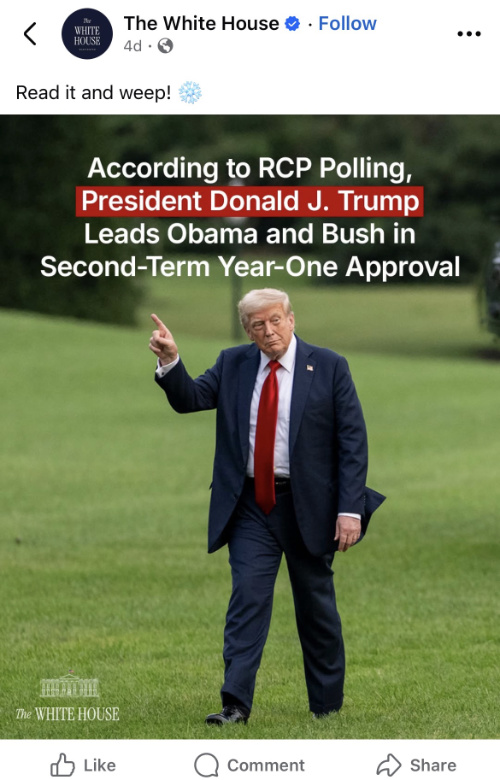
(Z) answers: We are going to start this answer with two notes. The first is that we did no research before choosing this question, and so don't know for sure how the answer will turn out. The second is that RCP is not a terribly reliable aggregator, and has been known to leave polls unfriendly to Republicans out of its database. So, we're already starting with a questionable source.
We do not know exactly what methodology the White House used, if any, for basis of its comparison. However, today is January 24, 2026. RCP's average for Donald Trump is presently 42.6% approve, 54.7% disapprove, putting him 12.1 points underwater. On January 22, 2014 (in other words, the nearly equivalent day in Barack Obama's second term), Obama was at 44.6% approve, 50.4% disapprove, putting him 5.8 points underwater. On January 26, 2006 (in other words, the nearly equivalent day in George W. Bush's second term), Bush was at 42.9% approve, 53.3% disapprove, putting him 10.4 points underwater.
In order to get these numbers, we have to rely on the Wayback Machine, since RCP's database no longer goes back that far. That is why we're not using January 24 for Obama and Bush, because Wayback did not index those days. It is possible that if someone had another source for the historical data, and/or they massaged the numbers a bit based on exactly what date is being used for basis of comparison, Trump 2026 might have a slight lead over Bush 2006. It is very implausible that one could make the numbers for Trump 2026 better than the ones for Obama 2014. In fact, across about 300 second-term polls, Obama only recorded double-digit disapproval 13 times, and usually that was -10 or -11. Trump has recorded double-digit disapproval 14 times just this month. And while Obama's worst number was -15 (which happened twice), Trump's current month already includes a -15, a -16, a -17, three -18s and two -19s.
In short, "We're going to use the most Trump-friendly source possible to show that he might be a shade more popular than a president who cratered in his second year and left office with the lowest approval ratings to be recorded, and then we're going to lie and claim Trump's more popular than the Black guy he hates."
M.H. in Salt Lake City, UT, asks: In which countries (planets, even?) did Donald Trump end eight wars?
(Z) answers: Here are the eight conflicts he is referring to:
- Armenia and Azerbaijan
- Democratic Republic of Congo and Rwanda
- Iran and Israel
- India and Pakistan
- Cambodia and Thailand
- Israel and Hamas
- Ethiopia and Egypt
- Serbia and Kosovo
There is so much spin going on here, readers should probably take a Dramamine right now. To wit:
- Some of these (e.g., #3, #7) deploy a very loose definition of "war"
- Some of these (e.g., #7, #8) were from his first term
- Some of these (e.g., #1, #4) had little or no involvement from the Trump administration
- Some of these (e.g., #2, #5), the war continued after Trump's involvement
- Some of these (e.g., #6, #8), the peace is very, very fragile
Trump's strongest claim as "peacemaker" is Israel and Hamas. His second strongest claim is probably Iran and Israel. If readers are unpersuaded that those efforts are Nobel Prize-worthy, then the other six do not improve the case.
K.M. in St. Louis, MO, asks: How much do you think the Mercator projection contributes to Trump's obsession with Greenland?
(Z) answers: Just to make sure everyone is on the same page, maps that use the Mercator projection make landmasses near the poles appear larger than they actually are.
I doubt that Trump is influenced by the Mercator projection of Greenland, per se. What he cares about is an island or other landmass large enough to be a "monument" to him and his presidency. Any island that is noticeable on a map would be good enough, I think—Cuba or Madagascar would do just as well as Greenland, for his purposes. On the other hand, he would not be interested in, say, St. Kitts and Nevis or Cabo Verde.
D.R. in Yellow Springs, OH, asks: As I write this, it looks like Donald Trump is finally backing off his attempts to take over Greenland. And I'm pretty sure the rest of NATO would fiercely resist any attempt to take over Canada. But Trump posed with a map of the Western Hemisphere that also included a U.S. flag over Venezuela. This makes me wonder: Why hasn't he made an attempt at taking over Venezuela and making it into a territory, like Puerto Rico is?
I'm not suggesting that this is a good idea. But it would achieve Trump's ambition for territorial expansion. So why do you suppose he isn't doing it?(Z) answers: Puerto Rico became a part of the U.S. almost 130 years ago, when the world was still in the era of imperialism, and had much more tolerance for those sorts of things. If Trump tried to annex Venezuela today, the international blowback would be massive, and not dissimilar to what would happen if he tried to grab Greenland.
Further, there may be many people in Venezuela who are happy to see Nicolás Maduro gone, and who are pleased to have some help from the U.S. However, very few of these people are interested in being U.S. colonial subjects. Not only do the people of South America know a thing or two about the downsides of colonialism, they also saw what happens when a place like Puerto Rico gets smacked by a hurricane.
Finally, there are roughly 50% of Americans who oppose pretty much everything Trump does, and who certainly would not approve of such neo-imperialism. There is some segment of the remainder (particularly Libertarians and Libertarian-leaning folks like Sen. Rand Paul, R-KY, and Rep. Thomas Massie, R-KY) who are isolationist and don't want the U.S. expanding its international footprint. And finally, Trump's base elected him, in significant part, because he promised to keep the brown people out of the country. How do you think they would react if he added 28 million+ brown people to the country's population overnight?
In short, trying to turn Venezuela into an American colony would be several orders of magnitude stupider than trying to acquire Greenland. And THAT is really saying something.
D.H. in Portland, OR, asks: Although I am opposed to and aghast over the U.S.'s invasion of Venezuela, I was amazed at the U.S. military's ability to drop in and shock and awe their way to capturing the head of a sovereign nation and then leave. My question, and I am not advocating this, just asking: Is there any nation in the world that could pull off this kind of thing against the United States?
(Z) answers: It would not be easy. In the U.S., the president is protected by the Secret Service, the U.S. military, and numerous physical barriers. Outside the U.S., the president is protected by the Secret Service, some U.S. military, and the security service/military of whatever country they are visiting. And, in general, the president's staff avoids visits to places where the local security forces won't be reliable.
Although it's not proven, there is much credible suspicion that someone inside the Maduro administration betrayed him and was working with the U.S. Having a mole inside the White House, probably a high-ranking Secret Service official, would be essential to an attempt at abducting the U.S. president. Any country who did it would also have to have a top-notch intelligence service, and some top-notch Black Ops troops. That country would probably also have to lure the president to a site where security is extra-difficult, like when Donald Trump met Kim Jong-Un in Singapore.
There are a few nations that would at least have a chance to grab a U.S. president. China, certainly, and Russia. Maybe Israel, since Mossad is very good at what they do, and is very experienced with this general type of operation. Possibly some of the European powers, like the U.K. or Germany. Of course, any country that pulled it off, or even tried to pull it off, would effectively be declaring war against the U.S., and none of those nations are interested in that outcome.
M.C. in Waitsburg, WA, asks: When is it time to leave the U.S.? I am a white citizen, child of an 80-year-old white immigrant who has been in the U.S. legally for over 50 years. I am not currently a target, but may well end up a target in the future. Most of my family was killed in the Holocaust, save a few who left Europe early. I don't want to overreact and blow up my life in vain, but I also don't want to wait too long and wish I had left. How do we know when it's time to leave? Are there specific indicators that we should be looking for?
(Z) answers: Keep in mind that moving to a new country comes with its own set of risks, like being targeted by local criminals, struggling to adapt to the climate, needing time to integrate into the health care system, and maybe even things like getting used to the local rules and customs that govern the driving of vehicles.
So, it's not enough to think about the risks of staying in the U.S., you have to think about exactly how big the gap is between those risks and the risks of moving somewhere else. I seriously doubt that calculation makes sense for you. The Trump administration has certainly unleashed its inner fascist, but the odds of any one person out of a population of 340 million being targeted are still pretty low. And they get lower if that any one person is older, white and female. The White House vastly prefers younger, brown, and male, because those are the people who scare MAGA voters.
Your implied Holocaust comparison is actually salient. The reason that worked for Hitler is that Jews were a small, but visible population that he could target. He was more than happy to target other populations, and sometimes did (e.g., the Roma), but after taking preliminary steps toward going after Catholics, he backed off because he realized that was biting off more than he could chew.
Jews, of course, are still a small, but visible population. And given how many times they have been targeted by demagogic leaders, we're not ruling out the possibility it could happen in the U.S. in the year 2026. But we think it unlikely, because Jews aren't what make MAGA angry and, besides, this administration has clearly decided that Jews are more useful in other ways (most obviously, as an excuse for going after universities).
Politics
P.B. in Chicago, IL, asks: We all know that most/all major cities in U.S. are blue. What are the largest red cities? How do they rank in population among all cities? How red are they and why are they red?
(Z) answers: This is not as easy a question to answer as you might think, as there are a lot of independent voters out there, and they pivot back and forth between elections. So, there are big cities that tend to vote Republican, but there aren't too many big cities that are 50%+ registered Republicans. In other words, this list represents our judgment, and others might produce a slightly different list:
City Population Rank in U.S. How red? Fort Worth, TX 956,709 13 Very Oklahoma City, OK 694,800 21 Very Fresno, CA 545,567 33 Slightly Mesa, AZ 512,498 36 Moderately Virginia Beach, VA 455,618 42 Slightly Bakersfield, CA 410,647 47 Moderately Lexington, KY 322,570 56 Slightly Henderson, NV 317,610 59 Slightly Plano, TX 285,494 73 Very Chandler, AZ 275,987 76 Moderately
The largest city with a Republican mayor, at the moment, is #9 Dallas. However, Dallas is clearly a blue city, and six of the seven mayors before the current one were members of the blue team.
Generally speaking, red cities fit in one of two categories. Either they are the "seat" of an area that is predominantly red and rural, or they are wealthy suburbs of larger, blue cities.
J.C. in Lockport, IL, asks: Let me preface by saying I'm not talking about any specific president here. If any president were to die peacefully in their sleep, and the administration wanted to keep it a secret, how long could they feasibly do so before the general public found out? I'm assuming that under normal circumstances we'd find out very quickly, but if staff/the administration really wanted to keep it under wraps for some reason, how long would they be able to keep the public from finding out?
(Z) answers: I am going to imagine writing a TV show or a movie script where the plot is driven by a scheme like this, and the president's staff is tasked with keeping the truth hidden for as long as is possible.
If the subterfuge is going to be extended beyond a few days, or maybe a week, it would first be necessary to come up with a story that explains why the president must remain "in seclusion." For example, "the president has contracted a very serious case of [SOME DISEASE THAT IS DANGEROUS, CONTAGIOUS, AND HARD TO RECOVER FROM], and has been ordered to remain in bed until a full recovery takes place." We are not physicians, and don't know what the ideal lie would be here, but maybe something like respiratory syncytial virus. The administration could claim that to avoid spreading the disease, contact has been limited to only a small number of medical professionals.
One could imagine a lie like this working for, what, maybe a month? Eventually, there would be questions about why the president was unable to conduct business via phone/teleconference. And if the explanation was "He's just too sick," then the questions would be about why the president did not temporarily hand over power to the VP, under the terms of the Twenty-Fifth Amendment. In particular, everyone would be asking, "If the President is too sick to handle a Zoom session, what's going to happen if there's a nuclear attack against the U.S.?"
Note that such a conspiracy of silence would likely include a pretty large number of people, all of whom would be guilty of numerous felonies. There would be a huge risk of one of them blowing the whistle, either because they do not approve of the whole arrangement, or they are trying to protect their own hides, or they have an agenda and want there to be a change in leadership.
It's hard to see this working for much more than a month. I am, of course, aware of the movie Dave, where this basic deception is extended by having a lookalike pose as the president for an extended period. But that's a Hollywood movie, and it's implausible that a lookalike could get away with it in the real world.
C.J. in Boulder, CO, asks: Say Donald Trump is somehow sidelined. Just how different might a Vance administration look, were it to take over during Trump's term?
(Z) answers: I do not think it would look very different at all. First, presidents who take over for predecessors who died almost invariably say, "I have a duty to carry on the agenda of [DEAD PREDECESSOR]." Second, J.D. Vance appears to be a man almost entirely bereft of imagination, and almost entirely beholden to doing whatever he thinks will keep him in the circles of power. Though he probably would tone down SOME of the crazy, like threatening to invade Greenland.
M.C. in Calgary, AB, Canada, asks: What are the actions that you think Donald Trump would get impeached for if the Democrats take the House?
(Z) answers: I do not think the Democrats want to impeach Trump, because they know that will fire up his base. It is fairly clear their plan is to impeach someone else in the administration, like AG Pam Bondi. That will signal to the Democratic base that "something is being done" and it won't fire up the MAGA base nearly as much.
If they do impeach Trump, it will have to look organic. In other words, "Trump just did [BAD THING X], and we simply can't ignore it." If that is the case, then it will be something he does in 2027 or 2028 (or January 2029), and so we cannot identify it right now.
If we are wrong, and the Democrats take over the House on Jan. 3, 2027, and then impeach Trump for some existing bad act, the likely candidate is one or more of the various grifts, like Qatar Force One. The grifts may not be the worst things he's done, but it's the easiest legal case to make, since the Constitution is very clear about emoluments. The other possibility is the ICE stuff, because that is just so unpopular.
Civics
J.M. in Silver Spring, MD, asks: You mentioned that the Federal Court of the Eastern District of Virginia is basically advertising a vacancy for the U.S. Attorney for that district. I had seen this mentioned elsewhere too. So, what prevents Donald Trump and Pam Bondi from simply firing whomever they hire?
(Z) answers: The relevant statute says that if an appointment as acting U.S. Attorney expires, as Lindsey Halligan's has, "the district court for such district may appoint a United States attorney to serve until the vacancy is filled." It does not say "until the vacancy is filled, or the person is fired by the president." In other words, the statute says that the judges' appointee gets to keep the job until Trump manages to get a nominee through the U.S. Senate.
B.M. in Chico, CA, asks: I wonder if, given his stances on other matters, Donald Trump might argue that he could withdraw a presidential pardon as a form of leverage over those he pardoned. For example, enlisting former Binance CEO Changpeng Zhao to bring $TRUMP up by 50%, and suddenly discovering that his pardon was illegitimately signed by an autopen (therefore void, in Trump's view) should Zhao fail to comply. What might that argument look like legally and should the folks who got pardons from Trump be worried?
(L) answers: If a pardon has been completed—meaning it has been delivered—it's generally understood to be irrevocable, especially for a past offense. But this has never been litigated in court and the question becomes more complicated for preemptive pardons, or pardons given before someone has been prosecuted for past conduct that a subsequent, independent Department of Justice may pursue charges for.
In that case, a court will have to decide if the pardon was legitimately given. If so, it's difficult to see a legal rationale for allowing even the same president to revoke it, since that would negate the broad presidential power to confer a pardon in the first place. But if anyone might try it, it would be Donald Trump and, once again, we're in uncharted legal territory.
J.H. in Boston, MA, asks: Is Alaska one of those states where you have to resign your current office to run for higher office? If Mary Peltola, congresswoman at large of Alaska, runs for the U.S. Senate, will she have to give up her House seat, even if she loses?
(Z) answers: There are only five resign-to-run states: Arizona, Florida, Georgia, Hawaii and Texas. Each of them has slightly different rules about the circumstances under which a person would be required to resign. For example, in Hawaii, you have to resign any political office you might hold in order to run for any other office. In Georgia, you have to resign a state office the moment you are nominated for a federal office, but it's legal to run for a federal office while you hold a different federal office.
Obviously, Alaska is not on the list. Even if it was, it would not matter, however, as Peltola is not currently in office. She lost her reelection bid in 2024 to Rep. Nick Begich III (R).
History
F.S. in Cologne, Germany asks: You have noted that Henry Kissinger was not eligible to be president, since he was not a natural-born citizen. Would Henry Kissinger have become president if he had been eligible? Which other people would have become president if they had been natural-born citizens?
(Z) answers: Henry Kissinger would not have been elected president. First, any particular "type" of president gets elected once per generation at most, and Richard Nixon was that generation's brilliant-at-foreign-policy-but-sleazy-as-hell president. Second, Kissinger was Jewish, and that would have been a non-starter in the 1960s and 1970s. Third, Kissinger was an egghead, and a LOT of Americans hate obvious eggheads.
Since people who are banned from running for president don't even take the preliminary steps toward making a bid, there is no way to be certain which foreign-born people might have gotten the top job, if the opportunity had been there. However, here are four fairly reasonable guesses:
- Albert Gallatin: The Swiss-born Gallatin served brilliantly as Secretary of the Treasury, at a time when American voters placed great value on competence and ability to manage the economy.
- Carl Schurz: Born in Germany, Schurz was a war hero and a general, in an era where six different Civil War generals served as president. He was a skilled political operative, and so served as a Cabinet secretary (Interior). He also had the enthusiastic support of the German-American community, then a key Republican bloc.
- Bob Hope: We put the British-born Hope here because his skill set is eerily similar to that of Ronald Reagan: telegenic, charming, knew how to deliver a joke.
- Arnold Schwarzenegger: While the Austrian was serving as governor of California, the notion of amending the Constitution to get rid of the "native-born" requirement was discussed somewhat frequently (the news that Schwarzenegger had been elected president was also a joke line in the film Demolition Man, made well before Schwarzenegger became governor). It is at least possible that Arnold might have mounted a serious presidential bid right after leaving the governorship. He would have no chance in today's GOP.
Yep, that's four white guys. We see no plausible non-white-guy answer. The closest is probably Madeleine Albright, but we cannot make the case that a diminutive, soft-spoken woman who preferred to work behind the scenes could mount a viable presidential campaign.
M.M. in Plano, TX , asks: I recently saw a commentary that made a claim that I found astounding, that Alexander Hamilton's mother was Jewish; that he had a Hebrew education in early life (including a bar mitzvah); and that he could recite The Ten Commandments, by heart, in Hebrew.
Does (Z) find any validity to this? Or is it all nonsense?(Z) answers: There are certain "identities" that had to be hidden in past centuries, usually for obvious reasons, and that historians are left to try to uncover, as best they can. In the West, the two identities where this is most common are gay and Jewish.
The easy part of your question is the last part. Hamilton grew up in an area with a large Jewish population, had a Jewish teacher, and most certainly did know the Ten Commandments in Hebrew.
The rest is very... aggressive speculation. Hamilton's mother's second husband was named Johann Michael Levien. It is possible that Levien is a variant of the Sephardic name Levine, and that he was Jewish. In turn, it is possible that Levien conveyed that Judaism to Hamilton's mother. And, in turn, it is possible that Hamilton's mother conveyed that Judaism to her son.
That is a lot of "it is possibles," however. And it would also have to be true that Levien's Jewishness was hidden enough that his mother-in-law didn't know about it, because she never would have approved the marriage if she did. As to Alexander himself, he hated his stepfather, and he never publicly identified as Jewish, although he DID express great admiration for members of that community.
Add it all up, and the general consensus is that Hamilton had fairly close ties to the Jewish community, particularly during his formative years, that there's a possibility, but not a probability, that his stepfather and maybe his mother were Jewish, and... that's about the end of it. If you would like to read the most notable book arguing that Hamilton actually WAS Jewish, at least as a kid, then you want The Jewish World of Alexander Hamilton by Andrew Porwancher. But again, this is not the mainstream view.
F.L. in Allen, TX, asks: This past week marks the 45th anniversary of the Iranian hostage crisis (or the end thereof). Hours after the release, and ever since, my conservative acquaintances (and some liberals) insisted it was because the Ayatollah knew that Reagan wouldn't hesitate to bomb Iran back to the Stone Age. (Oo! Upgrade!)
I was not politically savvy at the time (being at the tender age of 19), but this just didn't quite pass the smell test. And my feeling towards Nancy's husband was the same as to The Convicted Felon—he was a snake-oil salesman. To start, although Reagan did do a mighty military buildup (including the risible "Star Wars"), his only military actions, as far as I can remember, were Grenada and Libya—they barely qualified as skirmishes. Over time, I concluded that it was Carter, working quietly behind the scenes with diplomacy. So, two questions: (1) Do you think I have the right of it? (If so, I find it grating that Carter did all the donkey work and Bonzo got all the credit); and (2) Why did the Iranians wait until minutes after the Gipper was sworn in? Or was that just a coincidence?(Z) answers: The Iran Hostage Crisis was ended with the Algiers Accords, on which the Carter administration did all of the heavy lifting. So, the answer to your first question is: "Yes, Carter did the work and Reagan got the credit."
Second, there is no chance whatsoever that the timing of the release was coincidental, as the Iranian government was, and is, very politically savvy, and was well aware that the timing would send a message. The truth of the situation is disputed, and may never be fully known. But the less scandalous possibility is that the Iranians wanted to make nice with the new leader of the most powerful country in the world. And the more scandalous possibility is that there was a quid pro quo, and Reagan's people had told the Iranians that releasing the hostages the moment St. Ronnie became president would be rewarded with arms sales. For the record, the sales of arms to Iran began around 6 months after Reagan's inauguration.
Gallimaufry
P.R. in Arvada, CO, asks: Every now and then I see something on YouTube about earthquakes around the globe and predictions for when they are going to happen. Usually, these videos are focused on the eastern Pacific around Japan and Russia. At the moment, there is some reporting of earthquake swarms and other signs in California. This got me wondering, do you have earthquake preparedness plans? When I lived in Houston, they would have reminders every year to make sure your hurricane plan was up to date, and you had what you needed. Is there something similar for you in L.A.?
(Z) answers: Among the four of us, I have spent the most time living with California's propensity for earthquakes. When I was in elementary school, we did all sorts of drills and other such preparatory activities. And I was pretty close to the epicenter of two fairly major quakes: the 1987 Whittier Narrows earthquake and the 1994 Northridge earthquake.
My experience has suggested to me that earthquake preparedness, like the cliché of boiling water when a woman goes into labor, is basically just safety theater. It's useful to keep a level head when a quake hits, and to know what kinds of places are safest (e.g., a doorway). But beyond that, most earthquake preparedness imagines a result where you survived, but your home/workplace did not, and the stores did not, and the infrastructure did not, and the roads out of town did not. It could happen, but it's a pretty narrow set of results, and far less likely to happen with a highly centralized earthquake, as opposed to a hurricane that hammers hundreds of miles of land.
If there was an earthquake at this instant, my "backup supplies" would be the bottles of water and the various medical stuff (aspirin, bandages) I keep in my car, as a general-purpose insurance policy (mostly a hedge against the risk of breaking down in the desert). This is probably the smartest thing, for those who have a car, as your car is generally going to be somewhere close by, and has a good chance of surviving even if the building you are in becomes unsafe.
Reader Question of the Week:
Here is the question we put before readers last week:
L.L. in Seymour, CT, asks: How can I help Minnesotans right now? And others? How to help D.G. in St. Paul? I am protesting, all of the Connecticut federal delegation is speaking out as I would want them to, our state AG is at the forefront of lawsuits, and our state legislature is proposing legislation further limiting ICE in Connecticut. What else can I be doing?
And here some of the answers we got in response:
Anonymous in St. Paul, MN: Greetings from Minnesota. Things are as bad here as other locals have been saying.
Two days ago, ICE abducted a neighbor's relative right in front of our houses. They rammed his vehicle with theirs, broke his driver's side front and back windows (they brought their own bricks and left them behind), dragged him into the snow, and wrestled with him for a good 5-10 minutes while yelling obscenities and pointing their guns at the man's family while they cried and watched from the doorway of their house. Nobody got closer than 40+ feet, and still these guys felt "threatened" enough to aim their guns with fingers on the trigger at literal crying children.
We and other neighbors went outside to observe, film the evidence, blow our whistles, and try to support the family in the aftermath. It wasn't a protest, per se—I literally ran outside in socks on a moment's notice. It's just neighbors taking care of each other and communicating on Signal. Though surely this federal administration would accuse us of being protesters or worse.
Our city council representative showed up in person, after being alerted on our patrol networks, to speak with the family and try to help them get connected with lawyers. He's been doing that several times a day for weeks, for as many abductions as he can get to. I'm grateful that one of our elected officials is really present and part of the community in this time of crisis.
Later this morning, I will be standing out to do another shift of ICE patrol and crossing guard duty in single-digit temps with a wind chill below zero. ICE has been targeting school drop-off and pickup lines. Minneapolis and St. Paul have both introduced online learning options because so many families can't safely send their kids to school. In recent days, ICE has abducted teenagers and even a 5-year-old.
Most of the fundraising I'm connected with is small and hyperlocal. There's no tax-deductible nonprofit or even a shareable URL, it's just the Venmo link of trusted organizers and acquaintances putting out individual asks for support. I'm going shopping today for a family at my kid's school.
None of this is OK. Kidnapping neighbors and murdering community members is obviously the worst of it, but the widespread trauma for everyone living in and experiencing these conditions cannot be overstated either. For people wanting to support from outside MN, my second-favorite political writer (after the Electoral-Vote.com team), Naomi Kritzer, wrote this helpful post: "How To Help if You are Outside Minnesota."
If you have friends or family in Minneapolis, you can also ask them if they're supporting local mutual aid and give to them directly to redistribute. Your most effective donation might be one you send to a friend or relative to give locally on the ground, through informal channels.
D.M. in Burnsville, MN: Civil Disobedience? Not necessarily.
Here in the metro Twin Cities area, the ICE and ICE-adjacent agencies are playing dirty by, among other means:
- Blockading parking lots of places where folks go to buy food (e.g. Target, Sam's, Walmart, etc.) and then arresting passengers on the spot.
- Conducting raids on schools, causing parents to keep their kids at home during the day, and schools consequently have closed officially.
- Parking their big, powerful vehicles in the public areas of apartments where targeted minorities are known to have formed communities, forcing families to remain shut in.
- Creating a general atmosphere that has caused targeted communities to refrain from seeking health care, jobs, recreation, and generally having a normal life.
All these tactics are part of ICE strategy to force immigrants out of their homes, where they can be easily nabbed. It's a siege strategy, plain and simple.
I have found that an effective way to help with the consequences of (but certainly not resolve) the Federal Siege: delivering groceries. I know of at least two churches in the area, and there are probably numerous mosques as well, who collect donations of food, sort and distribute, and then deliver a week's worth of groceries to families-in-hiding.
These institutions receive much of the food they distribute as donations from "anonymous" corporations, but they can always use more to buy the essentials. One thing that seems always to be in short supply is infant diapers.
Here's a current link with some direct answers to your question: "Ways to Support Minnesota's Immigrant Communities as ICE Activity Escalates."
The organization I've been working with, as a delivery boy, is a local Spanish-language church. Check out their (and others') webpages for current info on needs (i.e. money, dinero, dollars, pesos, bitcoin, etc.).
J.D. in Cold Spring, MN: First, keep doing what you are doing: Speak out, lobby your politicians. Stand in solidarity with the people under ICE occupation. On a personal note, the best antidote to my own ICE-driven depression has been going to public events and seeing lots of other people protesting and supporting our neighbors. Reach out to anyone you know in Minnesota and let them know that they are not alone.
Second, prepare. If ICE can conduct brutal raids in St. Cloud, MN, they can do it anywhere.
Third, donate. Pick a nonprofit group you trust and designate your donation to support Minnesotans harmed by ICE. Many religious organizations are supporting local immigrant communities, as are legal groups such as the ACLU and the Immigrant Law Center of Minnesota. A local group here in central Minnesota, Fe y Justicia, is organizing volunteers to deliver groceries to folks who are afraid to leave their homes while ICE remains in town (baby supplies such as diapers and formula are especially needed).
B.K. in Eagan, MN: Here's a single resource linking to several worthy folks doing good work here in Minnesota. Stand with Minnesota.
P.R. in Arvada, CO: One thing that I think would really be helpful to help Minnesotans right now would be a small card that is very short and to the point in detailing their rights. It is surprising how few people actually want to help detail the rights people have and the rights ICE has. Take the "no judicial warrant" aspect, for instance. If ICE bursts through someone's door without a warrant, there is a clear violation of their rights. What should they say, as they are being marched away; what should they say when they get to a holding facility? ICE is clearly breaking the law here, so does that mean they have lost their immunity?
What about anyone who gets stopped for no reason, and they demand identification? How should someone respond? If they can't show a warrant or probable cause, can they then just drive away? If they start driving and someone starts smashing windows, again, that seems illegal and the person in the vehicle has the right to defend themselves at that point. What should people say that makes it very clear they know their rights and that they are being violated?
I have asked several places about this, and it is always ignored. I think the best thing you can do to help is to help make sure accurate information is gathered and then distributed to people there.
(V) & (Z) respond: The National Immigration Law Center has such a card, in English, Spanish, Haitian Creole, Korean, Tagalog and Vietnamese. Obviously, time for them to add Arabic and Somali to the list.
D.O. in Portland, OR: Ways to help, from a resident of one of the administration's favorite targets.
Take a "Stop the Bleed" course and purchase a decent personal trauma kit—they cost about $50 if assembled with bulk-purchase items, which many StB classes will help facilitate. These are purse-sized items you can easily carry in your car, or on your belt during protests.
Contact local activists and get tied in to their networks, rather than trying to start this all from scratch. Various disfavored groups tend to have networks that are already established, but if all else fails, walk into the sketchiest-looking cafe in your town that is decorated with tons of 'zines and political cartoons. They probably host meetings for several relevant groups. Or just ask on Reddit.
Most such groups participate in bail funds for arrested protesters, along with scheduling coverage to ensure people are waiting outside the jails when they are released (they carry things like coats, phones, snacks, water, cigarettes and other stuff people need after spending many incommunicado hours in jail). "Jail greeter" is a very important, low-risk role.
Unpleasant-but-important thing to consider: If you decide to buy body armor for protests, you should look for the word "plates," as soft armor does not protect against common rifle rounds. New or used, they are always graded, and the appropriate grades are Level III (not IIIa!), Level IV, RF1, RF2, or RF3.
K.H. in Albuquerque, NM: I, too, live in a blue city in a blue county in a blue state and wonder what else I can do besides voting in every election, from dog catcher on up. Like L.L. in Seymour, I occasionally cheer on my Congress critters (5calls.org helps), show up for the big protests (No Kings, et al.), and try to stay informed (thanks, Electoral-Vote.com).
Back in FELON45's day, we organized a group of local political stalwarts right after the first women's march and started meeting monthly. We set up a WordPress site, a closed Facebook group, and a mailing list for our 40 or so political friends. It helped to know we weren't alone. We set that effort down on low simmer during Joe Biden's interregnum, but dialed it back up for the 2024 election.
Now older, with less energy and more health issues, we don't have monthly meetings. There's some socializing, a fair amount of political FB and e-mail, and a small neighbors-helping-neighbors network. I try to make it to local Democratic Party events and volunteer for the county central committee, but don't make it to the state level.
I can recommend staying focused on an issue or two that really matters and putting your money and time there, even though at the local level it might seem useless in a blue state. I care deeply about the environment and education, so I volunteer as a docent at the Albuquerque Botanic Garden. There I meet visitors from all over the country, not just locals, and have an opportunity to talk about everything from climate change and evolution to citizen science and our small herbarium collection. I may not be changing the world or flipping the Senate, but I am planting seeds of knowledge that I hope might change conversations and votes somewhere far away.
Anonymous in WA: Here is the rant that some poor woman answering the phone at the Wenatchee office of Rep. Kim Schrier (D-WA) got. Note that when a friend called the same office later, it went to voicemail. I think I did the poor woman in:
My name is [X] and I live in zip code [X].
I am extremely disappointed in Rep. Schrier's lack of response to the ICE raids and detentions that have been going on for a year now. As a physician, Rep. Schrier has been a strong advocate for health care, yet she shows no concern at all for the man from Costa Rica who was detained in ICE facilities in a healthy state this past summer and then flown home in a vegetative state, where he died 5 weeks later. And he's just a tiny part of the physical suffering and sickness that goes on in the detention centers.
I lived in Minnesota for 33 years and raised my children in Minneapolis. My son is Asian and I told him last January not to leave the country and to carry a passport with him, following the detention of the Filipino woman—a U.S. citizen—at SeaTac. I fear for his safety every day and now, following the murder of Renee Good, he is afraid to leave his apartment for fear of ICE.
A church I attended while living in Minneapolis recently had to lock down during this past Sunday's service because ICE agents were circling the block. And why? It is in a low income neighborhood with a high Somali and Latino population. Minneapolis had to close schools until February due to the presence of ICE agents and the release of chemical irritants on school grounds in one their high schools.
And what do I hear from the people that are supposed to represent me? Nothing.
It is time for all Democratic representatives to speak out loudly and with outrage at the monstrous behavior of ICE agents. It is long past time to take our country back and silence in the midst of state sponsored terroristic behavior won't do that.
C.F. in Waltham, MA: Contribute to the ACLU to help them push back more in the courts.
M.M. in San Diego, CA: L.L. in Seymour may want to directly contact the Minneapolis DFL. After all, this national nightmare ends with a political solution, and it's the local political party working on the ground that registers voters and gets out the vote, all of which depends upon donors and volunteers. So, e-mail or call asking how you as an out-of-stater can help them. Bet they'll be thrilled to know you care about their plight.
J.L. in Mountain View, CA: Early last year, Rep. Alexandria Ocasio-Cortez (D-NY) sent something to her mailing list saying the number one thing people could do was go out and interact with your neighbors. I don't remember the reasoning; it was probably based on the literature showing loneliness and isolation are tied to a rise in extremism (search "fascism and isolation" and you will get many links making this argument). I thought that was a bit passive (not that I have done much that is more active since).
However, yesterday this article made its way into my news feed. In it, a reporter observes and reports on how a grassroots resistance is operating in Minneapolis, through Signal chats and neighbors working together in small groups. Reading it made me recognize that knowing your neighbors is also an important part of preparation for when the gestapo comes to your area.
B.R.D. in Columbus, OH: For people who want to know more about what they can do, Jess Craven's Chop Wood, Carry Water e-mail newsletter is very good. As her title indicates, she's all about taking action, and her frequent newsletters give you instructions about who to write or call and what you might say. She also does a Sunday Roundup of all the "wins" over the past week, and it's always encouraging to see what has been achieved, often through public pushback.
Ariella Elm, also on Substack, provides you with excellent material on what Democrats are, in fact, doing. She frequently points out how the narrative about Democrats doing nothing or being ineffectual is simply wrong, and she gives examples.
Two people with different aims from Electoral-Vote.com, but very helpful as supplements!
D.A. in Brooklyn, NY: The answer is not to focus on Minnesota but to focus on whatever is at hand. The Trump-fascist approach is to "flood the zone." They attack immigrants, universities, trans folks, Black people and other persons of color, law firms, Native Americans, DEI programs, a functioning federal government, democratic norms, consumer protections, protection for working people, climate catastrophe reduction measures, civil society, rule of law, you name it. We have to fight back on all fronts available. No one person or group can address more than a fraction of this, but if we all simultaneously and consistently do SOMETHING we will roll back the evil tide. Find people/groups who are already doing something and join in—make them stronger, louder, more resolute, and perhaps more militant.
B.J.L. in Ann Arbor, MI: I've been through my share of tragedies and been on the receiving end of both amazing acts of cultural awareness and tone-deafness as well. Some suggestions:
- No one is in a position to really effect change. People whom I knew directly sent me their own handmade origami paper cranes they had made. Each of the envelopes I was sent contained 10 or 20 packaged in them. The crane, in Japanese lore, is meant to express hope, longevity, and good fortune. Not bad qualities after dreadful disasters. Send them to the mayor's office, the Chamber of Commerce, the historical commission, the police department, the hospitals, Renee Good's widow, fire stations. Everyone could use a little good karma.
- Find an American flag company and buy a U.S.-made state of Minnesota flag. Fly it high outside of your house and take a picture and send a snapshot to the mayor's office. They will appreciate knowing they are not alone. Don't buy the cheapest flag you can find that's Chinese made.
- Grab the Peignot font and use it one day per week in honor of The Mary Tyler Moore Show, which was based around there (even if it wasn't filmed there). The original credits used this funky font.
- Don't go to Minnesota. You can't help. I would argue for rallies around taco trucks, but that only makes the proprietors that much more vulnerable. The governor seems to be doing measured responses and, in coordination with the mayor and police chiefs in Minneapolis and St. Paul, a working team will evolve.
- I would probably carry pepper spray and roundup, if I feared I was nearing abduction. A little glycophosphate to ingest to let them think about what Parkinson's will be like down the road. FAFO, you know. Personally, I would want to take these ICE losers down with me if I was chosen on a given day.
Here is the question for next week:
M.S. in Alexandria, VA, asks: In his novel The Number of the Beast, Robert Heinlein posits that every fictional world ever imagined actually exists as an alternate dimension. His protagonists go dimension-hopping through various fictional realms (including several of Heinlein's own previous works). If you were to climb aboard the Gay Deceiver and head off to a fictional universe for a vacation from our reality, what would be your top choice of destination, and why?
Submit your answers to comments@electoral-vote.com, preferably with subject line "Across the Universe(s)"!
Previous report Next report
If you wish to contact us, please use one of these addresses. For the first two, please include your initials and city.
- questions@electoral-vote.com For questions about politics, civics, history, etc. to be answered on a Saturday
- comments@electoral-vote.com For "letters to the editor" for possible publication on a Sunday
- corrections@electoral-vote.com To tell us about typos or factual errors we should fix
- items@electoral-vote.com For general suggestions, ideas, etc.
To download a poster about the site to hang up, please click here.
Email a link to a friend.
---The Votemaster and Zenger
Jan23 Legal News: You Don't Know Jack
Jan23 All Politics Is Local: Malliotakis Might Have to Go
Jan23 I Read the News Today, Oh Boy: Poker Face
Jan23 This Week in Schadenfreude: The President's Ratings Aren't What They Once Were
Jan23 This Week in Freudenfreude: She's Got a Ticket to Ride (And She Don't Care)
Jan22 TACO Wednesday?
Jan22 The Supreme Court May Hand Trump an Actual Defeat
Jan22 The Investigation of Jerome Powell Could Complicate Replacing Him
Jan22 Maryland Takes a Step Toward Redistricting
Jan22 Will a Future Democratic President Try to Turn the Clock Back?
Jan22 Data Centers Are Becoming a Political Issue
Jan22 Lindsey Halligan Finally Quits--after Multiple Judges Have Ordered Her to Do So
Jan22 Michele Tafoya (R) Files to Run for the Seat of Tina Smith
Jan22 Cook Political Report Now Has 18 House Races as "Toss-Up"
Jan22 Former Vice Admiral Fired by Hegseth Is Running for Congress
Jan21 Greenland Is Apparently the Hill that the White House Wants to Die On, Too, Part II
Jan21 The Hardest Job? Maybe It's Being Donald Trump's AG
Jan21 Why Do So Many People Still Approve of Trump?
Jan21 Anti-Trump Americans Walk Out
Jan21 Texas Senate Races Are Getting Interesting
Jan20 Minneapolis Is Apparently the Hill that The White House Wants to Die On, Part IV
Jan20 Greenland Is Apparently the Hill that the White House Wants to Die On, Too, Part I
Jan20 And the Grift Goes On
Jan20 One Year, One Walkout
Jan19 Trump Unilaterally Imposes 10% Tariffs on Allies
Jan19 Trump Is Destroying the Future
Jan19 Be Careful What You Wish for ...
Jan19 Party Identification Now Favors the Democrats by 8 Points
Jan19 Giving in to a Bully Rarely Works, Part I: Bill Cassidy
Jan19 Virginia Advances New Congressional Map
Jan19 Gov. Abbott, Meet Gov. Newsom
Jan18 Sunday Mailbag
Jan17 Saturday Q&A
Jan17 Reader Question of the Week: News, Worthy
Jan16 Minneapolis Is Apparently the Hill that The White House Wants to Die On, the Intermission
Jan16 Unforced Errors, Part III: Jack Smith
Jan16 The Legislative Branch: Republicans Aren't Always Playing Ball with Trump Anymore
Jan16 International Affairs: Trump Finally Strikes Gold, Receives Nobel Peace Prize
Jan16 I Read the News Today, Oh Boy: James Madison (and His Wife Dolley) Had a Bird Named Polly
Jan16 This Week in Schadenfreude: Kennedy Center Performers Keep Opting Out
Jan16 This Week in Freudenfreude: It Seems Some Folks Actually Care What Jesus Said
Jan15 Trump Focuses on Greenland
Jan15 Freedom of Suppress
Jan15 Trump Has an Affordability Plan: Threaten Whole Industries
Jan15 A Second Reconciliation Bill Is Increasingly Unlikely
Jan15 Trump Is Losing Latinos
Jan15 Trump Wants to See Susan Collins Lose
Jan15 Mary Peltola Raises $1.5 Million in the First 24 Hours
Jan14 Minneapolis Is Apparently the Hill that The White House Wants to Die On, Part III

