


 Welcome & FAQs
  Table of Senate polls
 Senate graphs
 Tipping-point-state
 Congress: retirements
 Governor's races
 Icons for bloggers
 Data galore


• Schumer Tries to Get the Epstein Files
• HACO?
• Two New Polls: Trump Is Deeply under Water
• Harris Is Out (Which Presumably Means She's In)
• You Can't Always Get What You Want
• Democrats Are Getting Slightly More Optimistic about 2026
• Twenty House Members Have Already Announced They Are Not Running in 2026
• Sherrill Is Leading Ciattarelli by 8 Points in New Jersey Gubernatorial Race
• Marjorie Taylor Greene Will Stay Put
Maxwell's Supreme Court Case Could Upend Everything
Donald Trump's current plan for trying to make the Epstein files go away is to get Ghislaine Maxwell to sign a document or testify that Trump did not commit statutory rape on Jeffrey Epstein's island, while a whole bunch of Democrats did. In return he would promise her a pardon. Of course, this plan might fail for a variety of reasons:
- Maxwell demands the pardon in advance because she expects Trump to renege.
- Maxwell does what she is ordered to do but the base doesn't believe her.
- The Supreme Court bails her out.
That third one would really shake things up, but it is possible. Everything depends on a sweetheart plea deal Epstein made with the feds in 2007. One line in it reads: "The United States also agrees that it will not institute any criminal charges against any potential co-conspirators of Epstein." Should the DoJ have made this deal? Maybe yes, maybe no, but it did. Maxwell's lawyers are arguing that the DoJ can be held to a written agreement it made. Since the DoJ agreed not to prosecute any of Epstein's potential co-conspirators, the case depends on whether Maxwell is a co-conspirator. It is an unusual thing for a criminal defendant to argue that, yes, she was a co-conspirator in a criminal conspiracy and for the government to argue that no, she wasn't. Still, here we are.
Her head lawyer, David Markus, argued: "This promise is unqualified. It is not geographically limited to the Southern District of Florida, it is not conditioned on the co-conspirators being known by the government at the time, it does not depend on what any particular government attorney may have had in his or her head about who might be a co-conspirator, and it contains no other caveat or exception. This should be the end of the discussion."
Several neutral lawyers have looked at the plea deal recently and were astonished. Normally the DoJ does not give blanket immunity to people not even named in the plea deal and certainly not to people they may not even know were involved in the crime. That it is unusual, though, doesn't make it invalid.
Oh, and the plea deal was made by the then-U.S. attorney for the southern district of Florida, Rene Alexander Acosta. If that name seems vaguely familiar, good for you. He was secretary of labor in Trump v1.0. Did his appointment somehow relate to the plea deal, which made Jeffrey Epstein a happy man and someone likely to keep his mouth closed? Beats us.
Solicitor General Dean John Sauer has argued to the Supreme Court that the government was not aware of Maxwell's role in Epstein's crimes at the time, so she can't possibly have immunity. After all, as the Supreme Court knows, the actual words in plea deals, legal documents, laws, and the Constitution don't actually mean anything. What counts is whether Donald Trump likes the final ruling.
Normally, the Supreme Court doesn't look at plea deals, but the DoJ warns U.S. attorneys not to cut deals that prevent a different U.S. attorney from prosecuting one of the co-conspirators who committed some part of the crime in his or her district. Of course, the DoJ's manual binds U.S. attorneys but not the courts and nothing binds the Supreme Court.
If the Supreme Court rules that the plea deal was much broader than it needed to be, but that is what it took to get Epstein to plead guilty, then it has to overturn Maxwell's conviction. If the Supreme Court decides to SCACO, that will help Trump now, but will make the DoJ's work much harder in the future. Suppose the DoJ has a lot of evidence about some crime and offers the defendant a deal to save it a lot of work going to trial, with the possibility of not getting a guilty verdict. The defendant may be worried about some future court voiding the deal for... whatever reason. The defendant then will probably reject the deal and take his chances in court, this is especially true for well-heeled defendants for whom the legal fees are not an issue. The result is that many more cases will have to go to trial and the DoJ will have to spread its resources much more thinly, such that criminals will get away with it more often. Making plea deals potentially revocable after the fact would probably not be a good development for the application of justice. But Trump doesn't care about that. He cares only about making Epsteingate go away. (V)
Schumer Tries to Get the Epstein Files
There is an obscure federal law that says if any five members of the Senate Homeland Security and Government Affairs Committee want to see documents within the purview of the Committee, the Executive Branch must provide them. Senate Minority Leader Chuck Schumer (D-NY) said yesterday that he will invoke the law to get the Epstein files. The House Committee on Government Operations also has that power, although there it takes seven members.
If the committees get the files, they could release them. Our estimate of the probability of getting unredacted files is roughly zero. Donald Trump could get out his trusty sharpie and black out every word in every document before handing them over. Alternatively, he could go to the Supreme Court to get the law declared unconstitutional on the grounds that he doesn't like it.
But this stunt may not result in a stalemate. The public wants to see the files. If the news story in the next few days is that the Democrats are demanding the files so they can release them and Trump is blocking this, Democrats are going to be screaming: "What is he hiding? Use your imagination." The net result of all this could be that the public comes to view the Democrats as the ones trying very hard to release the files and the Republicans being the ones blocking it. That could affect the midterms if enough Republican voters get so angry with the Republicans that they stay home on Election Day. (V)
HACO?
Columbia University just agreed to pay the Trump administration $220 million in protection money, so Donald Trump will temporarily refrain from destroying the university. University administrators are praying he will move on to the next victim and won't come back for more. They should know better.
For a while, it looked like Harvard would stand tall, refuse to pay protection money, and fight Trump in court, a battle it would clearly win (at least in the lower courts, where the law and the Constitution still play some role in rulings). By delaying as long as possible, Harvard might be able to drag it out until past Jan. 20, 2029, so the Supreme Court won't get to rule on it while Trump is still in office.
But now it is looking like HACO. There is reporting that Harvard is preparing to pay $500 million in protection money for the privilege of being allowed to continue to exist. When an organization with as much money in the bank as Harvard ($53 billion) and a law school full of brilliant law professors who would love to argue the case feels it must pay half a billion dollars just to continue to exist, we are deeply into fascism already. It is true that Harvard can afford to pay $500 million in protection money, and maybe Trump won't come back for seconds, but Harvard appeared to be willing to make a stand that universities should not have to kowtow to the current administration. But it appears that is now incorrect.
From the report, the amount is not in question, just how it will be paid, to whom, and what power the government will get over the university going forward. For example, will government officials get to determine which protests and speakers will be allowed on campus henceforth? Will government officials be able to interfere in hiring, student admissions, or what is taught in classes?
Some previous cases that have been settled have not involved money. Penn apologized for allowing a trans woman on the women's swim team and agreed to policy changes, but didn't have to pay up. If Harvard caves, it may end up being forced to change its policies and also pay up. That would be the worst of all possible worlds for the institution and would set a precedent for all other universities. If Harvard gives in to blackmail, will there be any university that can stand up to it? (V)
Two New Polls: Trump Is Deeply under Water
On Monday, we had an item with a Gallup poll putting Donald Trump's approval at 37%. Now a new Economist/YouGov poll has his approval at 40% and a Reuters/Ipsos poll also has him at 40%. That's three in one week with him at 40% or lower. Here is a list of polls since mid-July compiled by The New York Times. His approval clearly goes up and down and, of course, the pollsters' methodology varies. Nevertheless, this appears to be a new steady low.
| Pollster | Dates | Sponsor | Approve | Disapprove | Net |
| YouGov | July 25-28 | Economist | 40% | 55% | -15% |
| Ipsos | July 25-27 | Reuters | 40% | 56% | -16% |
| Morning Consult | July 25-27 | 47% | 50% | -3% | |
| RMG Research | July 16-24 | Napolitan News Service | 50% | 48% | 2% |
| McLaughlin & Associates (R) | July 21-24 | America's Majority Project | 47% | 54% | -7% |
| Quantus Insights | July 21-23 | 47% | 50% | -3% | |
| Trafalgar Group/InsiderAdvantage (R) | July 22-23 | 50% | 48% | 2% | |
| The Bullfinch Group | July 18-22 | 41% | 55% | -14% | |
| Emerson College | July 21-22 | Nexstar | 46% | 47% | -1% |
| J.L. Partners | July 21-22 | DailyMail.com | 45% | 46% | -1% |
| Gallup | July 7-21 | 37% | 58% | -21% | |
| Navigator Research | July 16-21 | 42% | 54% | -12% | |
| Beacon Research/Shaw & Company Research | July 18-21 | Fox Shaw | 46% | 54% | -8% |
| YouGov | July 18-21 | Economist | 41% | 55% | -14% |
| Fabrizio, Lee & Associates/Impact Research (R) | July 16-20 | Wall Street Journal | 46% | 52% | -6% |
If we go back to the start of Trump v2.0, the trend is unmistakable: down. At the start of this term, Trump was at 52% approval, 43% disapproval, for a net of +9. Now the running average puts him at 44% approval, 53% disapproval, for a net of -9. That is an 18-point drop so far. That cannot be explained by peculiarities in any pollster's methodology. The big driver here is that independents are souring on Trump. He is now -33 with them.
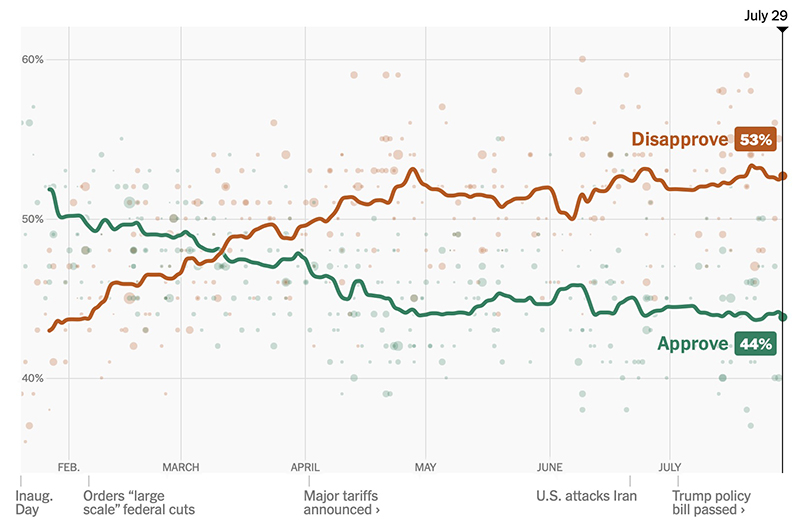
Most presidents lose approval as soon as they take office, but Trump's drop and standing is exceptional. Trump is now -9. In contrast, at this point, Joe Biden was +10, Barack Obama was +18, and George W. Bush was +24.
The crosstabs are interesting, as Trump is losing net support from groups that were previously firmly in his column. In the YouGov poll, Trump is -7 with men, -2 with white people, -8 with seniors, -16 with people earning <$50K and -15 with people earning $50K to $100K. He is also underwater on the issues like immigration (-16), the economy (-11), trade (-14), education (-15), abortion (-19), climate change (-20), and inflation (-25). At least his approval is better than that of Congress (-34). (V)
Harris Is Out (Which Presumably Means She's In)
Kamala Harris said she would take until the end of summer to make a decision on whether or not to run for governor of California. That works out to a deadline of September 21, but apparently she did not need the last 7 weeks or so, because she announced yesterday that she's going to take a pass.
Actually, what she said was that she "will not run for Governor in this election." That presumably leaves open the possibility that she could run in the future. However, California always gives its governors a second term. The last governor to be booted out after one term or less was Culbert Olson in 1942. Assuming that tradition holds, then Harris' next open-seat shot would be in 2034, when she will be 70. It's not impossible; Jerry Brown was 72 when he commenced his second stint as governor. But it is unlikely.
Readers hardly need us to tell them that Harris' decision means that she's surely planning to take another shot at the presidency in 2028. Undoubtedly, her people have done polling, and she likes the presidential math well enough to give it a go. What we would like to know is how good Harris' odds needed to be in order for her to take the presidential plunge. She would have been an overwhelming favorite to become the next governor, something very close to a 100% chance. If being president is, say, ten times better than being governor of California, then was a 10% chance of victory enough for her to take a shot? Or maybe being president is twenty times better. If so, then is a 5% chance of victory enough to make it worthwhile to pursue the big prize?
In any case, Harris ran a strong 2024 campaign, particularly under the circumstances, and she will enter 2028 with name recognition, a strong political network, and lots of money in the bank. That said, there are also two obvious problems that immediately present themselves. The first is that there are plenty of Democrats who think the 2028 nominee needs to be a bland white man. The second is that one of Harris' leading, and loudest, rivals for the Democratic presidential nomination is fellow Californian Gov. Gavin Newsom. Things could get ugly as they jockey for position, as they will be competing for some of the same financial backers, and they will both be after California's giant pile of delegates. Gov. Andy Beshear (D-KY) and Gov. Josh Shapiro (D-PA) are probably giving big sighs of relief right now.
With Harris out, the California gubernatorial election, at least on the Democratic side, will be a real barnburner. There are already 11 declared Democrats, at least 7 of those are serious, and at least 5 of those have very clear constituencies that will support them. There's been very little polling, and most polls that HAVE been conducted included Harris. That said, to the extent that we have data, the data says that former representative Katie Porter is the early favorite.
In a roundabout way, Harris' decision might also be good news for the California GOP. It is plausible that, if Harris had gotten in, the non-Harris Democratic vote would have coalesced around one alternative candidate (probably Porter). In that scenario, the primary could have concluded with Harris getting the most votes and the non-Harris Democratic alternative getting the second most. Given California's top-two system, that would have meant no Republican on the general election ballot. It's never happened in a gubernatorial race, but it has happened in a U.S. Senate race. Anyhow, with the Democratic vote split probably four or five or six ways, the usual 25% or so that the leading Republican gets in the primaries will almost certainly be enough for that Republican to make it to the general, where they will then get leveled. (Z & V)
You Can't Always Get What You Want
Democrats are jubilant that former North Carolina governor Roy Cooper jumped into the open-seat Senate race in North Carolina. That makes the election there a toss-up that might even lean slightly in Cooper's favor since, politics aside, people know and like Cooper and no one in North Carolina has ever heard of his probable opponent, Michael Whatley. Republicans will try to dredge up something heinous Cooper said or did 40 years ago, but that tends not to work so well with people who are already very well known. Cooper has held statewide office in North Carolina for 24 years and left office with a net approval rating of +14. As an aside, unless you are from eastern North Carolina, you are probably pronouncing the former governor's name wrong. It is not KOO-per. (Hint: Think ə).
But North Carolina is only one of the Senate races the Democrats need to win to take control of the Senate. And in the other ones, they don't have a good candidate yet. The next easiest seat to flip is Maine. The incumbent, Sen. Susan Collins (R-ME), is concerned. And with good reason. A recent Morning Consult poll shows that 38% of Mainers approve of her job performance and 54% disapprove of it. She is clearly vulnerable, but you can't beat someone with no one, and so far the Democrats have no one. They want term-limited Gov. Janet Mills (D-ME) to run, but she is 77 and hasn't said what she is going to do yet. If she doesn't run, next would be one of the two representatives. Rep. Chellie Pingree (D-ME) represents ME-01, a bit of the southeast Atlantic coast, but that is where half the Mainers live. It is D+9. The rest of the state, ME-02, is the biggest district east of the Mississippi, and it is represented by Jared Golden. ME-02 is the second-most rural district in the country and is R+4. Democrats want him to stay put since he is the only Democrat in the state who could win that seat. Any random state senator could win ME-01, so the Democrats' Plan B if Mills opts out is Pingree.
Next up is Alaska, where Sen. Dan Sullivan (R-AK) is running for reelection. Again, the Democrats know who they want, but the desired candidate hasn't said what her plans are yet. That candidate is Mary Peltola, the former at-large representative. Democrats know that Peltola can win statewide, since she did it twice before. She is a Yup'ik-American and has four children of her own and three stepchildren, which no doubt keeps her busy. If she opts out, there really isn't a Plan B. Alaska has a PVI of R+6, but it is an oddball state where unconventional candidates sometimes win. It also has ranked-choice voting.
Montana and Ohio are kind of in the same basket. Both are red states, but Democrats know who they want in both states. It is former senator Jon Tester in Montana and former senator Sherrod Brown in Ohio. Both have won multiple elections to the Senate. In a blue wave, they might be able to overcome their states' PVIs (R+10 and R+5, respectively) and win. Ohio is probably the easier of the two because (1) it is less red than Montana and (2) Sen. Jon Husted (R-OH) was appointed to his seat and appointed senators don't have a great track record.
If Texas AG Ken Paxton wins the Republican primary there, the Republicans will have a candidate quality problem and the Democrats will have a chance. The Party wants former NFL player and former representative Colin Allred to be their nominee, especially if the GOPer is Paxton. However, Allred will first have to win a primary against former USAF colonel and astronaut Terry Virts. There is also a good chance that state Rep. James Talarico will jump in, while Beto O'Rourke and Rep. Joaquin Castro have also expressed interest.
Beyond that, there are a couple of longshots. In Iowa, if Sen. Joni "We all are going to die" Ernst decides not to run, maybe a Democrat could win in a blue tsunami, but the Party doesn't have a candidate. In Nebraska, if independent Dan Osborn beats Sen. Pete Ricketts (R-NE), he might vote with the blue team sometimes. Sen. Ashley Moody (R-FL) was also appointed (when Marco Rubio resigned to become secretary of state). Florida has become fairly red of late, but in a blue wave maybe a strong Democrat has a chance, if the party can find one. Where is Claude Pepper when you need him? Oh yeah, dead. (V)
Democrats Are Getting Slightly More Optimistic about 2026
Democrats are getting a bit more optimistic about 2026 due to several factors:
- Health care is always an issue and Democrats will flog the cuts to Medicaid for all it is worth.
- The other parts of the BBB are polling poorly and the more the voters learn about the BBB, the less they like it.
- Donald Trump has not fulfilled his promise to get prices down.
- In theory, deportations are popular, but in practice they are very unpopular.
- A CNN poll showed that 72% of Democrats are enthusiastic about voting, vs. 50% of Republicans.
- Historically, the president's party gets hit hard in the midterms.
- When the president is especially unpopular, as Trump is, it hurts his party.
- Depending on how Epsteingate plays out, some Republican voters may feel deceived and not vote.
- College-educated voters, a majority of whom are now Democrats, represent a larger percentage of the electorate in midterms.
Winning the House will be easier than winning the Senate because there are more targets (although new gerrymanders in Texas and Ohio could make that more difficult unless Democrats fight back in California, New York, and New Jersey—more on this tomorrow). Still, keep in mind that the election is 15 months away and in politics a week is a long time. (V)
Twenty House Members Have Already Announced They Are Not Running in 2026
In every cycle, a few dozen House members call it quits for various reasons. Some run for another office, some just have reached a ripe old age and have had enough, and some just can't stand being in Congress because nothing ever happens there anymore. Members who don't run for reelection leave open seats behind, and these are easier to flip than seats that have an incumbent. So keeping track of open seats is important. Here are the 20 seats where the incumbent is not running in 2026. There will surely be more this year. In 2024 there were 45 open seats, in 2022 there were 50, and in 2020 there were 48. Here are seats where there has already been a retirement announcement:
| Representative | Party | District | PVI | Reason for retirement |
| John Rose | Republican | TN-06 | R+17 | He is running for governor of Tennessee |
| Randy Feenstra | Republican | IA-04 | R+15 | He is running for governor of Iowa |
| Dusty Johnson | Republican | SD-AL | R+15 | He is running for governor of South Dakota |
| Byron Donalds | Republican | FL-19 | R+13 | He is running for governor of Florida |
| Mike Collins | Republican | GA-10 | R+11 | He is running to challenge Jon Ossoff |
| Ralph Norman | Republican | SC-05 | R+11 | He is running for governor of South Carolina |
| Andy Biggs | Republican | AZ-11 | R+10 | He is running for governor of Arizona |
| Buddy Carter | Republican | GA-01 | R+8 | He is running to challenge Jon Ossoff |
| Andy Barr | Republican | KY-06 | R+7 | His is running for Mitch McConnell's open Senate Seat |
| John James | Republican | MI-10 | R+3 | He is running for governor of Michigan |
| Don Bacon | Republican | NE-02 | D+3 | He doesn't agree with Trump on much and it would be a tough fight |
| Chris Pappas | Democratic | NH-01 | D+2 | He is running for the Senate |
| Josh Gottheimer | Democratic | NJ-05 | D+2 | He ran for governor of New Jersey and lost the primary |
| Angie Craig | Democratic | MN-02 | D+3 | She is running for Tina Smith's open Senate seat |
| Mikie Sherrill | Democratic | NJ-11 | D+5 | She is running for governor of New Jersey and won the primary |
| Raja Krishnamoorthi | Democratic | IL-08 | D+5 | He is running for Dick Durbin's open Senate seat |
| Haley Stevens | Democratic | MI-11 | D+9 | She is running for Gary Peters' open Senate seat |
| Robin Kelly | Democratic | IL-02 | D+18 | She is running for Dick Durbin's Senate seat |
| Jan Schakowsky | Democratic | IL-09 | D+19 | She is 81 and retiring from politics |
| Dwight Evans | Democratic | PA-03 | D+40 | He had a stroke last year and is retiring at 71 |
Are there good pick-up opportunities for either party here? Not so much. Seats in the range R+5 to D+5 could be in play, but outside that range, it is tougher. Most Republicans who are retiring from the House are in safe districts. Only the districts of John James and Don Bacon are likely to be in play. In contrast, five Democratic seats will definitely be in play.
In addition to the above members who have officially announced they will not run for reelection in 2026, there are a number of others who are on the retirement watch list, either because they are planning to run for another office or they are simply way, way, way past the age at which anyone would retire in other professions. Here is a list of members who might toss in the towel later this year. Given the ages of the people involved, there could also be some... uh, "involuntary" retirements here.
| Representative | Party | District | PVI | Potential reason for retirement |
| Hal Rogers | Republican | KY-05 | R+31 | Age (87) and potential retirement from politics |
| Barry Moore | Republican | AL-01 | R+27 | He might run for the Senate |
| Harriet Hageman | Republican | WY-AL | R+23 | She might run for governor |
| Jim Baird | Republican | IN-04 | R+15 | Age (80) and potential retirement from politics |
| John Carter | Republican | TX-31 | R+11 | Age (83) and potential retirement from politics |
| Tom Tiffany | Republican | WI-07 | R+11 | He might run for governor |
| Elise Stefanik | Republican | NY-21 | R+10 | She might run for governor |
| Wesley Hunt | Republican | TX-38 | R+10 | He might run for the Senate |
| Virginia Foxx | Republican | NC-05 | R+8 | Age (82) and potential retirement from politics |
| Tom McClintock | Republican | CA-05 | R+8 | Age (69) and potential retirement from politics |
| Nancy Mace | Republican | SC-01 | R+6 | Likely run for governor |
| Cory Mills | Republican | FL-07 | R+5 | Potential run for higher office |
| Henry Cuellar | Democratic | TX-28 | R+2 | He has been indicted for taking bribes and more |
| Mikie Sherrill | Democratic | NJ-11 | D+5 | She is running for governor |
| Rosa DeLauro | Democratic | CT-03 | D+8 | Age (82) and potential retirement from politics |
| Emanuel Cleaver | Democratic | MO-05 | D+12 | Age (80) and potential retirement from politics |
| Jim Clyburn | Democratic | SC-06 | D+13 | Age (85) and potential retirement from politics |
| Doris Matsui | Democratic | CA-07 | D+16 | Age (80) and potential retirement from politics |
| Steny Hoyer | Democratic | MD-05 | D+17 | Age (86) and potential retirement from politics |
| Frederica Wilson | Democratic | FL-24 | D+18 | Age (82) and potential retirement from politics |
| Ritchie Torres | Democratic | NY-15 | D+27 | He might challenge Kathy Hochul for governor |
| Maxine Waters | Democratic | CA-43 | D+27 | Age (86) and potential retirement from politics |
| Danny Davis | Democratic | IL-07 | D+34 | Age (83) and potential retirement from politics |
| Nancy Pelosi | Democratic | CA-11 | D+36 | Age (85) and potential retirement from politics |
For the Democrats, there is actually some potential good news here. There are seven octodems who are in "fairly safe" to "very safe" districts. If they retired, they would almost certainly all be replaced by much younger Democrats. The Democrats are having a lot of trouble with younger voters and part of the problem is that so many of the Democratic politicians are so old. Injecting some new blood could be a real plus and provide a bench for the future. (V)
Sherrill Is Leading Ciattarelli by 8 Points in New Jersey Gubernatorial Race
There aren't a lot of major elections this year, so we have to cherish each one. There are gubernatorial elections in two states, New Jersey and Virginia, and they will be carefully watched. In New Jersey, the Democrat often wins, but there have been Republican governors recently, like Chris Christie. The margin is sometimes an indicator of the national mood. If it is close, Republicans may do well next year. If it is a blowout, Democrats may do well the next year.
Now that the candidates are known in New Jersey, the general election polling is starting. A new Fairleigh Dickinson University poll has Rep. Mikie Sherrill (D-NJ) at 45% and Republican Jack Ciattarelli (R) at 37%. The PVI for New Jersey is D+4. Kamala Harris beat Donald Trump in the Garden State by 6 points in 2024. So Sherrill is outperforming the baseline.
For the most part, people are voting the party line, with 87% of Democrats backing Sherrill and 86% of Republicans backing Ciattarelli. Independents are for Sherrill by a 30% to 23% margin. This means that many independents are undecided. Ciattarelli will need to pull in large numbers of them to make up for the fact that there are more Democrats than Republicans in New Jersey. But he has to walk a fine line. If he keeps Donald Trump at a distance, he may win more independents, but some Republicans may be turned off and not vote. If he hugs Trump closely, most Republicans will vote but he will lose independents.
Ciattarelli ran for governor in 2021 and lost by only 3 points. Now he is doing worse against Sherrill. (V)
Marjorie Taylor Greene Will Stay Put
Fire-breathing Trumpist and all-purpose right winger Rep. Marjorie Taylor Greene (R-GA) is an ambitious politician who craves attention. This could have been her year. With no incumbent governor running and a largely untested Democrat who barely won last time running for reelection to the Senate, she could have had her pick. She probably wouldn't have cleared the field in either primary, since she definitely has a candidate quality problem in statewide elections, but what's a good fight between friends? So, what is she doing? She is staying put in the House.
She didn't actually explain why she turned down two obvious opportunities for advancement. Maybe she is worried that as governor she would actually have to, well, govern. Incendiary tweets do not, as it turns out, get the potholes fixed. It could be that she doesn't really want to have the responsibility of getting things done. It is also the case that Georgia is much closer to the equator than Washington is. Depending on orbital trajectory, the Jewish space lasers might have a much cleaner shot if she takes up full-time residence in Georgia.
The Senate is different. Senators don't necessarily have to do anything except vote when it is time to do so. The rest of the time they can seek publicity and pontificate on anything they want to. She would make a fine senator, in the style of Sen. Ted Cruz (R-TX) or Rand Paul (R-KY). The fact that she passed on the race suggests to us that she did some polling of how she would match up against Sen. Jon Ossoff (D-GA) and discovered that independents don't like her at all and she would lose. We can't think of any other reasons she would turn down two wonderful opportunities to move up. (V)
If you wish to contact us, please use one of these addresses. For the first two, please include your initials and city.
- questions@electoral-vote.com For questions about politics, civics, history, etc. to be answered on a Saturday
- comments@electoral-vote.com For "letters to the editor" for possible publication on a Sunday
- corrections@electoral-vote.com To tell us about typos or factual errors we should fix
- items@electoral-vote.com For general suggestions, ideas, etc.
To download a poster about the site to hang up, please click here.
Email a link to a friend.
---The Votemaster and Zenger
Jul30 The Epstein Files: Maxwell Thinks She Has Leverage... and She Might Be Right
Jul30 Legal News, Part I: It's Now JUDGE Bove
Jul30 Legal News, Part II: CECOT
Jul30 Election News: U.S. Senate
Jul30 Never Forget: Scout's Honor
Jul29 What Is Trump's Gaza Policy?
Jul29 About That EU Trade Deal...
Jul29 The Epstein Files: Apparently, Ghislaine Maxwell Is the Real Victim Here
Jul29 Tone Deafness, Thy Name Is Ron DeSantis
Jul29 Never Forget: Budae Jjigae, Part I
Jul28 The Rosetta Stone Is in Florida
Jul28 The U.S. and E.U. Have a Trade Deal
Jul28 The Administration Has Fired 100 Immigration Judges
Jul28 Trump Has Found a Way around the Impoundment Act
Jul28 Trump Is Slipping with Independents
Jul28 Trump Has His Candidate for Thom Tillis' Senate Seat
Jul28 Trump Is Already Deeply Involved in the 2026 Congressional Races
Jul28 Jeanine Pirro's Nomination for U.S. Attorney for D.C. Advances
Jul28 Is the Washington Post in a Death Spiral?
Jul27 Sunday Mailbag
Jul26 Saturday Q&A
Jul26 Reader Question of the Week: Salud!
Jul25 The Epstein Files: Every Day, this Story Just Gets More Wild and Woolly
Jul25 States to White House: Extra Information on Voters Is Unneeded, Won't be Shared
Jul25 Candidate News: Who Will Succeed Tony Evers?
Jul25 Censorship Watch: Trump Is Made to Look Like a Buffoon
Jul25 Never Forget: Many Paths to Service
Jul25 I Read the News Today, Oh Boy: Ranger Rick (a.k.a. Rick Raccoon)
Jul25 This Week in Schadenfreude: The Appropriations Committee Did the First Lady No Favors
Jul25 This Week in Freudenfreude: Don't Judge a Man by His Tattoos
Jul24 POTUS Is Furious
Jul24 Democrats Are Struggling with a Possible Government Shutdown
Jul24 Bove's Nomination to the Third Circuit Clears a Key Hurdle
Jul24 Administration Removes Habba's Court-Appointed Successor
Jul24 Rand Paul Wants the Pardoned Anthony Fauci Charged with Something
Jul24 Big Law Caved but Little Law Didn't
Jul24 Virginia Is Beginning to Look Like a Disaster for Republicans
Jul23 Dead Men Tell No Tales, But a Live Woman Might Tell One or Two
Jul23 Today in Bending the Knee
Jul23 Iowa Wants to Go Back to the Front of the Line
Jul23 Democratic Presidential Candidate of the Week, #31: Gov. Katie Hobbs (D-AZ)
Jul23 Never Forget: A Moment Stuck in Time
Jul22 Of Course We Want to Release the Files, and... Hey! Look Over There!
Jul22 Republicans Want to Kill U.S. Tourist Industry
Jul22 Lots of Bad Polls for Trump
Jul22 Mark Green Makes It Official
Jul22 Never Forget: Flying Fox
Jul21 For a Dead Man, Jeffrey Epstein Keeps Making a Lot of News
Jul21 Trump Has Never Met a Scam He Didn't Like

