


 Welcome & FAQs
  Table of Senate polls
 Senate graphs
 Tipping-point-state
 Congress: retirements
 Governor's races
 Icons for bloggers
 Data galore


• Freedom of Suppress
• Trump Has an Affordability Plan: Threaten Whole Industries
• A Second Reconciliation Bill Is Increasingly Unlikely
• Trump Is Losing Latinos
• Trump Wants to See Susan Collins Lose
• Mary Peltola Raises $1.5 Million in the First 24 Hours
Trump Focuses on Greenland
Yesterday, Donald Trump again said that the U.S. must own Greenland for national security reasons. The White House also posted this cartoon on eX-Twitter:

Who is the intended audience? Americans? Greenlanders? Danes? If Greenlanders, it will likely backfire. They don't want to join America in any way, shape or form. In a poll from a year ago, 85% of Greenlanders said they do not want to become a part of the U.S., with only 6% saying they WOULD like that to happen. It is likely even worse now that Donald Trump is talking about annexing the island by military force. On Tuesday, Greenland's prime minister, Jens-Frederik Nielsen, said that if Greenland has to choose between America and Denmark, it will choose Denmark.
What about Denmark? Yesterday, the Danish foreign minister, Lars Rasmussen. and Greenland's foreign minister, Vivian Motzfeldt, had a meeting with J.D. Vance and Secretary of State Marco Rubio. Afterwards, Rasmussen and Motzfeldt held a press conference outside the Danish embassy in D.C. Rasmussen and Motzfeldt said the parties had a fundamental disagreement over the future of Greenland. In easy-to-understand terms, Trump wants to buy Greenland but Denmark doesn't want to sell it. At the presser, Rasmussen added: "We didn't manage to change the American position. It's clear that the president has this wish of conquering over Greenland. We made it very, very clear that this is not in the interest of the Kingdom."
Yesterday, Denmark began moving defense forces to Greenland and said other European NATO members would soon do so as well. The ministry said the move was to train the troops in Arctic fighting, but didn't specify who the potential enemy might be. There is no way the European troops could stave off an American attack, but having them there trying to at least slow an American advance would be a major PR hit to Trump. If American troops have to force their way in, against even nominal resistance, it would be impossible for Trump to say to the American people: "The Greenlanders welcomed us with open arms." It is also worth noting that, even if you have a force of superior size, it can be very, very hard to gain control of an enormous, largely empty, very cold piece of land. Ask Napoleon, if you have any questions.
On the positive side, the parties agreed to set up a working group to address security issues and whether they could be addressed without changing Greenland's ownership. It is possible they will come up with something, but that is unlikely to satisfy Trump. At heart, he is a real estate developer, and he likes to buy ground and develop it. He sees Greenland as a large chunk of undeveloped land he could buy and develop in case his deal to buy Gaza doesn't work out. The two have different problems. Greenland is cold and has no people. Gaza is hot and has a lot of people. However they are similar in that neither of the current owners is interested in selling the place to him. How long will it be before he gets the idea of moving all the people in Gaza to Greenland, so he can build hotels and condos in Gaza? That would violate international law, of course, but so what?
What about Congress? Is it enthusiastic about annexing Greenland? Well, a bipartisan team of Sens. Lisa Murkowski (R-AK) and Jeanne Shaheen (D-NH) has written a bill that would ban using U.S. funds to annex the territory of a NATO member state without the consent of that member. It is too soon to see how much support it has, but probably all Democrats will support it and likely some Republicans as well. Murkowski said "The mere notion that America would use our vast resources against our allies is deeply troubling and must be wholly rejected by Congress in statute."
What about the American people? Quinnipiac University ran a poll on the subject. It turns out Project Greenland is just as unpopular with Americans as it is with Greenlanders, with 86% of Americans opposed to taking the island by force and only 9% approving of the idea. When was the last time you saw 86% of Americans agreeing on anything? We bet if QU asked: "Do you approve of the American flag?" they wouldn't get 86% approval.
So, Greenlanders don't like the idea of being annexed, Denmark doesn't like it, members of Congress don't like it, and the American people don't like it. We are pretty sure no other country approves. So who does? Donald Trump. He is the only one, against essentially the entire world. Will he do it? At this point it is unclear, but the QU poll might actually deter Trump since doing something 86% of Americans don't want is not going to help the Republicans in November.
Ironically, Trump's approach is making it even less likely that he will be able to take Greenland without military force, which would destroy NATO and pit the entire E.U. against him. Avaaraq Olsen, the mayor of Nuuk, the capital of Greenland, said: "People here are getting more and more concerned because Trump's statements keep getting worse." He also said: "We were open for business, but when they showed that kind of disrespect, we lost that interest. We cannot be bought." If Trump were smart (which he clearly is not), he would have pushed for Greenland to become independent. Many Greenlanders want that. Then, as an independent nation, Trump could offer them security guarantees, money, investment, and more and they might go for it. But that is not Trump's way. His way is to pick on someone weaker than himself and then bully that person (or country) into submission to prove he is the boss. He would never, ever try this stunt with Chinese President Xi Jinping because Xi would just refuse, point blank. Then what?
Greenlanders' dislike of Trump has gotten so intense that the Greenland Dog Sledding Association revoked the invitation to Trump's new Greenland envoy, Jeff Landry, to attend the upcoming Avannaata Qimussersua. Take that, Trump.
Greenland is a hotspot for the intersection of geopolitical and climate concerns. Greenland has a lot of ice and it is melting fast due to global warming. The island has lost 100 billion metric tons of ice in the past year alone. That is enough ice to provide every adult on the planet with 1,500 margaritas every day for an entire year. As a consequence of this melting, the global sea level has gone up 4" since 1993. If this continues unabated, it will have disastrous consequences for heavily populated coastal regions all over the world.
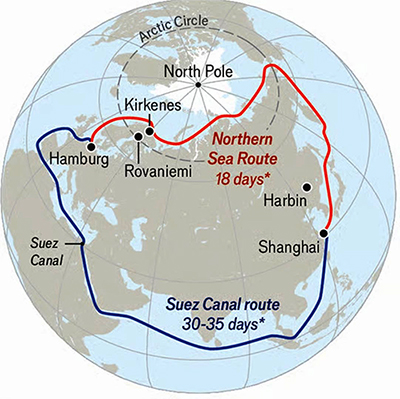
If enough ice melts, it could also affect global trade. China is working on a Polar Silk Road, which would cut shipping times from China to Europe in half. The new route through the Arctic would not go through Greenland, but could possibly pass by it, making control of that area crucial. This is one of the reasons Trump is interested in acquiring the island, but routes could also be safeguarded through NATO, without U.S. ownership against the will of the people who live there. Here is a rough map of the Polar Silk Road:
It is hard to see how this will end. Trump might be willing to destroy NATO. He never liked it in the first place, but he might not like some of the consequences. Suppose Germany decided that since America is no longer an ally, but an enemy, Germany needs nuclear weapons to defend itself. No one doubts that German engineers could build a quality product if the political leadership made a decision to do so. On top of that, sharing of intelligence would drop to zero. And trade would be hit hard, possibly resulting in a worldwide recession for which Trump would get the blame. Tourism would take a big hit, affecting the economy. There are some known unknowns but probably many unknown unknowns as well.
One of the known unknowns is how the isolationist voters who voted for Trump because he promised to stay out of foreign wars will react if American soldiers have been deployed to Venezuela, Greenland, Cuba, and other places Trump sees as rightfully his. And if American soldiers abroad begin dying as a result of sabotage and guerrilla actions, how will that affect public opinion in the U.S.?
Another known unknown is what Republican primary candidates say at town halls when a voter asks: "If you are elected and Trump asks Congress for funding to invade Venezuela, Greenland, Cuba, or some other place, will you vote for the funding?" Could be fun to watch the candidates squirm. (V)
Freedom of Suppress
We don't know where it's coming from (Stephen Miller?), but in the last week or so, there has clearly been a concerted effort from the White House to intimidate its "enemies" by using and abusing the legal system. It is true; this is a well-worn trick from the Trump playbook. However, the last several days have seen Sen. Mark Kelly (D-AZ), Fed Chair Jerome Powell, Renee and Becca Good, and others end up in the administration's crosshairs. A message is being sent and, in each case, the intended target of that message could not be clearer: active-duty troops (Kelly), Fed/independent agency appointees (Powell) and anyone who might dare resist ICE (the Goods).
There is another very obvious target for Trump, and it's one of his very favorites: the press. Reporters have a very nasty habit of shining a light on things that the administration would rather keep shrouded in darkness. And yesterday, the FBI, undoubtedly under orders from Director Kash Patel, raided the home of Washington Post reporter Hannah Natanson, who has spent the last year writing about the damage Trump has done to the federal workforce. Her coverage has been informed by numerous leakers, some of whom shared classified information. FBI agents, who were backed by a warrant, took with them Natanson's phone, two computers and a smartwatch.
Natanson is not arrested, and is not facing charges. Presumably, that will not change, since it is not illegal for reporters to share leaked information. On the other hand, this administration cares little for what the law actually says, so you never know. For the moment, one of Natanson's alleged sources, Aurelio Perez-Lugones, is the target. But every reporter who covers the Trump administration just got a warning: One day, maybe one day soon, FBI agents could show up at YOUR front door. Make sure all of your devices are fully encrypted. On Apple devices, use File Vault. On Android devices, use File-Based Encryption. On Microsoft devices, use BitLocker. These are close to unbreakable without the keys.
We would argue that this is yet another example of Trump and his underlings not thinking things through. The strategy of putting CBS News under the control of right-wingers? That one is paying off (as we will discuss in an upcoming item). But real journalists have an ethos that Trump and his people can never understand. If you try to intimidate them into not doing their jobs, they just double and triple down. Do you think, for example, that Natanson's coverage is going to get more friendly? We don't. (Z)
Trump Has an Affordability Plan: Threaten Whole Industries
Donald Trump has gotten the message that the voters care about affordability. He is starting to work on it using the tool he (and all mob bosses) know best: threatening people. Here are three examples:
- Health Care: Trump is going to call the leaders of health insurance companies to meet him
and then
demand
that they lower premiums. Could they cut them a little bit and just absorb the losses? If he threatens them enough,
maybe they could do it until the midterms. That's all he really cares about, after all. Then they could raise them
afterwards to make up for it.
Needless to say, this approach will not make any structural change in the system. An analysis by KFF (formerly Kaiser Family Foundation) shows the major driver of health care costs is what hospitals charge. To permanently lower premiums, hospitals have to charge less. KFF Senior Vice President Cynthia Cox said: "Prescription drug spending and insurance company overhead and profits is a tiny slice of the pie compared to spending on hospitals and doctors." Sen. Rick Scott (R-FL), who used to run the largest hospital company in America (which was fined $1.7 billion for billing fraud), agreed: "I used to run the largest hospital company so I can tell you, insurance can't charge a whole bunch less if the hospitals charge more." The reality, of course, is that hospitals have no incentive to lower costs. It is very rare for patients to do comparison shopping based on price, as they might when buying a TV. At most, they might check out where the "best" doctors are, but rarely where the cheapest ones are. The U.S. spends twice as much per capita as other wealthy countries and still ranks 48th in the world in longevity, behind Malta, the UAE, Greece, Costa Rica, Panama and even Albania. Much more radical change is needed in the system than having a few executives cut prices for a year.
- Credit Card Interest: Another expense Trump wants to get down by ordering executives
around is credit card interest. Because so much stuff is unaffordable, people put it on their credit cards and then get
socked with high interest rates. In 2024, the 195 million Americans with credit cards paid $160 billion in interest.
That's $821 per person in interest, and it's all lost money. Trump's
plan
is to have banks reduce the interest rate on credit cards to 10% until after the midterms. Current interest rates are
around 20%. It is not expected that the banks will receive this plan with great joy. Also not Wall St. The banks have
said that if they are forced by law to do this, they will cut costs by cutting credit to high-risk (i.e., poor) people,
forcing them to use payday loans and pawnshops. In the end, only Congress could actually force banks to lower interest
rates, not the president.
- Home Prices: On this one, Trump may actually have hit upon something that could work, but it would have fierce opposition. His idea is to ban corporations or large investors from buying single-family homes. He posted: "People live in homes, not corporations." The effects of such a ban would take years to show, and they would not all be positive. While it would prevent wealthy corporations from outbidding individuals looking for a home, there is also a downside. When a corporation buys a home, it rents it out. Banning this practice might reduce home purchase prices eventually, but it might also work to raise rents, as well, by reducing the supply of properties available for rent. Currently, about 3% of all single-family homes are owned by institutional investors, although in some cities it is much higher. For example, in Jacksonville, FL, it is 21% and in Charlotte, NC, it is 18%. In any event, this also requires congressional action and if enacted, would take years to have an effect.
In short, even if enacted, these plans are all basically putting lipstick on a pig. None of them will do much to fix the underlying problems that are creating the unpopular economic impacts. On the other hand, Trump doesn't give a hoot about whether any of these plans work to increase affordability. When no one else is listening, what he is likely to tell each group is: "I want you to announce that we have a deal that will lower costs. I don't care if you do or don't do it. What I care about is the announcement, not the ensuing action or lack thereof." Under these conditions, he might actually get the announcements. (V)
A Second Reconciliation Bill Is Increasingly Unlikely
House Speaker Mike Johnson (R-LA) would love to pass another big bill using the budget reconciliation process, but Republican members are skeptical that the votes are there. Republicans currently have a 218-213 majority in the lower chamber, but if one is in the hospital, as Rep. Jim Baird (R-IN) was recently, and can't vote, and when, on Jan. 31, one of two Democrats will win a special election to fill the seat of the late Sylvester Turner, it will make a party line vote 217-214. It would take only two defectors to kill any bill and Rep. Thomas Massie (R-KY) is always a wild card.
The chief architect of the first reconciliation bill, Ways and Means Chairman Jason Smith (R-MO), said that a second bill is impossible. That is why he put so many goodies in the first one: He knew there would not be a second one. But Johnson is not convinced. When Rep. Mike Lawler (R-NY), who represents a D+1 district in the Hudson Valley, said: "We are never getting a second reconciliation bill," Johnson replied: "Take those words out of your mouth." On the other hand, Majority Leader Steve Scalise (R-LA) said: "A lot of members have an interest in doing something. Question is, can we all come together behind the same thing?"
Some members other than Johnson do want a second bill. The Republican Study Group, the largest ideological caucus in Congress, came out with a 10-page plan. It cuts the government budget by $1.6 trillion over 10 years (including cuts to health care and welfare), deregulates the energy industry, and somehow magically creates low down payments for prospective homeowners. The hard-right chairman of the caucus, Rep. August Pfluger (R-TX), said: "The only way forward in this fight, unfortunately, is without Democrats. They refuse to work across the aisle, even at the expense of their own constituents." For moderate Republicans in swing districts, this plan is not going to fly, and without those swing seats, Republicans will be in the minority come Jan. 3, 2027. (V)
Trump Is Losing Latinos
Donald Trump's 2024 win was powered in no small part by Latino men, who like his macho style and thought he would fix the economy for them. They are rapidly souring on him. A poll of Latino small business owners shows that 42% say their economic situation has gotten worse under Trump and only 24% say it is getting better. Their top issue is cost of living, double that of any other issue.
This poll is striking because before the election, two-thirds said they trusted Trump more than Kamala Harris to handle the economy. This is a huge hit from a group (small business owners) that normally skews heavily Republican. Although the pollster didn't ask about Venezuela, Iran, or Greenland, we strongly suspect if that had been asked, many respondents would have replied: "Why is he spending all his time picking fights with other countries instead of fixing the economy at home?" Among Latinos as a whole, and not just small business owners, 68% say their situation is worse than it was a year ago and just 9% say it is better.
The CEO of the Arizona Hispanic Chamber of Commerce, Monica Villalobos, said: "We certainly do sense that our members—our clients in Arizona and across the country—feel a sense of betrayal by this administration, given its excessive overreach. Now that we've had a taste of [the Trump administration], I think you're going to see a big shift [in the vote]."
All these data points are omens that the Latinos who voted for Trump en masse in 2024 are not going to vote for Republicans this year. The best the GOP can hope for is that they all stay home, but probably a fair number will decide to send Trump a message and vote Democratic. It is hard to see how Trump can reverse this in only 10 months, especially if all his attention is going to be on foreign policy. (V)
Trump Wants to See Susan Collins Lose
Sometimes, Donald Trump's complete irrationality comes shining through. When he invades another country and captures its leader, he doesn't think that has any downside. And in some scenarios, it may not. As long as the new Venezuelan president, Delcy Rodríguez, keeps order, he might get away with it. It is kind of a calculated risk.
But when he said that Sen. Susan Collins (R-ME) (and four other Senate Republicans) should be defeated because they have voted with the Democrats to rein in his power, that is just crazy. As everyone knows, Maine is a blue state and Collins is the only Republican who could win that seat due to her personal popularity. She is also the Democrats' #1 target in the Senate. Democrats can now use his attacks on her in the northern part of the state to try to convince Republican voters to stay home rather than come out and vote for someone Trump hates. In effect, Trump is making it easier for Democrats to win the Senate in November.
Trump really and truly can't play one-dimensional checkers. If the Democrats capture the House, they are likely to impeach him, or at least one of the members of his administration. But if the Republicans control the Senate, majority leader John Thune (R-SD) will not allow a real trial, so he will probably just let each side have an hour to make their case and then call a vote. The defendant will be acquitted on a party-line vote and we will move on to the next thing.
But if the Democrats capture the Senate, too, there will be a real trial, possibly going on for a week or more, on national television, with law school professors, former federal judges, former federal prosecutors, disaffected former Republican politicians, and many more making a clear case that Trump (or his underlings) broke the law, abused power, and should be convicted. He will not enjoy that at all. Helping the Democrats defeat Collins brings that scenario quite a bit closer. If Collins wins, it will be nearly impossible for the Democrats to get a Senate majority. However much Trump dislikes her, from the perspective of what is best for himself (the only perspective he knows), trying to defeat her makes no sense at all. This is a recurring theme of our posts this week: Even if you grant Trump's me-first, America-second outlook, the things he's doing these days just don't make sense.
Gov. Janet Mills (D-ME), who is running for the Democratic nomination for the Senate seat, also went after Collins' vote. She said that Collins does the right thing only when it is politically expedient for her, otherwise not. The other Democrat running for the nomination, Graham Platner, didn't comment on the whole matter. We see this as a missed opportunity for him. He is the underdog in the primary and a fiery statement about Collins' hypocrisy and why she is failing the people of Maine would have gotten some attention. (V)
Mary Peltola Raises $1.5 Million in the First 24 Hours
Democrats need to flip four Senate seats to get control of that body. Maine and North Carolina are the easiest, and in a blue wave, will probably flip. Where are the other two coming from? Mary Peltola's announcement that she will take one for the team and run for the Senate instead of governor, despite the fact she might even be the favorite in the governor's race, is a hopeful sign.
If the first 24 hours are any indication, she will not want for funding. She raised $1.5 million in that period. Ninety-six percent of donations were $100 or less. Unlike states like North Carolina and Texas, where television time costs a fortune, Alaska is a cheap state, so $1.5 million goes a long way, and this is only the first 24 hours.
By way of comparison, Sen. Dan Sullivan (R-AK), her opponent, raised $1.2 million in all of Q3 of last year. He hasn't released his Q4 results yet. However, he had $4.8 million in the bank as of Oct. 1, 2025. There is every reason to believe that Peltola will be able to compete with Sullivan on the money front because she is a heroine to Democrats and Sullivan is a generic backbencher to Republicans.
What may be more important to Peltola than the money is that she also got 500 volunteers the first day. They can go out and talk to voters, give them leaflets about her, and so on. In the far-flung state, having snowboots on the ground is important. (V)
Previous report Next report
If you wish to contact us, please use one of these addresses. For the first two, please include your initials and city.
- questions@electoral-vote.com For questions about politics, civics, history, etc. to be answered on a Saturday
- comments@electoral-vote.com For "letters to the editor" for possible publication on a Sunday
- corrections@electoral-vote.com To tell us about typos or factual errors we should fix
- items@electoral-vote.com For general suggestions, ideas, etc.
To download a poster about the site to hang up, please click here.
Email a link to a friend.
---The Votemaster and Zenger
Jan14 Unforced Errors, Part IB: Jerome Powell (again)
Jan14 Unforced Errors, Part II: Mark Kelly
Jan14 This Week in Schadenfreude (Bonus Edition): Sieg Foiled
Jan13 Minneapolis Is Apparently the Hill that The White House Wants to Die On, Part II
Jan13 Unforced Errors, Part I: Jerome Powell
Jan13 Mary Peltola Will Run for the Senate
Jan12 Minneapolis Is Apparently the Hill that The White House Wants to Die On, Part I
Jan12 Is 2026 Like 2018?
Jan12 Ohio Will No Longer Count Ballots Received after Election Day
Jan12 Bannon/Loomer 2028
Jan12 More Democrats Retire
Jan08 Another Murder in Minneapolis?
Jan08 The Lost Cause, The Sequel
Jan08 Greenland Heats Up
Jan08 What Trump Really Wants from Venezuela
Jan08 Math Time
Jan08 Trump Has Made Grand Juries Grand Again
Jan08 Do Not Blame Trump
Jan08 Hegseth Goes after Captain Mark Kelly, aka Captain America
Jan08 Elizabeth Warren Is Donating $400,000 to State Democratic Parties
Jan06 Don't Cry for Me, Venezuela
Jan06 Walz on out of Here
Jan06 Twelve Days of Christmas... Games, Part II: Christmas Movie Trivia (the Answers)
Jan05 2025 in Review, Part I: The Democracy Demolition Derby
Jan05 How Does Trump Get Away with It?
Jan05 The President Is in Prison
Jan05 The Epstein Saga Continues
Jan05 Americans Are Initially Split on Venezuela
Jan04 The Don-roe Doctrine
Dec31 Things To Do
Dec30 Tuesday Mailbag
Dec29 Monday Q&A
Dec29 Reader Question of the Week: Leisure Where?, Part V
Dec27 Merry Christmas, America?: Trump Loses His Mind on Social Media
Dec27 Legal News, Part I: Great Scott! There's Something Called "Discovery?"
Dec27 Legal News, Part II: Apparently, Being Brown Is Not, in Fact, a Crime
Dec27 Lessons, Part I: DNC Doesn't Want to Wade Back into the Intra-Party Battles of 2024, Spikes Autopsy
Dec27 Lessons, Part II: The Contrarian Is Not a Merryman This Christmas
Dec27 In Congress: Johnson Puts Up a Record-Breaking Performance
Dec27 I Read the News Today, Oh Boy: Ogden Nash Wrote "The Ostrich" and "The Duck," but Not "The Hen"
Dec27 This Week in Schadenfreude: Maybe It Was a Mistake to Tinker around with the Kennedy Center Honors
Dec27 This Week in Freudenfreude: You Have to Be Loving These News Stories
Dec25 The DoJ Has Discovered Another Million Documents Related to Epstein
Dec25 Administration Will Start Garnishing Wages of People with Unpaid Student Loans
Dec25 Our Mess Is the Fault of the Voters
Dec25 You Win Some, You Lose Some
Dec25 Why Did Young White Men Vote for Trump?
Dec25 Democratic Representative Sues to Un-Rename Kennedy Center
Dec25 Twelve Days of Christmas... Games, Part XII: Only Connect

