


 Welcome & FAQs
  Table of Senate polls
 Senate graphs
 Tipping-point-state
 Congress: retirements
 Governor's races
 Icons for bloggers
 Data galore


• Redistricting Wars: Republicans Didn't See This Coming
• Legal News: Blanche Wants to Throw the Book at the SPLC
• Today in Marxism: Trump Administration Is Considering an Ownership Stake in Spirit Airlines
• I Read the News Today, Oh Boy: Vulcan Was Inspired by the Roman Emperor Nero
• This Week in Schadenfreude: Gold Card Program Is Going up in Smoke
• This Week in Freudenfreude: Clan of the Fiery Cross
Sometimes, the end of the month sneaks up on us. It turns out that tomorrow is the last Saturday of the month, which means all non-politics questions. So, if you have questions about movies, TV, theater, sports, books, history, this website, etc., please send them to questions@electoral-vote.com.
Iran: The War Is Not Going Well
We get this question a lot from readers, and (Z) gets it a lot from students: How the hell is this mess in Iran going to end? We wish we had a good answer to that, but we don't.
We've written it before, and we'll write it again, but Donald Trump has backed himself into a corner worse than any president except, maybe, Lyndon B. Johnson. Consider the President's basic options:
- Shock and Awe: The U.S. could bomb the living daylights out of Iran, with an eye towards
causing... surrender? Regime change? Something else? The goal of such a campaign is not clear and, even if it were
clear, the administration has already tried shock and awe without success. And now, the U.S. military is running out of
munitions. Even while the bombing was underway, we wrote several times that it would not work, and that no nation ever
won a war JUST with bombs. We could take a victory lap right now, except that everyone else was writing that, too.
Pointing that fact out required very little insight, and only a rudimentary grasp of 20th century history. Unfortunately
for America, Trump and Secretary of Defense Pete Hegseth have zero insight and no grasp of history.
- Ground Invasion: The point at which LBJ was really stuck was when he committed vast
numbers of troops to Vietnam, in the latter months of 1964. Once American soldiers have bled and died, the voting public
demands to see some meaningful benefit from that. And when there is no benefit, you just have to keep going... and
going... and going. As Vietnam vet John Kerry memorably put it, way back in 1971, "How do you ask a man to be the last
man to die for a mistake?"
The Trump administration appears to be savvy enough to know that "boots on the ground" would be disastrous. From a political standpoint, the American people would be furious, since the White House has done absolutely nothing to make the case for war. From a military standpoint, the only way that deploying soldiers can work is if you have a clear plan with a clear objective. For example, "capture Berlin and force Hitler from power" is a clear plan and a clear objective, and the military professionals can strategize ways to make that happen. By contrast, there was no clear plan and no clear objective in Vietnam or Afghanistan, beyond vague hand-waving about stopping communism/stopping terrorism, and those wars were disasters. We really don't believe it's possible to formulate a coherent strategic plan AFTER you've already commenced hostilities, and even if it somehow is possible, we really, really don't believe the people running this administration have the ability to pull off such a miracle.
The upshot is that we do not think Trump would be stupid enough to invade Iran with ground troops. But even if he is that stupid, all it will do is make a quagmire into an even bigger quagmire. - Declare Victory: For some period of time, we tended to think this would be the endgame:
Trump would tire of the war, would tire of the impact it's having on his approval rating and his political capital, and
would just declare victory and be done with Iran.
We don't think this option is on the table anymore, at least not in its original form. Trump's shenanigans have taught the Iranians that they can effectively strangle the world economy through their control of the Strait of Hormuz. This gives them enormous economic power (they can shake down ships that want to pass through the Strait) and enormous political power (they can hurt/help favored nations, say by demanding that oil transactions be conducted in Chinese yuan rather than U.S. dollars).
If Trump were to declare an end to the Iran War today, the Strait of Hormuz would not reopen under the same conditions as existed before the U.S. started bombing. Either the Iranians will keep it closed until they get concessions, such as security guarantees and unfrozen assets, or they will open it and start leveraging their newfound economic and political power, to the detriment of the United States.
At this point, the "Declare Victory" option is still the most likely outcome, we suppose, but it's now become "negotiate with the Iranians, give them some stuff, declare victory, and claim that the new agreement is way better than what Barack Obama came up with." The Obama part of that will be a clear-cut falsehood, albeit one that the MAGA cultists will accept. Will anyone else? We doubt it, and with nearly 70% of Americans disapproving, Democrats would be committing political malpractice if they did not point out early and often during this campaign season that "Trump Diplomacy" equates to "Give Iran [JUICY THING X] and [JUICY THING Y] while burning through hundreds of billions of dollars and getting nothing in return." - Besiege Iran: It would appear that the administration's current strategy is to blockade
the Strait of Hormuz, and in so doing, somehow bring Iran to its knees.
As a Civil War historian, (Z) knows a thing or two about blockades and sieges. Starting with the former, making a blockade work takes both a lot of time AND vast naval superiority. The Union blockade of the Confederacy took a couple of years to become at least somewhat effective, and that was despite the South's near-total lack of offensive firepower in its navy. The Strait of Hormuz is rather smaller than "the entire Southern coastline," so an effective blockade might come together a bit more quickly. However, that is counterbalanced by the fact that Iran, unlike the Confederates, has drones, mosquito boats and other sorts of headaches-for-admirals that will make it much harder for the U.S. to assert its naval superiority.
Meanwhile, the thing that blockades and sieges both require is time, and lots of it. When it comes to the Civil War, the big land battles—Gettysburg, Antietam, Fredericksburg, Shiloh, etc.—tend to get the lion's share of the attention. But the truth is that the real drama was in the two major sieges of 1864: Atlanta and Petersburg. Both sieges were in place by the (late) summer of that year, and the critical matter was that one of them simply had to work before November 8, 1864—Election Day. If one (or both) of the South's two most critical cities fell, then it was a message to Northern voters that the war effort was making progress, and could succeed, and it was worthwhile to let Abraham Lincoln finish the job. If both cities held on, then it would send the opposite message. Lincoln himself was pessimistic enough that in late August 1864, he made his Cabinet sign a promise to cooperate with the incoming presidential administration. Of course, Atlanta did fall (in early September), Lincoln's political fortunes turned around, and the rest is history.
The point of today's history lesson is that a siege only works if the besieging power has time on its side. The Union, as it turned out, had JUST enough time on its side to prevail. Trump, by contrast, does not have time. As we have pointed out many times, the oil/fertilizer economy is already screwed up, and will take months and months to get un-screwed (and it may never be fully unscrewed, if "money for Iran" becomes a permanent part of the cost of doing business). Meanwhile, Election Day is drawing closer and closer and closer, and the less space there is between the Iran War and the elections, the more voters will make Republicans pay at the polls.
You would think that someone who became President of the United States would be able to understand the dynamics of blockades and sieges, since it's really not all that hard. But Trump apparently does not. If you want to read more, and you have access to The New York Times, defense policy expert Jennifer Kavanagh just published an op-ed headlined "Blockades Don't Work the Way Trump Thinks," laying out that Iran has more at stake here than Trump does, and that it has a much higher tolerance for pain than Trump does, such that it's got the upper hand and then some in a siege/blockade situation.
This week alone, Trump has said there would be no extension on the ceasefire, has then extended the ceasefire, has bloviated about bombing Iran back to the stone age, and has said he's happy to wait for however long it takes to bring Iran to its knees. So, taking note of what he has to say about the Iran War on any given day is a waste of time, since his message will almost surely be different within 24 hours.
On the other hand, Trump's actions do afford some amount of insight. And yesterday, Trump fired Secretary of the Navy John Phelan. In contrast to the various high-ranking generals that Hegseth has fired, the Secretary of the Navy is a civilian, Senate-confirmed post, and so Trump had to approve the axe being swung.
Phelan was plenty Trumpy; he did not get his job because he was qualified, he got it because he donated lots of money to Trump's campaign, super PACs and inaugural fund. The reason he got fired was that, like "AG" Pam Bondi, he proved unable to do the impossible. In Phelan's case, the impossible was delivering the supposed Trump-class battleships by 2028. We write "supposed," because we are not sure they will ever be built, inasmuch as battleships are obsolete, or nearly so. If they somehow ARE built, it will be well after 2028, and Trump's name will not be on them.
But the real point here is that you don't fire high-level leadership in the middle of a war, unless the war is not going well. It's not being reported, but it's not hard to imagine that there were other points of tension between Phelan and the White House, like "This blockade is going to take a while to get in place" or "Blockades work very slowly, Mr. President," or "We don't have a great way to deal with Iranian drones or mines, right now."
Phelan will be replaced by Undersecretary of the Navy Hung Cao. The good news is that Cao has 25 years' experience serving in the Navy, as compared to the 0 years Phelan had. The bad news is that Cao, who ran for both the House and the Senate in Virginia, is nuttier than a fruitcake. One of his signature issues, as a politician at least, was that the U.S. is being overtaken by paganism, and that Christians need to fight back—violently, if needed. Presumably, Cao will not actually be able to act on that, even from his new, high posting. But you never know; after all, no one expects the Spanish Inquisition. The one thing we do know is that Cao might be more willing to polish Trump's apples than Phelan was, but he is not going to be able to deliver a new battleship by 2028. So, if he's smart, Cao won't sign any long-term leases on his residence in Washington. (Z)
Redistricting Wars: Republicans Didn't See This Coming
At the moment, seven states have altered their House district maps since the 2024 election. The states where the maps moved in a Republican direction are Texas (+5 GOP seats in the best-case scenario for Republicans), Ohio (+2), Missouri (+1) and North Carolina (+1). The states where the maps moved in a Democratic direction are California (+5 Dem seats in the best-case scenario for Democrats), Virginia (+4) and Utah (+1). That's +9 for the Republicans and +10 for the Democrats, which is basically a wash.
Yes, there are some remaining wildcards. The first is that the Virginia map may or may not stand up to legal scrutiny; it's already been the target of an injunction (albeit from a hyperpartisan Republican judge). The second is that Florida may still try to squeeze its maps to create a few more GOP seats. Certainly, that is what Gov. Ron DeSantis (R-FL) wants to do. However, that runs headfirst into the third wildcard, which is that the maps being drawn are based on voting patterns in an election where Donald Trump was on the ballot AND was much more popular than he is now. There is a fair chance that the Texas map will turn into a dummymander, and will hurt Republicans more than it will help them. Because of that risk, members of the Florida legislature might not be keen to do DeSantis' bidding.
(We recognize that there is a fourth potential wildcard, namely the Supreme Court gutting what's left of the Voting Rights Act of 1965, and thus killing off several majority-minority districts in the South. However, that's not a gerrymandering issue, per se, and besides, it does not look like that ruling will arrive in time to impact this year's election cycle.)
The upshot is that, at the moment, it sure looks like the Republicans' efforts to game the system, which started when Donald Trump made a phone call to his good buddy Gov. Greg Abbott (R-TX), have failed. And so, following the setback in Virginia this week, there is a lot of finger-pointing going on. In short, House Republicans blame Donald Trump for starting a fight that he didn't win, and that is certain to cost some of them their jobs. Meanwhile, the White House is furious that House Republicans, particularly those from Virginia, did not do more to try to prevent the Democratic gerrymander, up to and including raiding their campaign war chests to pay for anti-gerrymander ads. If the GOP is to have any hope of fending off a disaster in November, there will need to be very close cooperation between the members of Congress who are up for reelection and the White House, since Trump controls both the bully pulpit and an enormous amount of PAC money. The pi**ing contest over the gerrymandering does not bode well for that cooperation.
On the other side of the aisle, the buzz on the Hill is that the Gerrymandering War, and in particular the Battle of Virginia, is the first signature win for House Minority Leader Hakeem Jeffries (D-NY), and the first real proof that he might just be able to fill the very big shoes that Speaker Emerita Nancy Pelosi (D-CA) left behind. Even Pelosi herself has been singing his praises, declaring that her protégé handled redistricting "fabulously." Certainly, all of this should send a message to Republican politicians and to Democratic voters that the blue team's leadership is learning how to use the levers of power available to the minority party. It also makes clear that Democrats have at least temporarily decided to cast aside Michelle Obama's advice to "go high," and that they are willing to "go low" when they have to. Both lessons may give Republican politicians pause, and may serve to energize Democratic voters.
Meanwhile, allow us to pass along a comparison that has been making the rounds on social media. It's the op-ed that The Washington Post ran after Texas started the Gerrymandering War, and the op-ed the paper ran after Virginia (potentially) finished it:
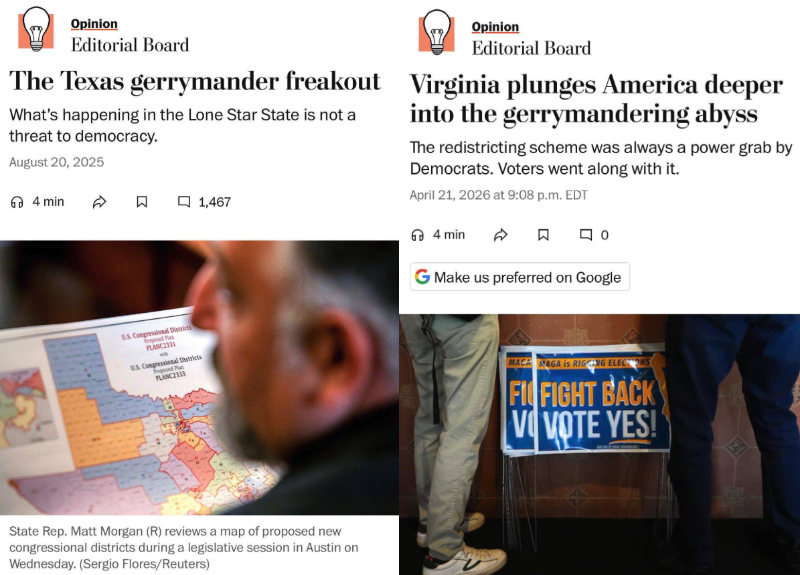
That's your idea of "fair and balanced," Mr. Bezos?
We do not agree with the Post's claim that the Virginia gerrymander was a power grab. That's like saying that it was a power grab when Ukraine counterattacked in Donetsk. We do agree that what happened in Virginia sent the country further down the gerrymandering abyss. And, truth be told, we hope the country goes further still down that abyss. It will not be until the majority of voters, including the low-information ones, perceive that there's a serious problem that the country will get some sort of meaningful fix to this obviously undemocratic practice that has now been going on for two centuries. (Z)
Legal News: Blanche Wants to Throw the Book at the SPLC
In the latest perversion of the mission of the Department of Justice, federal prosecutors are now targeting groups that fight far-right extremists. And they've alleged a truly bizarre legal theory, albeit one that somehow made it past a grand jury in Alabama.
The DoJ, under the direction of Donald Trump's personal attorney Todd Blanche, who is currently playing the role of Acting Attorney General, has brought charges of wire fraud, bank fraud, and money laundering against the Southern Poverty Law Center (SPLC) on the basis that the group was collecting donations under false pretenses. The DoJ alleges that, instead of using the funds for its mission of dismantling hate groups, it was secretly funding those groups' work. The indictment further alleges that fictitious entities were set up to pay informants so the payments couldn't be traced back to the SPLC. At the press conference held to announce the indictment, Blanche also claimed that the SPLC paid informants to "manufacture" the violence it told donors it was fighting. But note that the indictment itself doesn't actually say that. Blanche should be careful that he doesn't find himself on the receiving end of a defamation suit with remarks like that.
We've all watched enough episodes of shows like Law & Order to understand that a confidential source can't get paychecks with "FBI" or "SPLC" written on them. That just might give them away. Pat Cotter, a former organized crime prosecutor, pointed out that informants' safety depends on maintaining secrecy as to their funding sources. Calling that protocol fraud "is a unique if not perversely inventive theory of fraud," he said.
What is obviously missing from Blanche's narrative is the FBI's role in the SPLC's work and the Bureau's own time-honored tradition of using informants. As recently as October 2025, the SPLC worked closely with the FBI to root out these extremist groups and investigate threats to prevent violent acts and domestic terrorism. The use of informants is a tool that law enforcement routinely uses to expose organized crime, terrorism plots and other violence. And the FBI has been working with non-profit organizations fighting hate groups for a long time. During the George W. Bush administration, the FBI concluded that far-right extremist groups are the biggest threat for domestic terrorism. (Also, see below.)
Phil Williams, an investigative reporter, has a good theory as to why the SPLC is in this administration's crosshairs. A great many people in this administration have ties to white supremacists and other far-right groups, and the SPLC has uncovered a lot of it. They exposed White House Advisor Stephen Miller's ties to hate groups and his white nationalist ideology, "Border Czar" Tom Homan's involvement with the Proud Boys, and FBI Director Kash Patel's association with white supremacists. And now those people are in a position to use the powerful DoJ to deliver payback.
This is also driven by Republicans' false narrative that far-right groups have been "victims" of a federal government being run by leftist, partisan actors. So, the story goes, people in this administration—like Blanche—are just leveling the playing field. Of course, they can't fathom that the FBI has traditionally been one of the most conservative agencies in the government—and even they concluded that these far-right groups pose a unique threat to the country's safety.
We've written it before, but if there's evidence that these prosecutions are being brought for vindictive reasons or to harass and intimidate civil rights groups, the people responsible can be held accountable. Donald Trump can pardon them for federal crimes but can't protect them from civil suits, state criminal charges, court sanctions or state bar proceedings.
Of course, Blanche isn't thinking long-term right now. He's thinking very, very short-term. As in, "Sometime soon, Trump is going to name a new AG nominee, and I want it to be me!" By the time this case is adjudicated or (more likely) dismissed, Blanche will either be the AG, the former AG, or very disappointed. And whatever the case may be, he won't actually care about the outcome, because the audience of one he's performing for will have moved on to other things. (L)
Today in Marxism: Trump Administration Is Considering an Ownership Stake in Spirit Airlines
We are hardly experts in macroeconomics, so we don't claim to know all the nuances and subtleties of government bailouts of private concerns. But we do think those bailouts make sense sometimes. For example, the Troubled Asset Relief Program, which was passed under George W. Bush and largely implemented under Barack Obama, injected about half a trillion dollars into troubled financial companies and automakers. The money was largely paid back, such that the total cost to the federal government ended up being $31 billion (or, about two weeks of warring in Iran). We are willing to believe that the economic damage that would have been done, but for the TARP bailout, would have exceeded $31 billion, perhaps by several orders of magnitude. Though again, not our area, so we are happy to be corrected by any readers who know better, at comments@electoral-vote.com.
We are much less persuaded that a bailout makes sense in the case of an airline, like Spirit Airlines, which is in deep trouble right now. To start with, Spirit is in a cutthroat industry (airlines) and a particularly cutthroat sector of that industry (bargain carriers). There's no reason to believe that an infusion of cash will save it; it's more likely to just postpone the inevitable. There are also many other airlines that can pick up the slack, whereas with, say, auto makers, that is much less true. Spirit is also not essential to national defense, or to the national economy, or to any particular state or local economy. By contrast, if the banks go under, the U.S. and New York City will suffer badly, and if the auto makers go under, Detroit will be in trouble.
What definitely does not make sense is for the government to buy Spirit Airlines. That has "disaster" written all over it. And yet, that is what the Trump administration is thinking about doing. Earlier this week, Trump announced that the airline could receive up to $500 million in federal money, and in turn the federal government would own up to 90% of the airline. The alleged long-term plan would be to make the money back by selling Spirit to some other owner, at a hefty profit.
We almost cannot count the ways this just does not work. The government does not know how to run an airline. It could ask for help from the professionals at Spirit, but... they apparently don't know how to run an airline, either. The only thing the government could do is give Spirit some sort of favored treatment, like tax breaks or looser regulations. But that, of course, would be terribly unfair to the other airlines who have to play by the actual rules. And if the government can't right the ship (well, the airplane), then there goes $500 million of the people's money.
And then, consider the notion that the government is going to flip Spirit for a profit. If it was actually worth $500 million (or $555.5 million, as the 90% valuation implies), the airline would not be coming to the government for a handout; it would be talking to some private concern. How is the government going to get the value up to $555 million (or more)? The only way to make a profit is to "sell" the airline to, say, Qatar Airways for $1 billion or $2 billion or $10 billion. In other words, it could be a gateway for a big-time foreign bribe, one that could put Qatar Force One to shame.
And speaking of handouts, where does it stop? The other major players in the cut-rate American airline space, namely Frontier and JetBlue, are in trouble right now, too. And the situation is made worse by rising fuel costs, caused by the Iran War. So, if Spirit gets to sell itself to the government at a markup, Frontier and JetBlue are likely to want the same deal. And if those two are successful, there will be dozens of others who decide the federal government is their insurance policy. It's a real Pandora's Box.
Then there's the hypocrisy of the fact that government ownership of airlines is socialism, and is bordering on communism. This from a president that has made many attacks on "evil socialists" like Zohran Mamdani, Rep. Alexandria Ocasio-Cortez (D-NY) and Sen. Bernie Sanders (I-VT). Even those nations that DID embrace socialized air travel largely do not have government-owned airlines. They just grant a monopoly to a government-sanctioned private carrier.
We'll point out one more thing (and do appreciate that keeping it to just five things requires much restraint). This is an administration that just loves to round up alleged undocumented immigrants, and to ship them off to some random foreign country without benefit of any sort of legal process. One of the big hitches has been finding air carriers willing to do the dirty work. Well, if the government owns its own air carrier, that problem goes away, now doesn't it?
To their credit, some of the Republican members of Congress who are only pretending to be MAGA have screamed bloody murder about Trump's plans, with Sen. Ted Cruz (R-TX) perhaps screaming the loudest (albeit while also claiming that this is really Joe Biden's fault, because the Biden administration blocked a merger between Spirit and JetBlue). Sometimes, Trump listens to the screaming. Sometimes, he doesn't. Here, we think he'll have a very difficult time giving up the idea of a fleet of planes at his disposal, for any use he sees fit. (Z)
I Read the News Today, Oh Boy: Vulcan Was Inspired by the Roman Emperor Nero
There are a lot of people in the world who look down their noses at comic books and/or comic book movies. In our experience, this kind of "high culture"/"low culture" gatekeeping does not reflect well on the gatekeepers. Keep in mind, to take one example, that Shakespeare—now the epitome of "high culture"—was once a working-class entertainment, and one considered slight enough that the first formal publication of his plays did not happen until 7 years after the Bard was dead.
Similarly, a lot of modern "low culture" is actually very erudite. Not all of it, of course, but there are plenty of cartoons, and sitcoms, and mass-market movies that are actually full of references to history, literature, theater, poetry, etc. And so it is with comic books, which often draw on classical mythology, ancient history, epic poetry, timeless literature, and the like. For example, and as per the headline, the character of Vulcan, who has hundreds of appearances at this point, is an amalgam of the Emperor Nero and the Roman god of fire, Vulcan.
Oh, and as a sidebar, but a fairly closely related sidebar, (Z) is sometimes asked what movies are most likely to be known 500 years from now. His answer is: Westerns. Not all of them, of course, or even most of them. But Western films have an almost operatic dynamic to them, and they definitely have a universal quality that substantively transcends space and time. This is why Hollywood still makes plenty of Westerns; they're just not set in the Wild West anymore. No, now they are set in space (e.g., Star Trek, Star Wars), or in urban environments (e.g., Die Hard, Urban Cowboy, Taxi Driver).
For last week's theme, we gave two clues. The first was: "ABCDFGHIJKLOPQRSTUVWYZ." And the second was: "there was supposed to be one more item yesterday, but we ran short on time and space. If it had run, the headline would have been 'The Cabinet: Storm Clouds on the Horizon.'"
And here is the solution, courtesy of reader R.B. in Amherst, MA:
Names of various X-Men:
And of course, the four letters of "X-MEN" were the letters missing from the alphabet clue.
- New Jersey: No, the Longshot Did Not Win
- Fundraising News: ActBlue Is a Beast
- Legal News: In Court, Trump Has Lost His Mystique... if He Ever Had It
- I Read the News Today, Oh Boy: Gerald Ford Was a Michigan Wolverine
- This Week in Schadenfreude: Not-Exactly-Instant Karma
- This Week in Freudenfreude: The California Gambit?
The alphabet clue was inspired by an old riddle about the Christmas greeting hidden in this series: ABCDEFGHIJKMNOPQRSTUVWXYZ. No "L." Get it? And Vulcan, from this headline, is also an X-Men member. As is Storm, from the headline that never ran.
Here are the first 60 readers to get it right:
|
|
The 60th correct response was received at 5:09 a.m. PT on Friday. This was a very popular theme.
For this week's theme, it relies on one word in some headlines, multiple words in others, and it's in the category Language. For a hint, we'll say that we think Pope Leo XIV would approve.
If you have a guess, send it to comments@electoral-vote.com with subject line April 24 Headlines. (Z)
This Week in Schadenfreude: Gold Card Program Is Going up in Smoke
Puffery is one matter. Perjury is a different matter, entirely.
When the Trump administration announced it would sell "gold" visas to wealthy (and presumably white) people who wanted to establish residence in the United States, Secretary of Commerce Howard Lutnick was put in charge of the program. We would think that handing out green cards (even if they're golden) would be a DHS thing, or maybe a State thing, but when the primary goal is the filthy lucre, we guess Commerce makes sense, too.
In various public appearances, Lutnick has gushed about how well the program is going. Before it was formally announced, he predicted that it would add $1 trillion to the U.S. treasury. At $1 million/pop, that would require 1,000,000 takers, which is a pretty big number. Once the program was officially open for business, Lutnick declared that it had raised $1.3 billion (1,300 takers) in just a few days.
As it turns out, that was some rather aggressive salesmanship. Or, if you prefer, some rather aggressive lying. Lutnick testified before Congress this week, and was asked to report on exactly how many golden visas have been sold. It turns out, it's a fair bit shy of 1,000,000. In fact, it's a fair bit shy of 1,300. Thus far, the number of people who have paid the $1 million, and received their visa is... one.
There is—and we are obviously happy to hear this—a somewhat substantive vetting process before a person can get one of the golden visas. And the cost of vetting is $15,000, and must be borne by the applicant, regardless of whether they are successful. Lutnick claims that there are "hundreds" of people in the pipeline, but given his obvious propensity for exaggeration, you have to take that with several pounds (or given that all the applicants are foreign, kilograms) of salt. Further, even if it is true, several hundred people are not going to produce billions in revenue, much less $1 trillion.
So, it looks like the Trump gold visas will end up on the same junk heap as Trump Vodka, Trump Steaks, Trump Airlines, and—sooner or later, probably sooner—stock in Trump Media. Oh, well. At very least, we extend our congratulations to the one successful applicant who, as we understand it, is a Mr. Plad Vutin. Welcome aboard, Plad! (Z)
This Week in Freudenfreude: Clan of the Fiery Cross
In the Iran item above, we refer to "today's history lesson." That was a bit of a falsehood, because we're about to present another one. We had no idea, at the start of the day, that this would be this week's Freudenfreude. However, after we got (L)'s item on the SPLC, and then wrote that bit at the start of "I Read the News Today," this was really the only way to go.
The fellow we want to discuss today is Stetson Kennedy. By his demographics, he should have been an out-and-out racist. He was a white Southerner, born in 1916 to a wealthy and aristocratic family in Florida. Kennedy's middle name, which he used as his first name instead of the more bland "William," was a tip of the hat (no pun intended) to the main source of the family fortune, the Stetson hats empire. Several of his relatives were active participants in the Ku Klux Klan, most notably an uncle who rose to the rank of Great Titan, which is a couple of steps down from the top position of Grand Wizard.
However, Kennedy was not an out-and-out racist. He was a lefty, enough so that he would give Bernie Sanders a run for his money. That's pretty far left by American standards, even today. It was positively pinko by the standards of Kennedy's time. He used the position of privilege afforded by his family wealth to launch a career as a folklorist, conducting interviews across the South, and publishing them in volumes like Grits and Grunts: Folkloric Key West.
Of course, much Southern folklore was going to be uncovered among Black populations. As a result of his exposure to these folks, particularly his family's Black maid, Kennedy eventually pivoted, and started producing books about Southern racism. The best known of those is Jim Crow Guide to the U.S.A.: The Laws, Customs and Etiquette Governing the Conduct of Nonwhites and Other Minorities as Second-Class Citizens. This did not endear Kennedy to many of his fellow white Southerners, as you can imagine, but he was undeterred, and eventually followed that with Southern Exposure: Making the South Safe for Democracy.
Kennedy's life and career, from the 1930s through the 1960s, was really quite remarkable, and is reminiscent of those old "The Most Interesting Man in the World" beer commercials. He (Kennedy, not the Most Interesting Man in the World) worked for the Federal Writers Project during the Great Depression, collecting folk tales and folk songs. He traveled to Europe and worked on propaganda for the liberal side of the Spanish Civil War. He did coursework at the Sorbonne in Paris and the New School for Social Research in New York. He wrote a syndicated newspaper column, in which he advocated for "Frown Power"—anytime you hear anyone say anything that is bigoted, you should make a point of frowning. He supported the careers of Harlem Renaissance writers, particularly Zora Neale Hurston. And he served as Southeastern Editorial Director of the Congress of Industrial Organizations.
What Kennedy is most famous for, however, is his work in undermining the Ku Klux Klan. During World War II, he tried to volunteer for service, but was classified 4-F due to a bad back. Observing that many of his high school friends were off fighting bigotry in Europe, he decided to go to war against domestic "homegrown racial terrorists." So, with some help from The Anti-Defamation League of B'nai B'rith, he adopted an alias—John Perkins, the name of a deceased uncle who had been a KKK member—and he infiltrated the Klan. Given Kennedy's race, his background, and the fact that he, in his guise as "John Perkins," had been a longtime member, he had no trouble gaining the trust of the fellows in the white robes. And given his experience with folklore and with collecting documentation, he had no trouble figuring out which information was extra juicy.
Initially, Kennedy shared that information with state and federal law enforcement, including the FBI. Eventually, he began working with Drew Pearson, who was a newspaper reporter and a radio broadcaster, and who hosted a show called Washington Merry-Go-Round. Kennedy, using his own name to protect the Perkins alias, would reveal the minutes of the latest KKK meeting he'd been at (and he moved his way up the ranks, to national-level meetings), who had been there, and any other "interesting" details. This had the effect of causing many prominent people to renounce their KKK membership.
The platform afforded by Pearson brought Kennedy into contact with other radio programmers, among them the producers of the radio serial Superman. They were looking for content, and he was looking for exposure, and the result was a 16-episode story arc called "Clan of the Fiery Cross," in which Superman took on and defeated the KKK. The episodes revealed a little bit of inside information about the Klan, though their primary impact was to persuade young listeners that the KKK was wicked, and not something they should want to be a part of.
In 1947, Kennedy had to testify in a trial involving two Klansmen accused of (and convicted of) murder. That blew the lid off his alias, and brought an end to his undercover career. He later wrote a book about his KKK adventures entitled The Klan Unmasked. Some historians and other scholars have accused Kennedy of exaggerating his exploits; his response (before he passed away) was that he was really telling the story of two people, himself and another undercover operative who did not want to be identified.
In any event, exaggeration or no, there is no question that Kennedy did much damage to the KKK. Broadly speaking, he cost the organization hundreds or thousands of members. More specifically, he purloined evidence that the Georgia KKK was taking in much money and not paying taxes. That attracted the interest of the IRS and the Georgia Department of Revenue, who demanded immediate payment of the $685,000 they were owed (over $9 million in 2026 dollars). The Georgia klansmen did not have it, which led the state of Georgia to revoke the Klan's national corporate charter in 1947.
Stetson Kennedy is certainly someone who lived his best life (and it was a long life, too—he died in 2011 at the age of 94). Meanwhile, Todd Blanche's notions about the proper ways to deal with hate groups (see above) are clearly ahistorical hogwash. The acting AG might also want to take a look at the recent film BlacKkKlansman.
Have a good weekend, all! (Z)
Previous report Next report
If you wish to contact us, please use one of these addresses. For the first two, please include your initials and city.
- questions@electoral-vote.com For questions about politics, civics, history, etc. to be answered on a Saturday
- comments@electoral-vote.com For "letters to the editor" for possible publication on a Sunday
- corrections@electoral-vote.com To tell us about typos or factual errors we should fix
- items@electoral-vote.com For general suggestions, ideas, etc.
To download a poster about the site to hang up, please click here.
Email a link to a friend.
---The Votemaster and Zenger
Apr23 Trump Is Moving into Midterm Mode
Apr23 Trump Is Approaching the Bush Line
Apr23 What Can Be Done to Protect the Midterms from Federal Interference?
Apr23 Democrats Are Gearing Up for a Supreme Court Battle Anyway
Apr23 MAHA Will Get Its First Real Test in Louisiana
Apr23 Senate Rundown
Apr23 Why Is Abbott in No Hurry to Call a Special Election in TX-23?
Apr23 House Democrat David Scott Died Yesterday
Apr23 Trump Fires CEO of Trump Media after 90% of Former Value Is Wiped Out
Apr22 Virginia Wrestles with Redistricting
Apr22 Notes on the State of California
Apr22 Cherfilus-McCormick Falls on Her Sword
Apr22 Political Bytes: Paging Arlen Specter?
Apr22 The Trial of the Century... the 19th Century
Apr21 Another One Bites the Dust
Apr21 Notes on the State of Virginia
Apr21 Another Rebellion in the House
Apr21 Legal Bytes: TrumpWatch
Apr20 Virginians Go to the Polls Tomorrow to Vote on Redistricting
Apr20 Poll: Trump Has No Plan for Iran
Apr20 Trump in Talks with the DoJ about the Mother of all Grifts
Apr20 New Poll: A Quarter of Trump's 2024 Voters Think Deportations Have Gone Too Far
Apr20 Husted's Old Scandal May Come Back to Haunt Him
Apr20 This Is Where a Blue Wave Has to Start
Apr20 Trans Veteran and Rocket Scientist Booted Out by Hegseth is Running for Congress
Apr20 Source: Alito and Thomas Will Not Retire in June
Apr19 Sunday Mailbag
Apr18 Saturday Q&A
Apr17 New Jersey: No, the Longshot Did Not Win
Apr17 Fundraising News: ActBlue Is a Beast
Apr17 Legal News: In Court, Trump Has Lost His Mystique... if He Ever Had It
Apr17 I Read the News Today, Oh Boy: Gerald Ford Was a Michigan Wolverine
Apr17 This Week in Schadenfreude: Not-Exactly-Instant Karma
Apr17 This Week in Freudenfreude: The California Gambit?
Apr16 The Election in New Jersey Today Could Be Another Indicator
Apr16 Republican Senators Are Caught Between Trump and the Pope
Apr16 Vance's Bad Week Got Even Worse
Apr16 Trump's Small Tent
Apr16 Trump Wants Banks to Collect Citizenship Status of Customers
Apr16 Trump Promises Mass Pardons of Enablers before Leaving Office
Apr16 The First 2028 Cattle Call
Apr16 Data Centers Are Becoming a Hot Political Issue
Apr16 Virginia Is Trying to Make Us Obsolete
Apr15 Inflation Is Bad... Wonder Why?
Apr15 Well, That Didn't Go as Planned
Apr15 It's Tax Day
Apr15 Democrats Make "Attempt" to Remove Trump from Office
Apr15 The Dust May Be Settling in California
Apr15 Oh. Canada!

