


 Welcome & FAQs
  Table of Senate polls
 Senate graphs
 Tipping-point-state
 Congress: retirements
 Governor's races
 Icons for bloggers
 Data galore

|
Johnson’s Chaotic House No Plans U.S. and Russia Hold Peace Talks |
Trumps Obamacare Mess Mike Johnson Flashes Red on Trumps Healthcare Push Jim Justice Sued for $5 Million in Back Taxes |

• Congressional Republicans Are Not Keen on $2,000 Relief Checks
• Republicans Are Struggling to Deal with Health Care
• Race for Governor of California Heats Up
• The 6-Year Itch Could Hit Republicans Next Year
• J.D. Vance Is Not a Sure Thing in 2028
• Robert Kennedy Jr. Is Restarting His Political Party
• Poll: Americans Are Unhappy with the Economy
• Poll: Americans Are Not Happy with Billionaires Trying to Buy Elections
Alito Saves the Day for the Texas GOP
After Texas regerrymandered its congressional map in the summer, a Latino group named LULAC sued, claiming it was an illegal racial gerrymander. A three-judge federal district court last week ruled for the plaintiffs, agreeing that the map is indeed an illegal racial gerrymander and banning its use in 2026. Gov. Greg Abbott (R-TX) immediately appealed to the U.S. Supreme Court because the filing deadline is Dec. 8, and candidates need to know where the district lines are so they can file.
To the rescue rides Associate Justice Samuel Alito, who on Friday granted an administrative stay, meaning that Texas can use the new (highly gerrymandered) map until the Supreme Court has heard the case on the merits. Alito gave no indication when that might be.
Given the rapid approach of the filing deadline, if the Supreme Court delays ruling on the merits until after Dec. 8, de facto, the gerrymandered map will have to be used for 2026, although it could be voided for 2028. On the one hand, the Supreme Court should be against the new map, since it has previously ruled that racial gerrymanders are illegal and the new map is unambiguously a racial gerrymander. On the other hand, the current Supreme Court is basically an organ of the Republican Party, which wants the new map. We don't know which principle will win here.
One pro-Republican way out would be to hold that the new map is not valid, but to withhold that ruling until, say, January, or better yet, until June, so the 2026 election will be forced to use the new map, even if it can't be used in 2028. Abbott, mindful of the filing deadline, asked the Court to rule that the new map is OK by Dec. 1, but it is under no obligation to do so.
If the Court rejects the new map, that would be a huge blow to the Republican Party and Donald Trump, who asked for the new map. There are also lawsuits about the California map, but they are less likely to win because they are not racial gerrymanders—that is, they did not carve up Latino districts the way the Texas map did. Here is the current state of play:
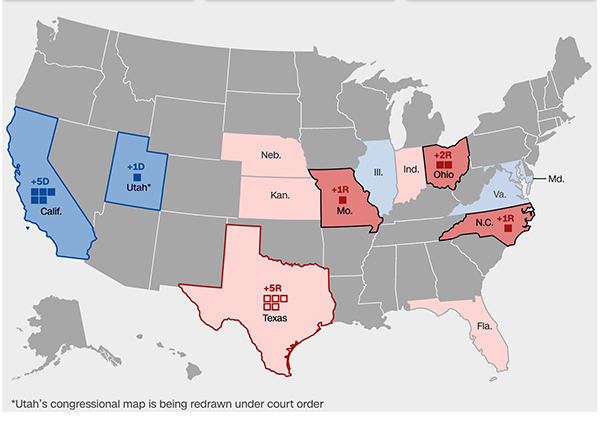
If the new Texas map survives, the net change in seats is probably R+3. If it does not, the net change is D+2. Of course, we are not done yet. Illinois, Maryland, Virginia, and Nebraska could yet change their maps. Virginia could probably net three seats for the Democrats and Illinois another two. Maryland could theoretically pick up another Democratic seat, but the map would be horrific. Nebraska could get another Republican seat. On the whole, if Virginia and Illinois draw new maps, together, that is D+5 and the whole exercise could be a wash if the Texas map holds and a net win for the Democrats if it does not. This goes to show that Donald Trump never thinks things through at all. He ordered Texas to change its map without thinking about blue states doing the same thing.
Florida is a wild card here. There are five Democrats in districts from D+2 to D+5. They are all potentially at risk if the legislature decides to go to town. So far it hasn't done anything, but the filing deadline is April 20, 2026, so it still has plenty of time. If Florida gave the Republicans five more seats, that would be a huge hit to the Democrats.
If the Democrats get the trifecta in 2028, all this monkey business might give them the backbone to genuinely do something about gerrymandering, such as requiring independent commissions along the lines of how it works in California. Or something more radical like making all representatives run statewide. (V)
Congressional Republicans Are Not Keen on $2,000 Relief Checks
Donald Trump has thought of a way to buy the midterms. He wants to send Americans a $2,000 check next year, presumably with his name on it in boldface. The plan is not going so smoothly.
Trump's idea was to use the money collected from his tariffs to pay for it, but math was never Trump's strong suit. If every American got $2,000, the total bill would come to $660 billion. The tariffs amount to about a third of that. If the formula is arranged so that only half of Americans get a check, it is still not enough. A second problem is that the tariff money goes into the federal treasury, not Trump's personal slush fund. For Secretary of the Treasury Scott Bessent to write the checks, Congress would have to authorize them.
The third, and biggest, problem is that many Republicans in Congress have other ideas about the tariff money. Sen. Ron Johnson (R-WI) said: "We're facing a deficit this year around $2 trillion. I think whatever revenue we get, from whatever source, ought to go to try and bring down those deficits." That doesn't sound like a "yes" vote to us. Sen. Rick Scott (R-FL) agrees: "You know, my focus would clearly be paying down the $38 trillion of the debt." Sen. Bernie Moreno (R-OH) is a firm "no." He said it would never pass, given the soaring national debt. He also wants to pay down the deficit. So far the only senator in favor is Josh Hawley (R-MO).
Over in the House it is not much better. Speaker Mike Johnson (R-LA) said: "The discussion would be: If you have trillions of dollars in new revenue, what's the best use for it? Should you pay down the debt? Because that saves families a lot of money in the long run and puts us back on a sound fiscal trajectory." Rep. Andy Biggs (R-AZ) said: "I mean, everybody's got their own idea. I would prefer we reduce the overall tax rate, and make that permanent."
Yet another problem is that the Supreme Court is now considering whether Trump even has the authority to levy tariffs. If he doesn't, the money already collected will have to be used to reimburse companies that paid it and there won't be any new money coming in from tariffs.
Finally, dumping $300 billion or more on consumers is going to lead to a buying spree, which will be inflationary, just at a time when consumers are complaining loudly about how much everything costs. In short, it will take a lot of arm-twisting for Trump to get his plan through Congress. More arm-twisting than he's probably capable of doing. (V)
Republicans Are Struggling to Deal with Health Care
Health care premiums for the ACA (and for non-ACA plans) are about to skyrocket and Republicans are going to get blamed. But they don't know what to do about it. They are all over the map on possible ways to get the monkey off their back.
Retiring Sen. Thom Tillis (R-NC) said: "I want all the Obamacare subsidies to be gone," although he was willing to phase them out over time. The consequence of ending the subsidies would be that millions of people, including large numbers of Trump voters, would lose their health insurance. Also, many rural hospitals would go under. This is a valid policy choice in the sense it could be implemented fairly easily, but it probably would not be terribly popular.
Some other Senate Republicans just want to send money to Americans and let them figure it out. Others like Health Savings Accounts. In short, GOP-ers are all over the map and insurance-buying season is now in full swing and people are seeing huge premium increases. If nothing is done, many young healthy people will drop their insurance, leaving only older, sicker people in the insurance pool. Insurance companies will respond by raising premiums, leading to a death spiral.
Sen. Rick Scott (R-FL) introduced a bill that kills the subsidies but creates "Trump Freedom Accounts." Details are sketchy, which makes sense because Scott himself is sketchy, but probably people could put pre-tax money in them and use them to pay health insurance premiums. It would also allow insurers to sell policies across state lines, thus evading state insurance regulators, long a GOP goal. Sen. Bill Cassidy (R-LA) said: "Right now, it's trench warfare."
For Democrats, the situation is simple. They want to keep the current ACA subsidies in place. The one concession Democrats got from Senate Majority Leader John Thune (R-SD) when they agreed to end the shutdown is a promise to hold a vote in December on extending the subsidies. Every Democrat will vote for it, but they need four Republican votes as well. And even then, the House has to agree.
Some House members are working on various plans, but there isn't a lot of time left. Enrollment is ongoing and one study, from KFF, showed an increase of out-of-pocket premiums by 114%. People are going to notice that, especially since grocery prices are also up. One potential outcome is a classic: Kick the can down the road. The subsidies could be extended for a year as-is, but then the problem would just come up next year, as nothing would have been solved. However, if the can is kicked, that might avoid a bloodbath for the Republicans next November. From that perspective, can-kicking is a good plan for them. (V)
Race for Governor of California Heats Up
Kamala Harris turned down a run for governor of California because she is suffering from the delusion that she could somehow get the Democratic nomination for president in 2028, a year when Democrats will be desperate to win and are not going to pick known losers, like Harris or Hillary Clinton. It will very likely be a white man, and most likely a straight one at that (sorry, Pete). In the California race, former Rep. Katie Porter (D) is running, but is enmeshed in a scandal because she is a prickly person. Former Sec. of HHS Xavier Becerra (D) is running but is also involved in a scandal because aides stole from his campaign account and he was totally unaware of it, which makes him look stupid. Sen. Alex Padilla (D-CA) has passed on a run. Lt. Gov. Eleni Kounalakis (D-CA) is running for state treasurer. There are a few others running, but no one with a commanding-enough presence to clear the field.
This situation generated an opening for Rep. Eric Swalwell (D-CA), who has now jumped in. His career is based on blasting Donald Trump morning, noon, and night. That could play well in California. On the other hand, Swalwell has only $500,000 in his campaign account and is personally one of the poorest members of Congress. He will need a lot of small donors to get going, but since plenty of Democrats also hate Trump, he might get them.
Another new entrant is billionaire environmental activist Tom Steyer. He ran for president in 2020 and got nowhere, but he is better known in California than nationwide. Also, a few hundred million dollars goes further in California than it does nationwide. His pitch is not about Trump especially. It is about affordability. Among other things is his plan to build 1 million new houses, in part by loosening permitting rules.
Riverside County Sheriff Chad Bianco and TV personality Steve Hilton are running as Republicans. Republican-turned-Democrat Rick Caruso could jump in, too. He is a billionaire, but Democrats don't like turncoats.
One potential outcome could be unpleasant for the Democrats. Kamala Harris got about 60% of the vote in 2024 and Donald Trump got about 40%. Suppose there end up being about six viable Democrats and each one gets about 10% of the total vote. Meanwhile, the two Republicans split the 40% Republican vote and get 20% each. California uses a top-two primary system, so in that case, Bianco and Hilton would meet in Nov. 2026 as the general election candidates. No Democrat would be on the ballot, so one of the Republicans would be elected governor. This is a potential consequence of California's (if we may say) stupid system.
If Californians want to be different and not hold first-past-the-post partisan primaries, the way most states do, a far better way is the Alaskan system. There the top four finishers in the open primary make it to the general election, which uses ranked-choice voting. There would almost always be at least one Democrat and one Republican in the top four, and the ranked-choice voting in the end would cause all the Democrats to ultimately coalesce on their best candidate and likewise the Republicans. Are Alaskans smarter than Californians? A case can be made. That said, we are operating in the realm of theory rather than reality here. Invariably what happens in high-profile California races is that some of the Democrats drop out when the money runs out. Among the rest, at least one emerges as enough of a frontrunner to outpace the Republicans. If there was any chance of a Republican vs. Republican gubernatorial election, the California Democratic Party would flip out, and make sure every Democrat in the state knows not to vote for a lower-tier candidate who has no chance of winning. (V)
The 6-Year Itch Could Hit Republicans Next Year
Next year will be the 6th year in which Donald Trump has been president, albeit over two nonconsecutive terms. Historically, the 6th year of an administration has been deadly in the Senate. Here are the Senate losses for the president's party in the sixth year of an administration since World War II:
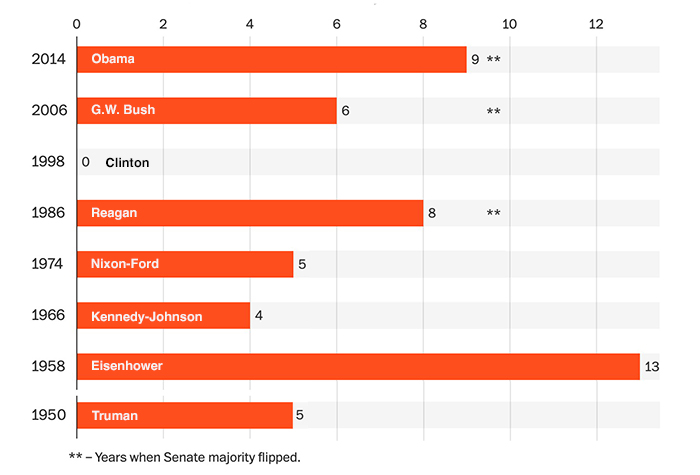
Going back 80 years, the most brutal Senate losses have been those a president suffered during the sixth year of an administration, including Kennedy-Johnson and Nixon-Ford. After 6 years, it is clear to the president's supporters that he is not going to achieve the things he promised and the opposition smells blood in the water. These factors combine for a very bad midterm. It even happened to Dwight Eisenhower, whose 8 years in office were marked by peace and prosperity and no scandals involving Ike himself, although there were a couple of minor ones involving other members of the administration. The biggest scandal involved his chief of staff, Sherman Adams, who accepted a vicuna coat (worth $900) for his wife from a Massachusetts businessman who was having issues with the FTC and SEC and wanted them to go away. A $900 gift was a Very Big Deal then. Nowadays, the president can openly accept a $400 million airplane likely stuffed to the gills with secret surveillance equipment from a foreign government and Congress doesn't say boo. How's that for inflation?
There are some parallels now with previous sixth-year elections, including corruption, an overreaching lame-duck president focusing on foreign affairs when the voters care about domestic affairs, and economic turmoil. Could Democrats pull off a big Senate win next year? History says it is possible. Here are the most likely seats to flip, ranked from easiest to hardest:
- North Carolina: A popular former Democratic governor is running against an unknown Republican apparatchik.
- Maine: Sen. Susan Collins (R) may finally succumb to her state's blue lean; she is very concerned.
- Ohio: Former three-term senator Sherrod Brown (D) is running against an appointed senator.
- Alaska: If Mary Peltola, who has won statewide before, runs, in a blue wave she could beat Sen. Dan Sullivan (R).
- Iowa: There is an open seat here and Iowa used to be a swing state.
- Texas: If Republicans nominate AG Ken Paxton and the Democrats pick a strong candidate, a miracle is possible.
- Kansas: It would take a blue tsunami, but Kansas occasionally elects Democrats, like two-term Gov. Laura Kelly.
- Florida: Sen. Ashley Moody (R-FL) was appointed, but Democrats need to find a compelling candidate.
The other races are well nigh impossible for the Democrats. In addition, Democrats would have to hold their own tough seats in Georgia, Michigan, Minnesota, and New Hampshire.
There is one "interesting" scenario possible. Suppose the Democrats win the "easy" races (North Carolina and Maine) and Sherrod Brown manages to squeak by in Ohio. Then the Senate will be 50-50 and President of the Senate J.D. Vance will have something to do all day—hang around in the Senate chamber in case they need his vote. A problem here is that Sen. Lisa Murkowski (R-AK) is not at all Trumpy and would suddenly have a lot of power. She could threaten to vote with the Democrats and kill bills or nominations. Trump would go ballistic and use his weapon of first choice: threatening her with a primary. But she knows that in 2010 she lost the primary to Joe Miller, ran as a write-in candidate, and won the general election. She could also threaten Trump right back by saying she is considering becoming an independent and caucusing with the Democrats. This would turn Minority Leader Chuck Schumer (D-NY) into Majority Leader Chuck Schumer (D-NY), which would wreak havoc with all of Trump's plans.
If independent voters are in a foul mood, the election may not be so much Democrat vs. Republican, but incumbent vs. challenger. One omen is the Virginia gubernatorial election earlier this month. Gov.-elect Abigail Spanberger (D) won independents by 20 points. Four years ago, Gov. Glenn Youngkin (R-VA) won them by 9 points. Shifts of 29 points are not statistical noise.
Always important in the midterms is how popular the president is. Bill Clinton's party didn't take a drubbing in 1998 because he was personally very popular. Donald Trump is not and it could get worse. Here are some of the factors that could possibly take a toll on Trump:
KNOWN UNKNOWNS- Prices and inflation
- Health care subsidies
- The Epstein files
- Corruption
- Outrage over U.S. citizens being swept up in raids and deported
- Foreign affairs: Venezuela, Ukraine, Gaza
- A recession
- Some kind of unexpected scandal involving, for example, a cabinet officer
- A polio outbreak somewhere due to low vaccination rates, with kids ending up in iron lungs
- New York Court of Appeals rules Trump defrauded banks to the tune of $500 million and orders him to pay up
- China takes Taiwan by force
- Something involving AI
- ?
Making predictions is always tough—especially about the future—but to the extent that history is a guide here, Democrats will probably pick up some Senate seats in 2026. The big question is whether they net four seats and take control. In January, bettors were putting the chances of Democratic control at 17%. It is now almost 30%. Democrats are at 73% on winning the House though. Here are a few other betting odds from that site.
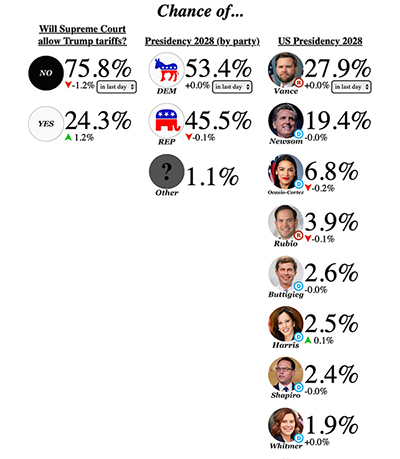
But take these with an adequate amount of sodium chloride and mucha agua. A lot of it is name recognition and/or aspirational. Rep. Alexandria Ocasio-Cortez (D-NY) is popular with some Democrats but she is not the third most likely winner, with a much greater chance than Secretary of State Marco Rubio. We really doubt she will even run for president when polls show her winning the NY Senate seat in 2028. She is smart enough to know that. And Gov. Andy Beshear (D-KY) doesn't even make the top 24 (because he isn't in the news much). We can safely assure you that Beshear's odds are better than those of Ivanka Trump (#11) or Andrew Cuomo (#22). (V)
J.D. Vance Is Not a Sure Thing in 2028
A lot of people are acting like J.D. Vance is a shoo-in for the Republican presidential nomination in 2028. We are not so sure. We are old enough to remember how pundits from all over the spectrum were sure that America's mayor, Rudy Giuliani, was a sure-fire Republican nominee and would face sure-fire Democratic nominee Hillary Clinton in November 2008. As we recall, it didn't happen quite like that.
Historically, sitting vice presidents don't usually get elected president. It has happened only twice since 1800. In 1836, Andrew Jackson's veep, Martin van Buren, got the nomination and won and in 1988, George H.W. Bush also got lucky. Both had unsuccessful presidencies and were not reelected. Other sitting vice presidents got the nomination but lost, namely John Breckinridge (1860), Richard Nixon (1960), Hubert Humphrey (1968) and Al Gore (2000). One could also put Kamala Harris on this list, though she doesn't fit 100% cleanly, for obvious reasons. In addition to not being worth a bucket of warm pi**, the vice presidency is a poor launchpad for higher office, of which there is only one. There are several reasons for this:
- No Personal Identity: Vice presidents have only one power: breaking ties in the Senate,
and ties are rare. Voters don't give veeps a lot of credit for doing that. They are almost always in the background.
They rarely have their own identity. They cut ribbons, go to foreign funerals, and give speeches, but these speeches
usually put them in attack-dog mode, which leaves a substantial "paper" trail that can be used against them later.
- Extension of the President: People think of veeps as extensions of the president and most
presidents lose their popularity over time. If the president is unpopular, "more of the same" is a poor platform. Van
Buren and Bush did well because their presidents, Andrew Jackson and Ronald Reagan, respectively, were still unusually
popular at the end, so "more of the same" worked.
- They Never Get Any Credit: It is rare when a vice president gets credit for anything.
During Nixon's 1960 run, reporters asked President Dwight Eisenhower for one thing Nixon did as vice president that
influenced decisions he made. Ike said: "If you give me a week, I might think of one." It is always like that. If the
president is successful, the president gets the credit, not the veep. However, if the president is unpopular, the whole
team is tarred. That's the way it goes.
- Conjoined at the Hip: Vice presidents can't reject the policies of their president. That would alienate the president's supporters. This makes it impossible for the vice president to be the "change" candidate, even if the public wants change. Remember when Kamala Harris was asked if she would make any decisions differently from Joe Biden and she said "no"? That didn't make her the change candidate at a time when voters wanted change. Al Gore made an attempt to distance himself from Bill Clinton's Monica Lewinsky scandal—which was obviously not a policy issue—by furiously making out with his then-wife Tipper Gore on stage at the Democratic National Convention in 2000. It didn't work. People didn't like Clinton's dalliances and blamed them on Gore. It's not fair, but it is politics.
How will this play out in 2028? Donald Trump is already deeply underwater, by something like 14 points, depending on the poll, and it's likely to get worse rather than better over the next 2 or 3 years, especially if the economy goes south. How will Vance separate himself from Trump without alienating Trump's fanatical supporters? And if Trump is 20 points under water, running as Trump III will not be a winning formula in the general election. But even getting the nomination won't be a sure thing if Trump is unpopular. Remember, many of his supporters will accept no substitutes and Vance will have plenty of competition, probably including Sen. Ted Cruz (R-TX), Gov. Ron DeSantis (R-FL), Gov. Brian Kemp (R-GA), Marco Rubio, Chris Sununu, and Gov. Glenn Youngkin (R-VA), not to mention potential wild cards like Tucker Carlson. None of the others will be as closely tied to Trump and his liabilities. Some of them will fall by the wayside early on, but some may hang on.
One candidate who is already quietly running is Cruz. In particular, he is already trying to differentiate himself from Vance. One battle was for NASA administrator: Cruz supported now-Transportation Secretary Sean Duffy while Vance supported Jared Isaacman, whom Trump nominated, withdrew, and then renominated. This was a proxy fight between Cruz and Vance. Another battle was over Trump's nominee for FCC chairman. Cruz opposed him while Vance supported him.
Cruz is also picking a fight with Tucker Carlson, who is close to Vance. The senator is very critical of Carlson's buddy, white supremacist and antisemite Nick Fuentes, and has attacked Carlson for tolerating Fuentes. Cruz has also attacked "Big Tech," knowing full well that Vance was formerly a venture capitalist in Silicon Valley and that Big Tech is not all that popular with the voters. Although the other 99 senators hate Cruz, outside of the Senate he is popular enough and crafty enough that he could derail Vance, possibly opening a path for someone other than the two of them. (V)
Robert Kennedy Jr. Is Restarting His Political Party
In 2024, Robert Kennedy Jr. formed a political party, We the People, and got it on the ballot in a number of states before making a deal with Donald Trump to support him in return for a cabinet position. Now a number of Kennedy's supporters are relaunching the party, potentially to allow Kennedy to run for president again in 2028. This is useful as a vehicle because in many states, it is easier for a political party to get on the ballot than an independent candidate. In 2024, We the People was on the ballot in 31 states. The initial goal this time is to get on the ballot in 26 states, then later, all the states.
One potential complication is that Laura Loomer, who wields a great deal of influence with Donald Trump, detests Kennedy and has called him a Marxist. She also has said Kennedy is Trump's worst cabinet pick. If she can convince Trump to do everything he can to scuttle Kennedy, it would probably slow down RFK's march to a potential 2028 campaign.
A short-term goal for We the People is to run a candidate for governor of New York in 2026. If the candidate gets enough votes, the party will get a ballot line in 2028. The candidate in question is Larry Sharpe, a former Libertarian, who has twice before run for governor of New York. He didn't win either time. Sharpe said a unifying theme for We the People is its distrust of both Democrats and Republicans. However, the party itself lacks any ideological underpinnings. It is just anti-establishment. That means it really doesn't stand for anything.
The party chairman, Oregon organic farmer Levi Leatherberry, is trying to enlist DNI Tulsi Gabbard to help the party. A spokesperson for Gabbard declined to comment about the matter.
It is hard to say which party would be hurt more by a Kennedy candidacy on the We the People ticket. There are anti-vaxxers on the left who believe in "nature" and don't trust big pharma. But there are also anti-vaxxers on the right who believe the deep state is putting microchips in vaccines to control people. And there are also a lot of people who think Kennedy is completely kooky. He has just about zero chance of winning any states, but if he pulls slightly more votes from one party or the other, that could tip a swing state. It is hard to say if he might be a spoiler and, if so, whom he might spoil. (V)
Poll: Americans Are Unhappy with the Economy
Maybe James Carville is still right, 30 years later: It's the economy, stupid. A new CBSNews/YouGov poll shows that Americans think the economy is in bad shape and it's Donald Trump's fault. The top four issues for Americans are the economy (33%), immigration (29%), government spending (15%), and trade (11%). And the people who rated the economy as tops overwhelmingly (77%) think Trump is not spending enough time dealing with it. His approval on it is down to 36% now (vs. 64% disapprove). Two of the questions stand out:
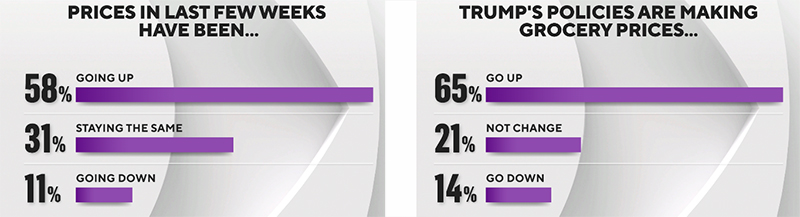
The one on the right is deadly. Trump's policies are the problem. Not Joe Biden's or Nancy Pelosi's. The economy is the top issue and there are many indicators that people are not happy with it and are blaming Trump. He really needs to fix that before the midterms and there is no quick fix.
The one way that might cheer up some voters is to send them Trump-branded checks for $2,000. The problem is that Congress doesn't seem to be interested in that for a variety of reasons (see above). But he had better figure out something quickly. (V)
Poll: Americans Are Not Happy with Billionaires Trying to Buy Elections
The Washington Post commissioned Ipsos to ask Americans what they think about billionaires spending money to buy elections. Here are the poll results. Broadly, it's not wildly popular for billionaires to be buying elections, but a substantial number of Republicans don't mind it, probably because they believe most of the billionaires are on their team. Here is a list of the big spenders in the billionaire class. It is true that more of them are Republicans than Democrats, but it isn't that lopsided. Three of the top four spenders are Republicans, but only 11 of the top 20 are Republicans.
On the subject of whether billionaires have too much influence, here are the results:

On the left, the question is about election spending. Democrats overwhelmingly (75%) think billionaires spending on elections is bad; with independents it is 60%; among Republicans it is only 42%.
On the right, the question is whether billionaires are useful at all. It is slightly better, but still 62% of Democrats, 46% of independents, and 23% of Republicans don't think billionaires are useful. So much for "job creators." Republicans aren't so much in favor of them (only 22% are), but they are more neutral (57%).
Still, billionaires aren't that popular, which suggests Democrats could have a campaign issue here: Tax the billionaires and use the money to shore up programs for ordinary Americans, like health care subsidies.
The most obvious thing for the Democrats to do if they get the trifecta is a direct wealth tax, as Sen. Elizabeth Warren (D-MA) has proposed. A number of European countries have such a thing, so it is technically doable. However, it would almost certainly require a constitutional amendment. Even the income tax required that. This is a bug in the Constitution. The founders could not have known what sources of income the government might have/want some day and should have simply said Congress has the power to levy taxes and left it to future Congresses to decide what to tax. Suppose travel to Mars becomes the cool thing for trillionaires to do some day. Shouldn't Congress be able to levy a transportation tax on it if Congress so desires? Note that the interstate commerce clause does not apply because Florida to Mars is not interstate commerce. It is interplanetary commerce and that is not covered in the Constitution.
Four easy fixes for a Democratic trifecta are these. First, only the first $176,100 of an individual's earnings are subject to FICA (Social Security) tax. Congress could simply remove the cap and subject all earnings to the FICA tax, which would shore up Social Security forever and allow greater payments. The impact would be felt very quickly.
Second, the top income tax rate could go back to the rates during the Eisenhower administration, when the top marginal rate was 91%:
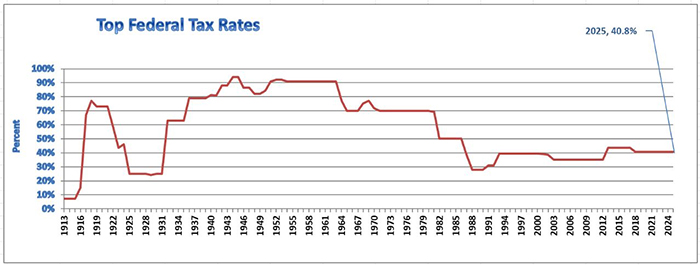
Third, the estate tax could go up to, say, 95% on estates of $100 million and more to prevent the children of billionaires from automatically becoming billionaires without having earned it. If someone is worth $10 billion, the kids would still get $500 million. They won't have to eat dog food.
Americans living abroad are subject to U.S. taxes with country-specific exemptions spelled out in individual tax treaties. Only when an expat has renounced his or her U.S. citizenship does U.S. taxation go away. So, fourth, the renunciation tax would need to be set to match the estate tax to largely defeat this loophole. (V)
Previous report Next report
If you wish to contact us, please use one of these addresses. For the first two, please include your initials and city.
- questions@electoral-vote.com For questions about politics, civics, history, etc. to be answered on a Saturday
- comments@electoral-vote.com For "letters to the editor" for possible publication on a Sunday
- corrections@electoral-vote.com To tell us about typos or factual errors we should fix
- items@electoral-vote.com For general suggestions, ideas, etc.
To download a poster about the site to hang up, please click here.
Email a link to a friend.
---The Votemaster and Zenger
Nov22 Today in Not Normal: Trump Says He Wants Democrats Executed
Nov22 Congressional Departures: Greene Will Be Resigning
Nov22 Legal News: Comey Prosecution, Halligan Law License Both In Big Trouble
Nov20 Welcome to the Great Scrubbing
Nov20 MAGA Is Showing Cracks
Nov20 Trump Threatens ABC Again
Nov20 Another Analysis of Trump 2016, 2020, and 2024
Nov20 Trump Is Dismantling the Department of Education on the Sly
Nov20 Former Republican Election Official Buys Dominion Voting Systems
Nov20 Xavier Becerra Is Stuck in the Middle of Scandal Not Really His
Nov20 New Marist Poll: Democrats are D+14 on Generic House Ballot
Nov20 Schlossberg Gets Company in the Race for Nadler's Seat
Nov20 Gov. Greg Abbott Finally Sets a Date for Runoff Election for Texas House Seat
Nov19 They Stabbed It with Their Steely Knives, But They Just Can't Kill the Beast
Nov19 We Hope Donald Trump Stocked up on Soap
Nov19 The 2025 Election: Post Mortem, Part VII--What Is the Lesson of Prop. 50? (aka, Gerrymandering, Part I)
Nov19 Gerrymandering, Part II: It Could Be a Sleeper Issue Next Year and Beyond
Nov19 Gerrymandering, Part III: Republicans Are Losing
Nov19 Gerrymandering, Part IV: Democrats Gone Wild?
Nov18 Trump Takes Things to Their Logical Conclusion
Nov18 America's Pennies Are Not Worth a Plug Nickel
Nov17 The Epstein Saga Continues
Nov17 Is MTG Running for Vice President?
Nov17 Latinos Are Back--to the Democrats
Nov17 Independents Are Souring on Trump
Nov17 Ruben Gallego Tries Out His Stump Speech
Nov17 The Next Special Election Could Give a Hint about the Midterms
Nov17 Democrats Have Their Boogeyman for 2026: RFK Jr.
Nov17 Fulton County D.A. Fani Willis Will Be Replaced by a Veteran Prosecutor
Nov17 Loomer Strikes Again
Nov16 Sunday Mailbag
Nov15 Saturday Q&A
Nov15 Reader Question of the Week: Leisure Where?, Part II
Nov14 Legal News: (Everything I Do) I Do It For You
Nov14 Hypocrisy Report: No One Needs To Know
Nov14 Today in Numismatics: A Penny More
Nov14 I Read the News Today, Oh Boy: Seasons in the Sun
Nov14 This Week in Schadenfreude: Working for the Weekend
Nov14 This Week in Freudenfreude: Thank U, Part I
Nov13 And So It Ends...
Nov13 Epstein's E-mails Show that Trump Knew about the Girls
Nov13 Running for Something
Nov13 Will 2026 Be a Rerun of 1894?
Nov13 Pushback on the Plains
Nov13 Supreme Court Will Handle Late-Ballot Case
Nov13 A Kennedy Is Running for Congress
Nov12 More on the (Imminent?) End of the Shutdown
Nov12 1 vs. 100
Nov12 News from the House

